 teas.co.uk
Tea and coffee from the brands you know
teas.co.uk
Tea and coffee from the brands you know
The sweet wiki
Everything about sweets
How sweets are made, where they came from, what is in them and the stories behind them. Every article is researched and lists its sources.
No articles match that yet.
New in the wiki
- British heritage sweetsAnglo BubblyAnglo Bubbly is a bubble gum sold in individually wrapped pieces. What is in it, what gum base is made of, and why bubble gum turned out pink.
- British heritage sweetsFloral gumsFloral gums are firm, chewy gums flavoured with flowers, sold under the Squirrel name. What is in them, where the colours come from, and the diet points.
- British heritage sweetsCandy lipsticksCandy lipsticks are novelty sweets sold as lipsticks. What Swizzels puts in its Love Hearts Candy Lipsticks, and why the maker lists them as vegan.
- British heritage sweetsTom Thumb dropsTom Thumb Drops are tiny, sugar coated boiled sweets that share a name with the thumb sized hero of a 1621 tale. The recipe here flags sulphites.
- British heritage sweetsNuttall's MintoesNuttall's Mintoes were butter mint hard sweets from a Doncaster firm. The name lives on in butter mintoes, which, unlike buttermints, contain real butter.
- British heritage sweetsClove rockClove rock is a hard sweet with the warm taste of cloves, the Spice Islands bud long used for toothache. The recipe here uses flavouring, not real cloves.
- British heritage sweetsMurray MintsMurray Mints are smooth, creamy mint sweets sold under the Bassetts name. What is in them, from molasses to palm oil, and the diet points worth knowing.
- British heritage sweetsWinter mixtureWinter mixture is a bag of wrapped boiled sweets with herbal, aniseed and mint flavours. The recipe here contains milk and soya and two warning colours.
How it is made
From boiling sugar to pulling rock: how every kind of sweet is made.
- How are sweets made?Most sweets start as sugar syrup boiled to a set temperature, from about 112°C for fudge to 160°C for hard sweets. The stages, the methods and some history.
- How is seaside rock made?Seaside rock is boiled sugar, pulled until it turns white, wrapped in a coloured casing and rolled out by hand into long thin sticks.
- How do they get the letters in rock?The letters in rock are built by hand from strips of coloured and white sugar while it is hot, then stretched down to size as the rock is rolled out.
- How are gobstoppers made?Gobstoppers are grown, not moulded. Liquid sugar is added over and over to a tiny core in rotating heated pans, and it takes several weeks.
- How are boiled sweets made?Boiled sweets are sugar syrup boiled to around 160°C, flavoured, coloured and shaped while warm, then set into a glassy solid about 98 per cent sugar.
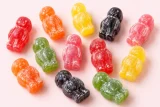
- How are jelly babies made?Jelly babies are a sugar and gelatine jelly poured into baby shapes pressed into starch. The starch helps release them, and some stays on as dusting.
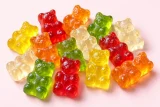
- How are gummy bears made?Gummy bears are a hot mix of sugar, glucose syrup, starch, gelatine and flavours poured into bear shapes stamped in starch and left overnight to set.
- How are jelly beans made?Jelly bean centres are set in starch moulds, then given a soft sugar shell in spinning drums and polished. Jelly Belly says one bean takes 7 to 14 days.
- How are wine gums made?Wine gums are firm, chewy gums of glucose syrup, sugar, starch and gelatine, moulded in five shapes stamped with wine names. Despite the names, no wine.
- How is fudge made?Fudge is sugar, butter and milk boiled to about 116°C, cooled to around 49°C and beaten until thick. Tiny sugar crystals give it a creamy texture.
- How is toffee made?Toffee is sugar or treacle boiled with butter to the hard crack stage, 149 to 154°C, then poured out to set. Cooked less, it stays chewier.
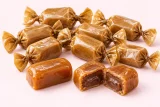
- How is caramel made?Chewy caramels are sugar and glucose heated to 130°C, then cream and butter added and reheated to 120°C before flavouring. Plus salted caramel.
- How are marshmallows made?Marshmallows are sugar syrup whipped with gelatine or egg white until half air, then moulded in starch or extruded and cut. They began as a plant medicine.
- How is liquorice made?Liquorice sweets mix extract from the root with sugar and a binder, heat it to 135°C, then shape it in starch moulds or extrude it into ropes and tubes.
- How is candy floss made?Candy floss is sugar melted in a spinning head and flung through tiny holes, where it cools into fine threads. The machine was invented in 1897, by a dentist.
- How are sour sweets made?Sour sweets get acid inside and out: citric or malic acid can be mixed into the sweet, and sour coated ones are tumbled in sugar mixed with acid crystals.
- How are fried egg sweets made?Fried egg sweets are two layers in one mould: a white foam whipped full of air and a yellow yolk, deposited one on top of the other and left to set.
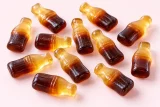
- How are cola bottle sweets made?Cola bottles are cola flavoured gummies cast in bottle shaped hollows in trays of starch, set, then glazed or, for fizzy ones, tumbled in sour sugar.
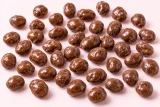
- How are chocolate raisins made?Raisins tumble in a rotating drum while warm chocolate is added a little at a time and set with cool air, then the coated raisins are polished and glazed.
- What is sugar panning?Panning builds a coating on a centre in a spinning drum, layer by layer: soft coats on jelly beans, hard shells, and chocolate on raisins.
- How are humbugs made?Humbugs are sugar, glycerine, colour and flavouring, usually peppermint, boiled to about 145°C, then pulled, striped, rolled into a rope and cut.
- How is barley sugar made?Barley sugar began as sugar boiled with barley water, poured onto oiled marble and rolled. Modern recipes use sugar, water, lemon and cream of tartar.
- How is nougat made?White nougat is whipped egg white sweetened with sugar or honey, mixed with nuts or fruit, left to harden and cut. The recipe goes back to 10th century Baghdad.
- How is Turkish delight made?Turkish delight is a gel of starch and sugar flavoured with rosewater, mastic, bergamot or lemon, cut into cubes and dusted with icing sugar.
- How is marzipan made?Marzipan is ground almonds and sugar made into a paste, by grinding with sugar or mixing with syrup. Lübeck makers guarantee two thirds almonds.
- How is coconut ice made?Coconut ice is made two ways: a no cook mix of condensed milk, icing sugar and coconut pressed in layers, or a cooked syrup beaten until thick, like fudge.
- How is honeycomb toffee made?Honeycomb toffee is hot sugar syrup with baking soda stirred in. The soda gives off carbon dioxide, which blows the syrup into a foam that sets hard.
- How is peanut brittle made?Peanut brittle is sugar syrup boiled to hard crack, about 146 to 154°C, with peanuts stirred in, poured thin onto a slab and broken once cool.
- How is Kendal Mint Cake made?Kendal Mint Cake is sugar, glucose, water and peppermint oil boiled in copper pans and stirred so it crystallises, then poured into moulds and broken into bars.
- How is Scottish tablet made?Tablet is sugar, butter and condensed milk boiled to the soft ball stage, about 120°C, then beaten until thick and grainy, poured into a tin and cut.
- How are candy canes made?Candy canes are sugar syrup flavoured with peppermint, pulled white, striped, rolled into a rope, twisted, cut, wrapped warm and only then bent into a hook.
- How are lollipops made?Lollipops are sugar and corn syrup cooked almost dry, flavoured, kneaded, rolled into a rope and pressed onto sticks at over 1,000 a minute, then wrapped.
- How is chewing gum made?Gum base is melted and filtered, mixed warm with sweeteners and flavours into a dough, then extruded, shaped, cut, coated and wrapped. Here is each step.
- How is bubblegum made?Bubblegum is made like chewing gum, but its base has more elastic, heavier polymers, so it stretches into a bubble instead of breaking. Here is what goes in.
- How are message heart sweets made?Love Hearts are powdered sugar pressed into tablets with the message stamped in; American conversation hearts are a sugar dough, stamped and dried.
- How is popping candy made?Popping candy is hot sugar syrup stirred with carbon dioxide under high pressure and left to set under pressure, trapping tiny bubbles that pop later.
- How are pear drops made?Pear drops are sugar and glucose boiled to about 146°C, flavoured with fruity esters, then fed through engraved brass rollers that press out the drops.
- How are rhubarb and custard sweets made?Rhubarb and custards are pink and yellow boiled sweets of sugar and glucose, flavoured and sharpened with citric acid. The custard is only a flavour.
- How are aniseed balls made?Aniseed balls are comfits: a single rapeseed tumbles in a rotating pan while layer after layer of aniseed flavoured sugar syrup builds up around it.
- How do jelly sweets set?Jelly sweets set when a gel forms in the cooling syrup: gelatine through protein bonds, pectin with sugar and acid, starch as it thickens, agar from seaweed.
- How is fondant made?Fondant is sugar and water boiled to the soft ball stage, cooled undisturbed, then beaten hard so many tiny sugar crystals form at once, giving a smooth cream.
- How are fruit pastilles made?Fruit pastilles are a thick, fruit flavoured syrup poured into moulds of powdered starch, left to set and dry, then coated in sugar. Today they are vegan.
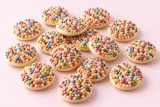
- How are hundreds and thousands made?Hundreds and thousands are tiny sugar balls built up in rotating pans: a single sugar crystal is sprayed and dusted, layer after layer, for about 100 hours.
- How are sweets coloured?Colour goes into a sweet at different stages: stirred into the cooked syrup, worked in on the slab, added in the last coats in a pan, or printed on top.
- How are sweets flavoured?Sweets get their flavour from flavourings, essential oils such as peppermint, fruity esters and juices, often added after cooking so they do not burn off.
- What is starch moulding?Starch moulding shapes jelly sweets in trays of cornstarch: shapes are pressed in, hot syrup poured in, moisture drawn out, and the starch reused.
- How are sweets wrapped?Sweets are wrapped by machine: twisted in paper or film, heat sealed, or stacked into tubes, some at up to 2,000 a minute, and candy canes while still warm.
- What happens inside a sweet factory?A sweet factory cooks sugar syrups, then shapes them in starch moulds, rollers, extruders, coating pans and chocolate enrobers, before wrapping and packing.
- How is sugar made from sugar beet?Beet is washed, sliced into strips called cossettes and soaked in hot water; the juice is cleaned with lime, concentrated and seeded to grow sugar crystals.
- How is sugar made from sugar cane?Cane is crushed at a mill to make raw sugar, which is shipped to a refinery to be washed, cleaned, decolourised, crystallised again under vacuum and dried.
- What is glucose syrup?Glucose syrup is a thick syrup made by breaking down starch, usually from maize or wheat. Sweet makers use it to sweeten, soften and stop sugar crystallising.
- What is invert sugar?Invert sugar is ordinary sugar split into glucose and fructose with acid or an enzyme. It is sweeter, keeps sweets moist and stops sugar crystallising.
- What is the difference between fudge and toffee?Fudge is milk, butter and sugar cooked to about 116°C and beaten into tiny crystals. Toffee is butter and sugar boiled to 149 to 154°C and sets hard.
- What is the difference between toffee and caramel?Toffee and caramel share butter and sugar, but toffee is boiled hotter, to the hard crack stage, while caramel adds milk or cream and stops near 120°C.
- How is butterscotch made?Butterscotch is brown sugar and butter, sometimes with treacle or cream, boiled to the soft crack stage rather than hard crack, then poured out to set.
- How are fruit drops made?Fruit drops are boiled sugar and glucose, coloured, flavoured and sharpened with citric acid on the slab, then pressed through engraved rollers into drops.
- How are milk bottle sweets made?Milk bottles are chewy white sweets cast in bottle shaped moulds. Some recipes use condensed milk and beef gelatine; others use starch and plant protein.
- How are gummy worms made?Gummy worms are gummy mixture poured into worm shaped hollows in starch, set, then oiled or tumbled in sugar or sour sugar. Trolli made the first in 1981.
- How is salt liquorice made?Salt liquorice is liquorice flavoured with salmiak, ammonium chloride, mixed into the paste or dusted on the outside for an extra salty kick.
- How are Pontefract cakes made?Pontefract cakes are cooked liquorice paste deposited into starch trays pressed with the Pontefract cake design, then left to cure for several days.
- How is rock candy made?Rock candy is grown, not shaped: sugar is dissolved in hot water to make a supersaturated syrup, and big crystals slowly form on a string or stick.
- How are sugared almonds made?Sugared almonds are hard panned: skinned almonds turn in rotating pans while sugar syrup is added layer by layer, then smoothed, coloured and polished.
- How is halva made?Halva is a family of dense sweets. Sesame halva is tahini mixed with a sugar syrup foamed with soapwort extract, worked until fine fibres form.
- How are mint balls made?Mint balls are brown cane sugar and cream of tartar boiled in copper pans, worked by hand with peppermint oil, rolled into a rope and pressed into balls.
- How is chocolate made?Cocoa beans are fermented, dried, roasted and shelled; the nibs are ground to liquor, mixed with sugar and often milk, then conched smooth and tempered.
- How are gummy sweets shaped?Gummy shapes are cast in starch, with a stamp pressing each shape into a tray of cornstarch for the hot gel, or poured into metal or silicone moulds.
- How are strawberry laces made?Strawberry laces are a chewy dough of glucose syrup, wheat flour and sugar, pushed through a die into long thin strands, cut to length and glazed.
Sweet by sweet
The sweets of the British sweet shop, one by one: what they are, where they came from and what is in them.
- Gummy bearsGummy bears compared: Haribo Goldbears made with gelatine, halal bears with beef gelatine, and vegan bears set with pectin and starch, wheat included.
- Jelly babiesJelly babies compared: Bassett's, Haribo and Candy King recipes, all made with gelatine, plus the history, names and famous fans, in one place.
- Jelly beansJelly beans have a soft centre and a thin sugar shell. Their history, from an 1861 claim to Reagan's jar, and two UK recipes, one of them vegan.
- Jelly snakesJelly snakes are long, striped gummy sweets, and some giant ones are over a metre long. What is in them, and why vegan ones can still contain wheat.
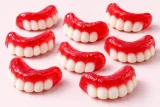
- Jelly teethJelly teeth are novelty jelly and foam sweets shaped like teeth, often sold with jelly lips. What is in them, why many contain gelatine, and what to check.
- Jelly ringsSugared jelly rings are ring shaped gummy sweets coated in sugar. What goes into them, why some carry a warning about colours, and what gelatine means.
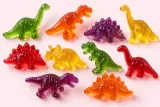
- Jelly dinosaursJelly dinosaurs are gummy sweets shaped like prehistoric beasts. What goes into them, the colours they use, and why gelatine means they are not vegetarian.
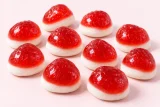
- Giant strawberriesGiant strawberries are big, soft strawberry flavoured jelly sweets set with starch, not gelatine. Why one is vegetarian, another vegan, and one has wheat.
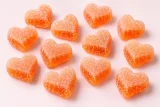
- Peach heartsPeach hearts are sugar coated, heart shaped jelly sweets with a peach flavour. What is in them, where the peach taste comes from, and what E120 means.
- Fruit gumsFruit gums are firm, chewy fruit sweets. Rowntree's began them in 1893, cut their fruit juice from 25% to 1%, and made them vegan in 2020. The full story.
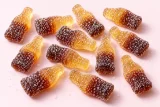
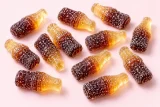
- Cola bottlesCola bottles are cola flavoured gummy sweets shaped like bottles. One recipe uses four added colours, another lists only caramelised sugar.
- Fizzy cola bottlesFizzy cola bottles are cola gummies in a sour sugar coat. Three UK recipes compared: a vegan one made with wheat starch, a halal one and a standard one.
- Fizzy dummiesFizzy dummies are dummy shaped gummy sweets with a fizzy, sour sugar coat. What is in them, what makes them tingle, and why they contain gelatine.
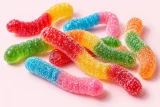
- Fizzy wormsFizzy worms are gummy worms in a sharp sugar coat. Two recipes from one UK shop differ in their gelatine, colours and acids, so the label matters.
- Sour cherriesSour cherries are cherry shaped sweets with a sour, sugary coat. Two recipes compared: one vegan with wheat, one with gelatine, and why both taste so sharp.
- Sour apple ringsSour apple rings are ring shaped gummy sweets with a sharp apple flavour and a sour sugar coat. What goes into them and what to check if you avoid gelatine.
- Peach ringsPeach rings are soft, ring shaped gummy sweets, some with a sour sugar coat. One recipe uses 8% real peach juice concentrate. What is in them, and why.
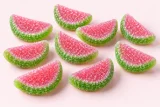
- Sour watermelon slicesSour watermelon slices are melon shaped gummy sweets in a sour sugar coat. Two listings for one brand show two recipes, which is why labels matter.
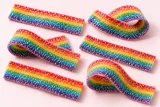
- Rainbow sour beltsRainbow sour belts are striped strips coated in sour sugar. They are made with wheat flour, so they contain gluten. What is in them, colour by colour.
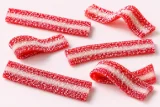
- Fizzy strawberry beltsFizzy strawberry belts are flat strips of sweet in a sour sugar coat. Vidal's are made with wheat flour and carmine, so not vegan or gluten free.
- Blue raspberry sweetsBlue raspberry is a flavour no raspberry has. It was first sold on American snow cones in 1958, and it is blue by design. What is in blue raspberry sweets.
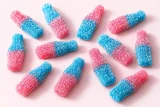
- Bubblegum bottlesBubblegum bottles are bottle shaped gummy sweets that taste of bubblegum but contain no gum. Two recipes compared, including a halal version.
- Foam bananasFoam bananas are soft, airy banana flavoured sweets. The two recipes here use beef gelatine and turmeric yellow, and neither lists any banana.
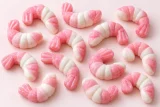
- Foam shrimpsFoam shrimps are pink, airy sweets. Three UK listings differ on the gelatine, pork or beef, on the colour, and even on the flavour.
- Fried egg sweetsFried egg sweets pair a white foam with a yellow yolk. Three UK recipes compared, from plant colours to a halal version with a colour warning.
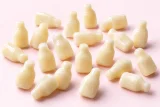
- Milk bottle sweetsMilk bottle sweets are chewy, milk flavoured bottles. Some recipes use condensed milk and beef gelatine, while one here has neither.
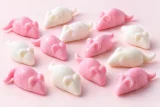
- Pink and white micePink and white mice are chocolate flavoured candy mice with no cocoa in them. They contain milk, wheat and soya, and carmine turns them pink.
- Strawberries and cream sweetsStrawberries and cream sweets are boiled sweets named after the dessert served at Wimbledon. The recipes here contain no cream, and one is sugar free.
- MarshmallowsMarshmallows began as a French sweet made with mallow root and are now sugar whipped with gelatine. Their history, what is in them, and diet points.
- FlumpsFlumps are Barratt's twists of vanilla flavour marshmallow, wrapped one by one. Barratt uses pork gelatine, so they are not vegetarian or halal.
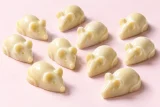
- White chocolate miceThe white mice in the three UK listings here are white chocolate flavour candy, not chocolate. They have no cocoa butter, and contain milk and wheat.
- Chocolate miceThe chocolate mice in the UK listing here are milk chocolate flavour candy, made with palm fat and cocoa powder. What is in them, and why it matters.
- Chocolate raisinsChocolate raisins are raisins coated in real milk chocolate. Two UK recipes compared, from soya to shellac, and why they must be kept from dogs.
- Chocolate peanutsChocolate peanuts are peanuts coated in milk chocolate. Two UK recipes, the 1925 Goobers story, and the allergy and choking warnings that matter.
- Chocolate brazilsChocolate brazils are Brazil nuts coated in milk chocolate. What is in them, why the nuts come from wild Amazon trees, and the selenium and radium facts.
- Chocolate eclairsChocolate eclairs are chewy toffees with a chocolate centre. Two UK recipes compared, and the 2008 recall of Cadbury eclairs made in Beijing.
- LollipopsLollipops are hard sweets on a stick. Their history, from medieval sugar on sticks to Dalí's Chupa Chups logo, and why the creamy ones contain milk.
- Gum ballsGum balls are round bubblegum sweets in a hard sugar shell, sold from machines since 1907. What goes into one, and the soya and colour points.
- NougatNougat is whipped egg white, sugar or honey and nuts. Its story runs from Baghdad to Montélimar and the Milky Way bar. What is in it, and allergy points.
- Turkish delightTurkish delight, or lokum, is a gel of starch and sugar. Its history runs from Istanbul to Narnia and Fry's 1914 bar. What is in it now, and diet points.
- MarzipanMarzipan is almonds ground with sugar. Its history from Toledo and Lübeck to Shakespeare's marchpane and the Simnel cake, plus the allergy points.
- Dutch liquoriceDutch liquorice, or drop, is eaten at about 2 kg a head a year in the Netherlands. How it is made, what makes salty drop salty, and how much is too much.
- Candy cornCandy corn is America's Halloween sweet, first made in the 1880s as Chicken Feed. What Brach's contains, from Red 3 to shellac, and why it divides opinion.
- Tutti fruttiTutti frutti means all fruits: chopped candied fruit, or a flavour copying many fruits with vanilla. Its story from 1860 ice cream to 1888 gum machines.
- Strawberry bonbonsStrawberry bonbons are a British sweet with a hard outside and a chewy centre, dusted in icing sugar. What is in them, and why one recipe is vegan.
- Toffee bonbonsToffee bonbons are chewy toffee sweets dusted in icing sugar. Made with condensed milk, they suit vegetarians but contain milk. What else is in them.
- Coconut mushroomsCoconut mushrooms are mushroom shaped sweets coated in coconut. The recipe here has 24 per cent coconut, cocoa and gelatine. What that means for diets.
British heritage sweets
The old fashioned sweets of the British sweet shop by their proper names: toffees, mints, boiled sweets, penny sweets and the regional favourites people grew up with.
- Old fashioned sweets: the A to ZAn A to Z of old fashioned British sweets, from acid drops and aniseed balls to Wham bars and yellowman, with a line on each and a link to its full story.
- Traditional English sweetsA county by county guide to traditional English sweets, from Pontefract cakes and Kendal Mint Cake to Uncle Joe's Mint Balls and Love Hearts.
- Old fashioned toffeeA guide to Britain's old fashioned toffees, from slab toffee broken with a hammer to Everton, Harrogate, Walker's Nonsuch, Riley's, Sharps and Mackintosh's.
- Slab toffee and the toffee hammerHard toffee was once sold in slabs and broken with a little hammer. Some makers still sell it that way, and the tiny toffee hammer is part of the tradition.
- Everton toffeeEverton toffee was made in Everton village, now part of Liverpool, from the 18th century by Molly Bushell. It is why Everton FC are called the Toffees.
- Harrogate toffeeHarrogate toffee was created in the spa town in 1840 to take away the taste of the town's spa water. Farrah's of Harrogate still makes it today.
- Sharps toffee of MaidstoneSharps of Maidstone began with a grocer's wife's homemade sweets, and by 1921 claimed to be the world's biggest toffee maker. Its face: Sir Kreemy Knut.
- Walkers Nonsuch toffeeWalker's Nonsuch has made toffee in Longton, Stoke on Trent, since the 1890s. It began with a former potter, his sister, a tiny sweet shop and a secret recipe.
- Blue Bird toffeeBlue Bird Toffee was founded near Birmingham in 1898 by Harry Vincent, first as Harvino, then named after a Maeterlinck play. Its factory may become flats.
- Rileys toffee rollsRiley's Toffee Rolls were made in Halifax from 1907, dropped in the 1990s, and revived in 2008 when the recipe turned up in a family cookery book.
- Thorntons Special ToffeeThorntons Special Toffee was first made in Sheffield in 1925, when Stanley Thornton perfected the recipe at the 50th attempt. It is still made the same way.
- ToffeeToffee is an English sweet made by boiling sugar or treacle with butter to the hard crack stage. What it is, where the word came from, and its British forms.
- Treacle toffeeTreacle toffee, or bonfire toffee, is a hard, dark, brittle toffee made with black treacle, traditionally eaten on Bonfire Night and at Halloween.
- Honeycomb toffeeHoneycomb toffee, cinder toffee or puff candy is a crisp toffee full of bubbles, made by adding bicarbonate of soda to hot sugar syrup.
- Highland toffeeMcCowan's Highland Toffee is a chewy Scottish toffee bar from Stenhousemuir. Legend says the recipe was bought in a pub for the price of a pint.
- Moffat toffeeMoffat toffee is a boiled sweet with a tangy centre, made in the Scottish town of Moffat to a family recipe first used commercially in the late 19th century.
- FudgeFudge is a soft sweet of sugar, butter and milk. Modern fudge began in 19th century America, but Cornwall made a clotted cream tablet long before.
- Devon fudgeDevon fudge is West Country fudge, often made with clotted cream, the thick cream Devon and Cornwall have argued over for centuries. What makes it different.
- ButterscotchButterscotch is a Yorkshire sweet of brown sugar and butter, boiled to soft crack. Doncaster made it famous, and a tin went to Queen Victoria in 1851.
- Scottish tabletTablet is a Scottish sweet of sugar, butter and condensed milk, boiled and left to crystallise. Firmer and grainier than fudge, it dates to the early 1700s.
- Toffee applesToffee apples are whole apples on a stick, dipped in a hard sugar coating. Sold in London in the 1890s, they are eaten in autumn across the UK.
- Uncle Joe's Mint BallsUncle Joe's Mint Balls have been made in Wigan by William Santus and Co since 1898, from just cane sugar, peppermint oil and cream of tartar.
- Everton MintsEverton Mints are black and white striped mint humbugs from Liverpool, linked for over a century with Everton Football Club and its Toffee Lady tradition.
- Fox's Glacier MintsFox's Glacier Mints are clear peppermint sweets sold since 1918, with Peppy the polar bear. Fox's once used a real stuffed polar bear in its adverts.
- Murray MintsMurray Mints are smooth, creamy mint sweets sold under the Bassetts name. What is in them, from molasses to palm oil, and the diet points worth knowing.
- Victory V lozengesVictory V lozenges were first made in Lancashire in 1864 with ether, liquorice and chlorodyne, a medicine containing laudanum, cannabis and chloroform.
- Fisherman's FriendFisherman's Friend lozenges were created in Fleetwood, Lancashire, in 1865 by a pharmacist for deep sea fishermen, and are still made there by Lofthouse.
- Nuttall's MintoesNuttall's Mintoes were butter mint hard sweets from a Doncaster firm. The name lives on in butter mintoes, which, unlike buttermints, contain real butter.
- Polo mintsPolo, the mint with the hole, was first made by Rowntree's in York in 1948. How it began, why it is called Polo, and the court fight over the shape of a hole.
- Mint imperialsMint imperials are round white mints with a hard sugar shell and a softer middle. In Scotland they are pan drops or granny sookers.
- Butter mintsButtermints are hard boiled sweets that taste of butter and mint. The recipe here contains no butter or milk, and three of its four colours are synthetic.
- HumbugsHumbugs are striped boiled sweets, usually peppermint, made in Britain since at least the 1820s. Here is what they are and how they are made.
- BullseyesBullseyes are striped peppermint boiled sweets, close cousins of the humbug, also known as Black Bullets. Here is what they are and how they are made.
- Kendal mint cakeKendal Mint Cake is a peppermint sugar bar from Kendal in Cumbria, said to have been born from a mistake in 1869. It went to the Antarctic and up Everest.
- GobstoppersA gobstopper is a hard, round boiled sweet built up in layers so it lasts for ages. Americans call it a jawbreaker. Here is what is inside one.
- Pear dropsPear drops are pink and yellow British boiled sweets with a sharp, fruity flavour that comes from two esters, one tasting of pear and one of banana.
- Acid dropsAcid drops are old fashioned boiled sweets made sharp with citric or tartaric acid. What they are, how the sour coating works, and how they differ.
- Sherbet lemonsSherbet lemons are sharp lemon boiled sweets with a fizzy sherbet centre. The fizz comes from an acid and bicarbonate that react on your tongue.
- Rhubarb and custard sweetsRhubarb and custard sweets are two tone boiled sweets, half sharp rhubarb and half smooth custard, named after a British pudding pairing.
- Pineapple chunksPineapple chunks are golden, sugar dusted boiled sweets with a tangy pineapple flavour, named after a fruit that was once a Georgian status symbol.
- Kola kubesKola kubes, or cola cubes, are sugar dusted cola flavoured boiled sweets. Why they are spelled with a K, and where cola flavour comes from.
- Aniseed ballsAniseed balls are small, hard, reddish brown sweets flavoured with aniseed oil and built up in layers around a single rapeseed. They last for ages.
- Barley sugarBarley sugar is a golden boiled sweet, traditionally twisted into sticks and first made with barley water. Here is what it is and how it got its name.
- Clove rockClove rock is a hard sweet with the warm taste of cloves, the Spice Islands bud long used for toothache. The recipe here uses flavouring, not real cloves.
- Winter mixtureWinter mixture is a bag of wrapped boiled sweets with herbal, aniseed and mint flavours. The recipe here contains milk and soya and two warning colours.
- Cough candyCough candy is a boiled sweet with a herbal flavour, sold in twists. It is a sweet, not a medicine: what is in it, and how it differs from lozenges.
- Blackcurrant and liquorice sweetsBlackcurrant and liquorice boiled sweets: what is in them, including milk and soya, and how wartime Britain took blackcurrant to heart from 1942.
- Lemon dropsLemon drops are small, sugar coated, lemon flavoured boiled sweets, often shaped like tiny lemons. They began in England, and a squeeze of acid is the secret.
- Tom Thumb dropsTom Thumb Drops are tiny, sugar coated boiled sweets that share a name with the thumb sized hero of a 1621 tale. The recipe here flags sulphites.
- Rainbow dropsRainbow Drops are sugar coated puffed maize and rice pieces made by Swizzels, first sold in the 1930s for a penny a bag. A version even appears in Roald Dahl.
- Coltsfoot rockColtsfoot Rock is a brittle stick of rock flavoured with coltsfoot extract, made only by Stockley's Sweets of Oswaldtwistle, Lancashire, to a secret recipe.
- Seaside rockSeaside rock is a hard stick of boiled sugar, usually peppermint, with a pink casing and words running all the way through it.
- Blackpool rockBlackpool rock is thick seaside rock with the town's name running through it, and the subject of a George Formby song that ran into trouble with the BBC.
- Brighton rockBrighton rock is the seaside rock sold in Brighton, with the town's name running through it. It also gave its name to Graham Greene's 1938 novel.
- Edinburgh rockEdinburgh rock is a soft, crumbly Scottish sweet sold in sticks, invented by Alexander Ferguson, known as Sweetie Sandy. It is nothing like seaside rock.
- Soor ploomsSoor plooms are sharp green boiled sweets from Galashiels in the Scottish Borders. The name means sour plums, and it is also the town's motto.
- Berwick cocklesBerwick cockles are white mints with red stripes, made since 1801, named after Berwick upon Tweed and shaped like a cockle shell with a rib round the middle.
- Hawick BallsHawick Balls are minty, buttery boiled sweets from the Borders town of Hawick, said to date from the 1850s and linked with the commentator Bill McLaren.
- Jethart snailsJethart snails are snail shaped peppermint sweets from Jedburgh in the Scottish Borders. Legend says a French prisoner of war gave the recipe.
- Starrie rockStar rock, or starrie, is a Scottish rock made in Kirriemuir since 1833 and sold in bundles of pencil sized sticks. The story of the rock and its shop.
- YellowmanYellowman is a crunchy, golden honeycomb toffee from Northern Ireland, famous at the Ould Lammas Fair in Ballycastle, one of Ireland's oldest fairs.
- Pontefract cakesPontefract cakes are black liquorice discs from Yorkshire, stamped with a castle. They began as medicine and sealed Britain's first secret ballot box.
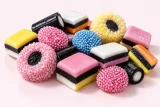
- Liquorice AllsortsLiquorice Allsorts: layered liquorice, coconut rolls and jelly buttons, first sold by Bassett's of Sheffield in 1899. What is in them, and how they began.
- Liquorice wheelsLiquorice Catherine wheels are strips of black liquorice coiled around a jelly button covered in hundreds and thousands, named after the firework.
- Black jacksBlack Jacks are black, aniseed flavoured chews first sold in the 1920s and now made under the Barratt name. Here is what is in them.
- Fruit salad chewsFruit Salads are raspberry and pineapple flavour chews sold under the Barratt name. Since 2019 they have been made without gelatine.
- RefreshersRefreshers are two British sweets: fizzy tablets first sold by Trebor in 1935, now a Barratt sweet, and Swizzels' chewy, sherbet filled New Refreshers.
- Wham barsWham bars are thin, chewy bars with fizzy pieces inside, created by McCowan's in Scotland in the early 1980s. At their peak 30 million were sold a year.
- Bazooka Joe bubble gumBazooka bubble gum was launched in 1947 by Topps of Brooklyn, and from 1953 each piece came wrapped in a Bazooka Joe comic strip. The full story.
- Anglo BubblyAnglo Bubbly is a bubble gum sold in individually wrapped pieces. What is in it, what gum base is made of, and why bubble gum turned out pink.
- Drumstick lolliesThe Drumstick is Swizzels' chewy milk and raspberry lolly, first made in 1957 in New Mills, Derbyshire. The lolly and the family firm behind it.
- Double lolliesSwizzels Double Lollies are pressed fruit tablets on a stick, launched in 1952, the year Elizabeth II came to the throne. What goes into one, and the maker.
- Love HeartsLove Hearts are tablet sweets printed with messages like Be Mine, made by Swizzels in Derbyshire since 1954. They grew from Victorian message sweets.
- Parma VioletsParma Violets are violet flavoured tablet sweets made by Swizzels in Derbyshire since 1946. People either love the floral taste or say it is like eating soap.
- Dip DabsThe Dip Dab is Barratt's sherbet dip: a packet of fizzy sherbet with a strawberry flavoured lolly for dipping. It was launched in 1935 and is still made today.
- Sherbet fountainsThe Sherbet Fountain, a tube of fizzy sherbet with a liquorice straw, has been sold since 1925. Its 2009 plastic makeover upset many fans.
- Sherbet dipsSherbet dips pair fizzy sherbet with something to dip in it: a liquorice stick, a lolly or a finger. The Sherbet Fountain and Dip Dab are two of them.
- Flying saucersFlying saucers are coloured wafer discs filled with fizzy sherbet. They were first made in Belgium in the 1950s and are still sold in British sweet shops.
- Space DustSpace Dust was a powdered popping candy made by General Foods, makers of Pop Rocks. How popping candy crackles, and the exploding stomach myth.
- Sweet cigarettesSweet cigarettes were sugar sticks made to look like real cigarettes. Why they caused controversy, why they are now candy sticks, and where they are banned.
- Chocolate cigarettesChocolate and candy cigarettes: sweets made to look like cigarettes since the late 19th century, the research linking them to smoking, and the bans.
- Milk teeth sweetsMilk teeth are tooth shaped gums in strawberry and vanilla. Despite the name, the recipe here has no milk, but it does have beef gelatine and carmine.
- Jelly TotsJelly Tots are small, round, sugar coated fruit jellies, invented at Rowntree's by Dr Brian Boffey of Leeds and launched in 1965.
- Dolly MixturesDolly mixtures are tiny, multi coloured fondant shapes and sugar coated jellies, a British sweet aimed at young children and sold today as Dolly Mix by Barratt.
- Midget gemsMidget Gems are small, firm fruit gums loved in the north of England. In 2022 Marks and Spencer, Tesco and Maynards Bassetts renamed them Mini Gems.
- Sports mixtureSports Mixture is a bag of hard fruit gums shaped like sports equipment, sold under the Maynards Bassetts name. It contains gelatine.
- Floral gumsFloral gums are firm, chewy gums flavoured with flowers, sold under the Squirrel name. What is in them, where the colours come from, and the diet points.
- Cherry lipsCherry lips are firm, lip shaped sweets with a scented cherry flavour. One recipe uses beef gelatine and carmine; a softer jelly version uses pork gelatine.
- Candy necklacesCandy necklaces are pressed sugar beads on elastic, to wear and nibble. The recipe here is vegan but uses four warning colours and is not for under threes.
- Candy lipsticksCandy lipsticks are novelty sweets sold as lipsticks. What Swizzels puts in its Love Hearts Candy Lipsticks, and why the maker lists them as vegan.
- Sugar miceSugar mice are a traditional British Christmas sweet: little mice of boiled sugar fondant with a string tail, dried until firm and crumbly.
- Coconut iceCoconut ice is a British sweet of coconut, condensed milk and sugar, often made in pink and white layers. What it is and how it began.
- Chocolate limesChocolate limes are lime boiled sweets with a dark chocolate centre. The green comes from a blue and a yellow, and the recipe here contains soya.
- Chocolate coinsChocolate coins are foil wrapped chocolates shaped like money. In Britain they hang on the Christmas tree and fill stockings. How they are made.
- Fry's Chocolate CreamFry's Chocolate Cream, launched in 1866, is the world's oldest chocolate bar brand still sold: a fondant centre in plain chocolate, now made by Cadbury.
- SpanglesSpangles were square boiled sweets with a dimple on each side, made by Mars from 1950 to 1984. In 2008 they topped a poll of brands Britons most wanted back.
- Opal FruitsOpal Fruits were launched by Mars in Slough in 1959 and renamed Starburst in the UK in 1998. They were made to make your mouth water.
- PacersPacers were chewy mint sweets from Mars with green peppermint stripes, sold from around 1976 until 1985. They began life as Opal Mints, sister to Opal Fruits.
- Aztec barThe Aztec was a Cadbury bar of nougat and caramel, launched in 1967 to take on the Mars bar and discontinued in 1978. A 2000 revival did not last.
- Texan barThe Texan was a chewy nougat and toffee bar covered in chocolate, sold with cowboy adverts. It was withdrawn in 1984 and briefly brought back in 2005.
- CaramacCaramac was a caramel flavoured bar created by Mackintosh's and launched in 1959. Nestlé withdrew it in 2023, then brought it back for a limited time in 2024.
- Sweets you can no longer buySpangles, Pacers, Aztec, Texan, Opal Fruits and Marathon: the British sweets and bars that disappeared or changed their names, and the few that came back.
- What people call sweets around BritainSweets, sweeties, spice, kets or lollies? What you call sweets depends on where you grew up. Britain's regional words for sweets, and a few from abroad.
- Why is sherbet called kali?In parts of northern England, sherbet is called kali. Where the word may come from, how it links to the word alkali, and how sherbet makes its fizz.
- Why is liquorice called Spanish?In Yorkshire, Lancashire, Cumbria and County Durham, liquorice is called Spanish. Two old stories explain why, one about monks and one about the Spanish Armada.
History and origins
Pick and mix, rationing, seaside rock and the sweet makers who started it all.
- A short history of sweets in BritainFrom medieval comfits to the Woolworths counter: a timeline of sweets in Britain, taking in sugar, Victorian boiled sweets, chocolate bars and rationing.
- The history of pick and mixPick and mix grew from sweets weighed out of jars by the quarter. Woolworths made it a British high street habit, and Sweden gave the world candy walls.
- Woolworths pick and mix: the storyWoolworths sold weigh out sweets in Britain from its first shop in Liverpool in 1909 until its stores closed in January 2009: a century of pick and mix.
- The history of the sweet shopBritain's sweet shops grew from confectioners' glass jars and Victorian street sellers to Woolworths counters, and a revival of old style shops since 2004.
- Sweet rationing in BritainSweets were rationed in Britain from July 1942 to February 1953, starting at 2 oz a week. A false start in 1949 ended in shortages within months.
- The Bradford sweets poisoning of 1858In 1858 a Bradford sweet maker was sold arsenic instead of cheap filler. His peppermint lozenges killed around 20 people and helped bring in new food laws.
- How sugar came to BritainSugar reached Britain as a rare medicine and spice. Caribbean plantations built on slavery made it cheap, and by the 1700s Britons of every class ate it.
- How sweets from abroad came to BritainMany sweets sold in Britain began abroad. The Mars bar was an American idea made in Slough, Haribo came in 1972, and American candy shops filled Oxford Street.
- The history of liquorice in PontefractPontefract grew liquorice from at least the 1600s, turned it into medicine and then sweets, and still makes Pontefract cakes, though the fields have gone.
- Where does seaside rock come from?Seaside rock is believed to have grown out of fair rock. Ben Bullock made lettered rock in 1887, and Morecambe and Blackpool both claim a part.
- The history of chewing gumPeople have chewed gum for at least 5,000 years, from birch tar in Stone Age Finland to Maya chicle. Modern gum began in 1860s New York with a failed rubber.
- The history of chocolate in BritainChocolate reached England as a drink around 1657. Quaker firms Fry, Cadbury and Rowntree turned it into bars, and by 1902 England ate four times as much.
- Victorian sweetsVictorian Britain gave us Harrogate toffee, Jelly Babies, Victory V, Fisherman's Friend, Fry's Chocolate Cream, Kendal Mint Cake and Liquorice Allsorts.
- Sweets in the 1950sBritain's 1950s sweets began on the ration. Spangles came in 1950, rationing ended in 1953, and then came Love Hearts, Drumsticks, Caramac and Opal Fruits.
- Sweets from the 1960sThe 1960s brought Galaxy, Topic, Toffee Crisp, the Creme Egg in its modern form, Twix and Aztec, and a Beatles fan craze for throwing Jelly Babies.
- Sweets in wartime BritainIn both world wars Britain's sweets went short. Factories made aircraft parts, Kit Kat went blue and bomber crews were given Fry's Chocolate Cream.
- The history of penny sweetsPenny sweets come from the days of old money, when a penny bought a bag of Rainbow Drops. What a penny bought, and what happened after decimalisation.
- The history of the tuck shopA tuck shop is a small school shop selling sweets and snacks. Tuck is old slang for food, and under 2014 rules English state schools may not sell sweets.
- The history of sour sweetsAcid drops go back to Victorian London. Sour Patch Kids began as Mars Men in the 1970s, and 1990s Warheads turned sourness into a playground dare.
- The history of Christmas sweetsBritish Christmas sweets run from Twelfth Day sweet jars and Tom Smith's crackers to candy canes, chocolate coins, sugar mice and the Chocolate Orange.
Questions people ask
Straight answers to the things people search for about sweets.
- Why is chewing gum so hard to get off pavements?Gum bonds to pavements and shoe soles because they are made of similar polymers. Removing it needs steam and scrapers, and costs cities a fortune.
- What happens if you swallow chewing gum?Swallowed gum is not digested, but it does not stay inside you either. It passes through in a day or two. Here is what happens, and when to worry.
- Does chewing gum stay in your stomach for seven years?No. Swallowed gum cannot be digested, but it passes through your body in a day or two, like other food that is not fully digested. The myth has no known source.
- Is chewing gum bad for you?For most people, chewing gum in moderation is fine, and sugar free gum can help teeth. But sugary gum, too much sweetener and swallowing gum all have downsides.
- Is chewing gum good for your teeth?Sugar free gum can help teeth: chewing it after a meal makes saliva, which washes away food and acid. Sugary gum does the opposite. Xylitol may help most.
- Why is chewing gum banned in Singapore?Singapore banned the sale of chewing gum in 1992 after vandals stuck gum on train door sensors. Chewing it is not illegal, and it is not punished by caning.
- What is chewing gum made of?Chewing gum is gum base, sweeteners, softeners, flavourings and colours, often with a hard coating. Here is what each part does, and what gum base really is.
- Is chewing gum made of plastic?Most modern gum has a synthetic gum base: petroleum based polymers related to rubbers and plastics. Here is what that means, and what research says.
- Can dogs eat chewing gum?No. Sugar free gum often contains xylitol, which is poisonous to dogs and can cause a dangerous drop in blood sugar within minutes. Call a vet straight away.
- Why does chewing gum lose its flavour?Gum loses its taste because the sugar, sweeteners and flavourings dissolve in saliva and are swallowed, while the gum base stays behind. The timeline.
- What does Haribo stand for?Haribo stands for HAns RIegel BOnn: the first two letters of the founder's first name, surname and home town. The story behind the name.
- Is Haribo made from pig?Standard Haribo Goldbears are made with pork gelatine, so they are not vegetarian, halal or kosher. Haribo makes halal and kosher versions.
- Is Cadbury still British?Cadbury began in Birmingham in 1824 and still makes chocolate at Bournville, but it has been owned by the American group Mondelez International since 2010.
- What were Jelly Babies originally called?Jelly Babies were first sold as Unclaimed Babies, made in Lancashire in 1864. Bassett's made them as Peace Babies from 1918, then Jelly Babies from 1953.
- Do Jelly Babies have names?Yes. Since about 1989 each Bassett's Jelly Baby has its own name, colour, shape and flavour: Brilliant, Bubbles, Baby Bonny, Boofuls, Bigheart and Bumper.
- What is the oldest chocolate bar in the UK?Fry's Chocolate Cream, from 1866, is the oldest chocolate bar brand still sold. Fry's also made what is often called the first bar, in 1847.
- Do wine gums have wine in them?No. Wine gums usually contain no alcohol, though they are named after port, sherry and claret. Their inventor even had to convince his teetotal father.
- Why are Jelly Babies covered in powder?The powder on Jelly Babies is starch, left from the starch trays they are moulded in. It stops them sticking. Australian ones usually come without it.
- Why are Jelly Babies called Jelly Babies?Jelly Babies are named after their shape: plump little babies made of soft jelly. The name was in use by 1885, and Bassett's adopted it for good in 1953.
- Are Jelly Babies vegetarian?Classic Bassett's Jelly Babies are not vegetarian, because they contain gelatine, which comes from slaughtered animals. How to find vegetarian jelly sweets.
- Are Jelly Babies vegan?No. Classic Jelly Babies contain gelatine, which comes from animals. Their colours come from plants, but the gelatine rules them out. What a vegan label means.
- Are wine gums vegan?Traditional wine gums are not vegan or vegetarian, because they are usually made with gelatine from animals. What else to check for, and how to find vegan gums.
- Are wine gums halal?Wine gums contain no alcohol, but they usually contain gelatine, which may come from pigs. What that means for halal diets, and the 2016 Mondelez change.
- Are wine gums gluten free?Wine gums contain no wheat flour, but one brand's product record lists gluten as a possible trace, so they cannot be called gluten free. What that means.
- What sweets have pork gelatine?Many gummy sweets use gelatine, and it can be pork. Standard Haribo Goldbears use pork gelatine, and Mondelez says its gelatine may be beef or pork.
- What sweets are gelatine free?Boiled sweets, rock and sherbet rarely need gelatine, and some chewy sweets have dropped it, from Fruit Pastilles to Percy Pigs. How to check.
- What sweets are vegan in the UK?Fruit Pastilles, Fruit Gums, Jelly Tots and Percy Pigs are all now vegan. What to check on the label, and why recipes keep changing.
- What sweets are halal in the UK?Look for halal certification. Sweets with pork gelatine are not halal, and some brands' gelatine may be pork. Also check for carmine and alcohol.
- What is sherbet made of?Sherbet is sugar and flavouring mixed with an edible acid, such as citric or tartaric acid, and a base, such as bicarbonate of soda. Add saliva and it fizzes.
- Why do pear drops smell like nail varnish?Pear drops get their flavour from ethyl acetate, which is also a solvent in nail varnish removers and glues. Same chemical, same smell. It is safe in sweets.
- Why are boiled sweets called boiled sweets?Because they are made by boiling sugar syrup until almost no water is left. Strictly it is the water that boils, not the sugar, so the name is a misnomer.
- Why is rock called rock?Nobody recorded who first called it rock, but hard sugar sweets have been called rock since at least 1723. What the records show, and what they do not.
- Why is seaside rock so hard?Seaside rock is boiled to about 147 degrees C, driving off almost all the water. What is left is a glass made of sugar, hard and brittle once it cools.
- How long do sweets last?Sweets last a long time because they hold so little water, but each kind ages differently. Jellies harden, boiled sweets go sticky and chocolate can bloom.
- Do sweets go out of date?Most sweets carry a best before date, which is about quality, not safety. Some sweets made almost solely of sugar, and chewing gum, need no date at all.
- How should you store pick and mix?Keep pick and mix sealed, cool and dry, away from sunlight. Store hard and soft sweets apart, keep chocolate out of the fridge, and keep sweets away from pets.
- Why do jelly sweets go hard?Jelly sweets go hard mainly because they lose water to the air. Jellies set with starch also firm up as the starch slowly recrystallises, fastest in the fridge.
- What does may contain mean on sweets?A may contain warning means traces of an allergen could have got in by accident. It is voluntary, and not the same as the allergens in the ingredients.
- What are E numbers in sweets?E numbers are codes for food additives, from colours to glazes. Many are natural, like vitamin C and pectin. What the numbers mean, and the rows over them.
- What is gelatine made from?Gelatine is made from collagen from animal skin, bones and connective tissue, mostly pigs and cattle. Why it matters for vegetarians, Muslims and Jews.
- What is pectin?Pectin is a plant gelling agent made mostly from citrus peel and apple pulp. It sets jam and many vegan jelly sweets. How it is made, and is it safe?
- What is carnauba wax on sweets?Carnauba wax, E903, comes from the leaves of a Brazilian palm. It makes sweets shine and stops them sticking. How it is made, and the labour scandal behind it.
- What is beeswax on sweets?Beeswax, E901, is the wax honey bees build their comb with. A thin coat gives sweets a shine and keeps moisture in. It is not vegan and cannot be digested.
- What is shellac on sweets?Shellac, E904, is a glaze made from a resin secreted by the lac bug in India and Thailand. It gives sweets a hard shine, and vegans avoid it. Here is why.
- What is carmine?Carmine, E120, is a deep red colour made from cochineal insects that live on cactus. It colours sweets, drinks and lipstick. Why vegans avoid it.
- Is candy floss vegan?Usually, yes. Candy floss is spun sugar with a little flavouring and colour. Check the colour, as carmine comes from insects, and where the sugar is from.
- What are foam sweets made of?Foam sweets like foam shrimps are made like marshmallow: sugar and syrup whipped full of air with gelatine. Some use pork gelatine, so check the label.
- Are gummy bears made from pigs?Many are. Classic gummy bears get their chew from gelatine, and most gelatine comes from pork skin, bones or cattle hides. Some bears use plant gels.
- Why are gummy bears shaped like bears?Because of the trained bears once seen at European street festivals. Haribo's Hans Riegel made his first Dancing Bears in 1922; Gold Bears followed in 1967.
- What is the difference between sweets and candy?None, really. Sweets is the British and Irish word, candy the American and Canadian one, and lollies the Australian. Where the words came from.
- What is the difference between sherbet and sorbet?In Britain, sherbet is a fizzy sweet powder. In America it is a frozen dessert with a little dairy, and sorbet has none. All three share one root word.
- What is the difference between fudge and tablet?Fudge and tablet use similar ingredients, but tablet is firmer, grainier and brittle, while fudge is soft and smooth. The secret is how the sugar sets.
- Why do the British call them sweets?Sweets is short for sweetmeats, an Old English word for sweet food. Candy meant crystallised sugar, broadening to all sweets in America by the 1800s.
- What is a quarter of sweets?A quarter of sweets is a quarter of a pound, 4 ounces or about 113 g. Loose sweets have been sold in metric since 2000, which led to the Metric Martyrs row.
- How many sweets are in 100 g of pick and mix?It depends on the sweet. Makers' figures put 100 g at about 88 Jelly Belly beans, about 43 Haribo Goldbears, or 25 small hard caramels.
- How many sweets are in a kilo of pick and mix?It depends on the sweet. Jelly Belly says a kilo holds 882 of its beans; Haribo's US label works out at about 430 Goldbears. How to plan by the kilo.
- How much pick and mix do you need per person?There is no official figure. Sweet sellers' guides range from about 100 g to 250 g per adult guest, and 50 to 75 g per child. How to work out your total.
- Why is pick and mix sold by weight?Because every scoop is different. Weighing is the fair way to price a mix of sweets of all sizes, and UK law says loose goods must be weighed in metric.
- Can you freeze sweets?You can, but most sweets do not need it and some suffer: chocolate can bloom and hard sweets go sticky as they thaw. Freeze dried sweets are different.
- Are sweets gluten free?Many sweets have no gluten ingredients, but some do, such as liquorice made with wheat flour, and others carry may contain warnings. How to check.
- Which sweets contain nuts?Nougat, marzipan, brittle, chocolate peanuts and some Turkish delight contain nuts. Peanuts and tree nuts are separate allergens, and labels must show them.
- Why is black liquorice black?Black liquorice gets its colour from liquorice root extract, which is thickened into dark blocks. Molasses deepens it, and some sweets add colouring.
- Is liquorice a root?Yes. Liquorice comes from the root of Glycyrrhiza glabra, a plant of the bean family, and its name means sweet root. How the root became Britain's black sweet.
- Is aniseed the same as liquorice?No. Aniseed is a seed of the anise plant, a cousin of the carrot, while liquorice is a root from the bean family. Both taste alike thanks to anethole.
- Why do sweets change the colour of your tongue?Strong food colours cling to the rough upper surface of your tongue. The stain is harmless and fades by itself. Plus the 2013 study on blue dyes.
- Why do sour sweets make your mouth pucker?Sour sweets are coated in acids. Sour taste cells sense the acid through a channel called OTOP1, and your mouth floods with saliva to protect your teeth.
- Why do fizzy sweets fizz on your tongue?Fizzy sweets fizz because an acid and bicarbonate react in your saliva and make carbon dioxide. Your sour taste cells then sense the gas as a tingle.
- How does popping candy pop?Popping candy is hard candy with tiny bubbles of carbon dioxide trapped inside under high pressure. As it melts on your tongue, the bubbles burst and crackle.
- How do they get the stripes in candy canes?Candy cane stripes are coloured candy built into a thick rod of white candy, then rolled thin and twisted. The same trick puts the letters in rock.
- How long is the longest stick of rock?The record stick of rock was made in Blackpool in December 2000. It weighed 424.5 kg and was about four and a half metres long.
- What is the biggest gobstopper ever made?The record gobstopper weighed 12.6 kg and was made in Ontario, Canada, in 2003, after 476 hours of work spread over nearly five months.
- What are the most popular sweets in the UK?In a 2024 poll, Jelly Babies came top, ahead of Fruit Pastilles and Wine Gums. In 2019 a Channel 5 countdown crowned Haribo Starmix, at 87 million bags a year.
- What are retro sweets?Retro sweets are the sweets of past childhoods: Black Jacks, Sherbet Fountains, Parma Violets, Love Hearts, flying saucers and Wham bars. Here are their dates.
- What sweets were popular in the 1970s?Curly Wurly, Skittles, Freddo, Yorkie, Lion, Double Decker and Pacers all arrived in 1970s Britain, alongside Spangles and Opal Fruits.
- What sweets were popular in the 1980s?Drifter, Wispa, Wham bars, Boost, Cabana and Secret all arrived in 1980s Britain, while Spangles, Texan and Pacers bowed out. Here is the decade year by year.
- What sweets were popular in the 1990s?Fuse sold 40 million bars in its first week in 1996. The 1990s also brought Time Out, a returning Freddo, and Marathon and Opal Fruits changing their names.
- What sweets have been discontinued in the UK?Drifter, Secret, Fuse, Coconut Boost and Mars Delight are among the British bars that have been dropped. Here is when they went, and why sweets disappear.
- What were sweets called in Victorian times?Victorians bought sweetmeats and sweet stuff: hardbake, brandy balls, bullseyes, humbugs, peppermint lozenges and toffee. Lollipops had no stick yet.
- Do Americans have pick and mix?Yes, but they call it bulk or loose candy. Woolworth's five and dime stores sold it for much of the 20th century, and Swedish candy walls are spreading.
- What is Swedish pick and mix?Swedish pick and mix, lösgodis, is loose sweets from candy walls, bought by weight, often for Saturday sweets. Sour gums and salty liquorice star.
- Why is Swedish candy so popular?Swedish sweets went viral on TikTok in 2024 for their textures, shapes and flavours. Behind the craze is a nation of champion sweet eaters.
- What is a sweet cart?A sweet cart is a decorated cart or stand of sweets in jars, where guests at weddings and parties scoop their own. What hire includes and costs.
- What are sugar free sweets made with?Sugar free sweets use sugar alcohols such as maltitol, sorbitol, isomalt and xylitol, often with intense sweeteners. What they are and what the label says.
- Why do sugar free sweets carry a laxative warning?Sugar free sweets use sugar alcohols the gut cannot fully absorb, so too many can cause wind and diarrhoea. The law requires a warning. And the Haribo saga.
- Why are jelly babies used by runners?Jelly Babies are small, easy to chew sugar, so some runners use them instead of energy gels. One sports nutritionist says five or six match one gel.
- Why are Jelly Babies used for low blood sugar?Some people with diabetes treat a hypo with Jelly Babies, a quick way to take in sugar. What the general guidance says, and why your care plan comes first.
- How many calories are in pick and mix?It depends on the mix. Sugar sweets come in near 390 kcal per 100 g, while chocolate runs from about 540 to 600 kcal because of its fat. Check the label.
- What does suitable for vegetarians mean on sweets?It means the sweets contain nothing from slaughtered animals, so no gelatine. The UK has no legal definition, but 2006 FSA guidance set out the meaning.
- Why are sweets so sweet?Sweets are mostly sugar, and our tongues are built to love it, because sweetness signals energy rich food. How sweet taste works, and which sugars win.
- What is the oldest sweet in Britain?Comfits, sugared seeds and nuts, are among the oldest sweets. The Pontefract cake stamp dates from 1612, and humbugs are recorded from the 1820s.
- What is the most expensive sweet?Guinness lists a Swiss saffron chocolate bar, at over £6,000 a kilo, as the most expensive chocolate. A Cadbury bar from Scott's Antarctic trip made £470.
- Why do some sweets have a warning about children?Sweets with any of six artificial colours must warn they may affect activity and attention in children. The Southampton study behind it, and the row since.
- What is the difference between gummies and jellies?Gummies and jelly sweets are one family. Gummy comes from the German Gummi, the British say jellies or gums, and the real difference is the gelling agent.
- Why are sweets called ket?In the North East, sweets are kets. The word probably comes from Old Norse kjöt, meaning flesh, and in older northern use ket meant carrion or rubbish.
- What is rock made of?Seaside rock is sugar, glucose syrup and water, boiled hard, then coloured, pulled and flavoured, usually with peppermint or spearmint. That is nearly all.
- What are boiled sweets?Boiled sweets are hard sweets made by boiling sugar syrup until almost no water is left. They set into a glassy solid that dissolves slowly as you suck it.
- What are chews?Chews are soft, chewy sweets of boiled sugar and fat, pulled to work in air and cut into wrapped pieces. Fruit Salads, Black Jacks and Chewits are chews.
- Why is Kendal Mint Cake called a cake?Because cake is an old word for any flat, rounded mass, not just a baked sponge. Kendal Mint Cake is a slab of peppermint sugar, never baked.
- Why does Edinburgh rock crumble?Edinburgh rock is boiled less hot than seaside rock, pulled, then left for a day to turn sugary, giving a soft, crumbly bite instead of a glassy one.
- Why are sweets wrapped?Wrappers keep out the air and moisture that change sweets, hold in aroma and flavour, and gave Quality Street its twist wrap. Here is how.
- Can dogs eat sweets?No. Sugar free sweets and gum can contain xylitol, which can kill a dog. Chocolate and raisins are dangerous too. If your dog eats sweets, call your vet.
- Can you eat sweets with braces?Carefully. The British Orthodontic Society says sticky sweets like toffee, caramel and lollies must be avoided, and other sweets kept to mealtimes.
- Why do sweets stick to your teeth?Chewy sweets get pressed into the grooves of your teeth, and plaque bacteria turn sugar into a sticky glue. The longer sugar stays, the longer acid attacks.
- What is glazing agent in sweets?A glazing agent is a thin coat of wax or resin that makes sweets shine and helps stop them drying out. The usual ones are beeswax, carnauba wax and shellac.
- What is citric acid in sweets?Citric acid, E330, is the acid that makes lemons sour. In sweets it adds a sharp tang, and with bicarbonate it makes sherbet fizz. Most is now made by a mould.
- What is malic acid in sweets?Malic acid, E296, is the acid of apples and rhubarb. It is sourer than citric acid, so it goes into very sour sweets, some of which warn it can sting.
- What is dextrose in sweets?Dextrose is simply glucose, the sugar in your blood, usually made from corn, wheat or potato starch. It is about 80 per cent as sweet as table sugar.
- What is modified starch in sweets?Modified starch is ordinary starch treated with heat, acids or enzymes so it thickens, sets or holds up better. It is nothing to do with genetic modification.
- What is spirulina doing in my sweets?Spirulina, a blue green alga, gives sweets a natural blue from its pigment, phycocyanin. Why it replaced artificial blues and has no E number.
- What is black carrot concentrate?Black carrot concentrate is concentrated juice of purple carrots. It colours sweets red and purple without an E number, in place of artificial reds. What it is.
- How much sugar is in sweets?A lot. Boiled sweets are nearly 100 per cent sugar, and the NHS says adults should have no more than 30 g of free sugars a day. How to read the label.
Stories, heists and records
Sweet thefts, famous moments and record breakers.
- The great Creme Egg robberyIn February 2023 a man stole a lorry trailer holding nearly 200,000 Creme Eggs in Telford. The chase ended on the M42 and he was jailed.
- The twelve tonne KitKat theftIn March 2026 a lorry carrying about 12 tonnes of KitKats, 413,793 bars, disappeared on its way from Italy to Poland.
- The Nutella heistIn April 2013 thieves stole about 5 tonnes of Nutella from a parked trailer in Bad Hersfeld, Germany. The spread was worth about €16,000.
- The great maple syrup heistIn 2011 and 2012 thieves stole nearly 3,000 tonnes of maple syrup worth C$18.7 million from a Quebec reserve, swapping it for water.
- Famous sweet thefts from lorriesFrom 200,000 Creme Eggs on the M42 to 12 tonnes of KitKats lost in Europe, the biggest sweet and chocolate thefts, with the facts.
- The Beatles and the Jelly BabiesIn 1963 George Harrison let slip that he liked Jelly Babies, and fans pelted the Beatles with them. In America they threw hard jelly beans instead.
- Doctor Who and his Jelly BabiesThe Doctor first offered a jelly baby in 1968. Patrick Troughton started it, Tom Baker made it a trademark, and in 1996 Paul McGann offered one too.
- The sweet that went up EverestRomney's Kendal Mint Cake went up Everest with Hillary and Tenzing in 1953, and the pair buried sweets in the snow on the summit. Here is the story.
- Sweets in spaceYuri Gagarin ate chocolate sauce from a tube in 1961, M&M's first flew on the shuttle in 1982, and President Reagan sent jelly beans into space in 1983.
- The Haribo shortage of 2021In July 2021, Haribo said a shortage of lorry drivers was making it hard to get its sweets to UK shops. What happened, and why there were too few drivers.
- The toffee hammer and the suffragettesThe little hammer made for breaking slab toffee found a second use in the fight for votes for women: suffragettes used toffee hammers to smash windows.
- The deep fried Mars barThe deep fried Mars bar was born in a Scottish chip shop in the 1990s, became a worldwide joke about the Scottish diet, and was even studied in The Lancet.
- The oldest sweet shop in EnglandThe Oldest Sweet Shop in Pateley Bridge, North Yorkshire, has traded since 1827 in a building from 1661. Guinness listed it in its 2014 book.
- The wartime aniseed ball timerIn 1939, British inventors needed a timer for a new limpet mine. A child's aniseed balls dissolved at a steady rate, and they did the job.
- How Smarties inspired M&M'sM&M's were probably inspired by Rowntree's Smarties, seen in the Spanish Civil War. Instead of a lawsuit, the two firms quietly shared out the world.
- The biggest bag of pick and mixThe biggest bag of sweets on record weighed 1,025 kg. The dearest pick and mix was the last bag sold by Woolworths, which went for £14,500 in 2009.
- Funny sweet stories from the newsA stolen trailer of Creme Eggs, 12 tonnes of missing KitKats, wooden Wonka bars and a £14,500 bag of pick and mix: odd sweet stories from the news.
- Sweets that were bannedKinder Surprise in the US, chewing gum in Singapore, jelly mini cups in Europe and the dye Red No. 3 in America: sweets that were banned, and why.
- The pick and mix hygiene debateIs pick and mix clean? Students found bacteria on scoops in 2010, Covid rules emptied cinema sweet counters in 2020, and allergies raise questions too.
- Strange sweet flavours from around the worldWasabi Kit Kats in Japan, earwax flavour jelly beans and Nordic liquorice made salty with ammonium chloride: strange sweet flavours from around the world.
- The sweets named after placesPontefract cakes, Everton mints, Kendal Mint Cake, Edinburgh rock, Hawick Balls and more: the British sweets named after the towns they come from.
- Sweets that changed their namesMarathon became Snickers, Opal Fruits became Starburst, Dime became Daim and Peace Babies became Jelly Babies. The sweets that changed their names, and why.
- Sweets in famous books and filmsTurkish delight in Narnia, Reese's Pieces in E.T., Bertie Bott's beans in Harry Potter and a BBC row over Blackpool rock: famous sweets in books and films.
- Charlie and the Chocolate Factory and real sweet factoriesRoald Dahl tested new Cadbury chocolates at school, and rival makers really did send spies. How real factories shaped Charlie, and how Wonka became real.
- Sweet mix ups and packaging blundersMissing nut warnings, plastic in a Snickers, a mouse in a Topic and toffees stuck to their wrappers: sweet mix ups and packaging blunders that made news.
- The sweets people take on holidayTravel sweets for the glovebox, a sweet for your ears on a plane, the airport liquids rule and bringing sweets home: the sweets people take on holiday.
- Sweet traditions around the UKYellowman at the Lammas Fair, free mints at Everton, treacle toffee on Bonfire Night and 80 million Easter eggs: sweet traditions around the UK.
Sweet scandals and controversies
Takeovers, factory closures, recipe rows, palm oil, cocoa and the fights that made the news. Good and bad, with sources.
- How Cadbury was sold to KraftIn 2010 the American food giant Kraft bought Cadbury for £11.5bn after a hostile bid. How a British institution was sold, and why it still stings.
- Why Cadbury lost its royal warrantIn December 2024 Cadbury lost the royal warrant it had held since Queen Victoria's day. The Palace gave no reason, but campaigners had pointed to Russia.
- The Cadbury salmonella scare of 2006In 2006 a leaking pipe put salmonella into a Cadbury production line. Cadbury took months to tell the regulator, recalled a million bars and was fined £1m.
- The Somerdale factory promiseKraft said it believed it could save Cadbury's Somerdale factory. A week after taking over, it said it would close. The Takeover Panel criticised it.
- Who owns the famous British sweet makers now?Cadbury is American owned, Rowntree's is Swiss, Terry's and Thorntons are Italian. Here is who really owns Britain's famous sweet makers today.
- When Nestle bought RowntreeIn 1988 a dawn raid on Rowntree's of York ended with the Swiss giant Nestlé buying the maker of KitKat, Aero and Smarties for £2.55bn. Here is how it happened.
- How Terry's left YorkTerry's made sweets and chocolate in York for more than 230 years. Kraft closed the factory in 2005, and the Chocolate Orange is now made in France.
- Cadbury, Fairtrade and Cocoa LifeIn 2016 Cadbury dropped its Fairtrade commitment for Dairy Milk in favour of Mondelez's own Cocoa Life scheme. Critics objected; Fairtrade backed it.
- The Creme Egg recipe rowIn 2015 Cadbury changed the Creme Egg shell from Dairy Milk to a standard milk chocolate and cut packs from six eggs to five. Fans revolted and sales fell.
- Cadbury and the palm oil backlash in New ZealandIn 2009 Cadbury swapped some cocoa butter for palm oil in chocolate sold in New Zealand and Australia. Customers objected, and it backed down.
- KitKat, Greenpeace and the palm oil campaignIn 2010 Greenpeace targeted KitKat over palm oil linked to the destruction of orangutan habitat in Indonesia. A viral video pushed Nestlé to change.
- The Toblerone gapsIn 2016 Toblerone widened the gaps between its peaks in the UK, cutting the weight by about 10% at the same price. The outcry reached Poundland.
- Shrinkflation: why sweets keep getting smallerShrinkflation is when products shrink but prices do not. Mars bars, Toblerone, the Chocolate Orange and Creme Eggs are some British examples.
- Why chocolate got so expensiveCocoa hit a record of nearly $13,000 a tonne in December 2024 after bad weather and disease wrecked West African harvests. Here is why, and what it did to bars.
- Child labour and the cocoa tradeMost of the world's cocoa comes from Ivory Coast and Ghana, where research found 1.48 million children in hazardous work on cocoa farms. Here is what is known.
- Why British Cadbury is hard to buy in AmericaHershey has made Cadbury for the US since 1988. In 2015 it stopped an importer bringing in British made Cadbury, and fans of the real thing were furious.
- The Mars rennet U turnIn May 2007 Mars made Twix, Snickers, Maltesers and more unsuitable for vegetarians by using animal rennet. After a week of protests it backed down.
- Why Kinder Surprise is banned in AmericaKinder Surprise eggs cannot be sold in the United States because a 1938 law bans sweets with a non food object embedded inside them. Kinder Joy gets round it.
- The Kinder salmonella recallIn spring 2022, salmonella traced to a Kinder factory in Belgium made hundreds ill, mostly young children. Ferrero recalled Kinder products in many countries.
- The golliwog and British sweetsFor decades the golliwog appeared on Black Jack wrappers and Robertson's jam jars. How a Victorian character became a mascot, and why it was dropped.
- The sugar tax and sweetsBritain taxes sugary drinks but not the sugar in sweets. How the 2018 sugar levy works, why sweets escaped it, and the VAT that sweets pay while cakes do not.
- Why sweets were moved away from the checkoutSince October 2022, larger shops in England cannot put less healthy sweets and chocolate by checkouts, at entrances or on aisle ends. Why, and who is exempt.
- The Wispa comebackCadbury dropped the Wispa in 2003. Fans campaigned online, even invading the Glastonbury stage, and Cadbury brought it back in 2007, then for good in 2008.
- When Marathon became SnickersBritain and Ireland knew the Snickers bar as Marathon until 1990, when Mars changed the name to match the rest of the world. People still call it Marathon.
The people behind the sweets
The founders, inventors and families who made the sweets we still eat today.
- The mystery of the Mars familyThe Mars family owns one of America's biggest private companies and almost never talks. A father and son feud, a bar born in Slough, and a hidden fortune.
- Forrest Mars and the Mars barThe Mars bar was invented in Slough in 1932 by Forrest Mars, the American son who fell out with his father. How a family row created a British icon.
- Frank Mars and the Milky WayFrank Mars learned to dip chocolates at his mother's side while ill with polio, failed in business once, then created the Milky Way and Snickers.
- John Cadbury and the first Cadbury shopJohn Cadbury, a Quaker, opened a shop at 93 Bull Street, Birmingham, in 1824, selling tea, coffee and drinking chocolate. Cadbury grew from there.
- George Cadbury and BournvilleGeorge Cadbury and his brother Richard moved Cadbury to a green field site in 1879 and built Bournville, a model village with gardens, parks and no pubs.
- Joseph Rowntree, the Quaker chocolate makerJoseph Rowntree built a small York cocoa works into a chocolate giant, gave his staff pensions and doctors, and set up trusts that still exist today.
- Joseph Fry and the first chocolate barJoseph Fry, a Bristol Quaker, began making chocolate around 1759. In 1847 his family firm made what is often called the first chocolate bar.
- Joseph Terry and the chocolate orangeJoseph Terry was a York chemist who turned a sweet shop into a chocolate empire. His family went on to create All Gold and the Terry's Chocolate Orange.
- John Mackintosh, the toffee king of HalifaxIn 1890 John and Violet Mackintosh opened a sweet shop in Halifax. Violet's toffee made their name, and their firm went on to create Quality Street and Rolo.
- Hans Riegel and the gummy bearHans Riegel of Bonn founded Haribo in 1920 and made his first gummy bears, called Dancing Bears, in 1922. How a sack of sugar and a copper pot became Haribo.
- Michele Ferrero, Nutella and Ferrero RocherPietro Ferrero made a cheap hazelnut paste in wartime Italy. His son Michele turned it into Nutella in 1964, then created Kinder Surprise and Ferrero Rocher.
- Milton HersheyMilton Hershey's first sweet businesses did not last. Caramels made his fortune, milk chocolate made his name, and he left most of it to a school for orphans.
- Enric Bernat, Chupa Chups and Salvador DalíEnric Bernat's investors walked out when he pitched a lollipop. He made it anyway, called it Chupa Chups, and got Salvador Dalí to design the logo in 1969.
- Walter Diemer, the accountant who invented bubble gumIn 1928 Walter Diemer, an accountant at a Philadelphia gum firm, made the first bubble gum that worked. It was pink because that was the only colouring to hand.
- William Wrigley Jr and the chewing gum empireWilliam Wrigley Jr came to Chicago in 1891 with $32, selling soap. Gum began as a free gift with his baking powder, and proved more popular than either.
- Henri Nestlé, Daniel Peter and the first milk chocolateDaniel Peter invented milk chocolate in Vevey, Switzerland, using condensed milk from his neighbour Henri Nestlé. How it happened, and what Nestlé became.
- Rodolphe Lindt and the concheIn 1879 Rodolphe Lindt of Bern invented the conche, a machine that made chocolate melt smoothly in the mouth. The story goes he left it running all weekend.
- Theodor Tobler and TobleroneTheodor Tobler and his cousin Emil Baumann created Toblerone in Bern in 1908. Was the shape inspired by the Matterhorn, or by dancers in Paris?
- George Bassett, the liquorice allsorts manGeorge Bassett began making sweets in Sheffield in 1842 and became mayor. After his death, a salesman's dropped tray is said to have created Liquorice Allsorts.
- The dentist who invented candy flossCandy floss was invented by a dentist. In 1897 William Morrison of Nashville and sweet maker John C. Wharton built a machine that spun sugar into fairy floss.
- Tom Smith and the Christmas crackerThe Christmas cracker began as a sweet. Tom Smith of London wrapped sugared almonds in paper, then added love notes, a bang and, via his son, paper hats.
- The Cadbury family and the QuakersBritain's three great chocolate makers, Cadbury, Fry and Rowntree, were all founded by Quakers, and their faith shaped how they treated their workers.
Sweet tips and how to
Why rock goes soft, how to melt a Mars bar, the most chocolatey hot chocolate and the other things people ask in the kitchen.
- Why does seaside rock go soft?Rock goes soft and sticky because sugar pulls moisture out of the air. Here is the science, and how to keep a stick of rock hard for longer.
- Why does chocolate go white?That white or grey coating on old chocolate is called bloom. It is caused by fat or sugar coming to the surface, and the chocolate is still safe to eat.
- How to melt chocolateMelt chocolate gently, in short bursts or over a pan of hot water, and keep every drop of water away from it. Here is how, and how to rescue it if it seizes.
- How to melt Mars barsMars bars melt best chopped up, over a low heat, with butter and a spoonful of golden syrup. The nougat is the slow part. Here is how to get it smooth.
- How to melt boiled sweetsBoiled sweets melt in a hot oven into clear, coloured sugar glass. The classic way is stained glass biscuits: crush the sweets, fill the windows and bake.
- How to melt marshmallowsMelt marshmallows slowly, in a pan over a low heat with a little butter, or in short bursts in the microwave. How to do both, and the classic crispy square.
- How to make the most chocolatey hot chocolateFor the richest hot chocolate, melt real chocolate into hot milk instead of using powder, add cream, and thicken it the way the Spanish and Italians do.
- Why do marshmallows expand in the microwave?A marshmallow is half air in a stretchy gelatine foam. In a microwave its water turns to steam and its bubbles swell, so it puffs up, then shrinks back.
- Why do marshmallows catch fire so easily?A marshmallow is mostly sugar, which burns, whipped with air into a light foam. That combination is why it catches fire so quickly over a campfire.
- Why does candy floss dissolve in water?Candy floss is sugar spun into very fine, glassy threads with a huge surface area. That is why a whole cloud of it vanishes in water almost at once.
- Why does candy floss go hard?Candy floss is glassy sugar that pulls water from the air. Then it collapses and crystallises into hard lumps, in under a day in humid air.
- Why is my fudge not setting?Fudge that will not set may not have been boiled hot enough: below about 116°C it stays soft. The other reasons, and what to check next time.
- Why is my fudge grainy?Good fudge is full of tiny sugar crystals. Grainy fudge has big ones, from stray crystals, stirring the boiling syrup or beating it hot. How to avoid it.
- Why is my toffee grainy?Grainy toffee means sugar crystals have formed in a sweet that should have none. Stirring, stray crystals and undissolved sugar are the usual causes.
- Why is my toffee not hardening?Toffee only sets hard if the syrup reaches the hard crack stage, 149 to 154°C. The usual reasons toffee stays soft or sticky, and how to avoid them.
- How to make fudge with condensed milkCondensed milk fudge is boiled to 113 to 115°C, stirring all the time, then beaten until thick. A classic method step by step, and the reasons behind it.
- How to make toffee applesToffee apples need sugar syrup boiled to the hard crack stage, about 150°C. A traditional method, the safety rules, and why damp weather can spoil them.
- How to make honeycomb toffeeHoneycomb is golden syrup and sugar cooked to an amber caramel, then foamed up with bicarbonate of soda. A simple method, and why it can go flat or chewy.
- How to make candy floss without a machineWithout a machine you can still spin sugar: boil it to 155°C, then flick the syrup from a fork over a rolling pin into fine threads. How to do it safely.
- How to make rocky roadRocky road is melted chocolate, butter and golden syrup, stirred with biscuits, marshmallows, nuts and fruit, then chilled. A family recipe and its history.
- How to make marshmallows without gelatineMarshmallows can be made without gelatine using agar, from seaweed, and aquafaba, the liquid from cooked chickpeas. How it works, and a method to try.
- How long does fudge last?Homemade fudge keeps about 2 weeks airtight, and one fudge maker dates its fudge 6 to 8 weeks ahead. Why the fridge dries fudge out, and freezing.
- How to get chewing gum out of clothesFreeze the gum hard with ice or in the freezer, then scrape it off gently with a blunt knife or spoon. If that fails, warmth can soften it enough to peel away.
- How to get chewing gum out of hairTo get gum out of hair, dermatologists suggest coating it in vegetable oil or creamy peanut butter, which makes it less sticky. Ice can work on small bits.
- How to get chocolate out of clothesScrape off what you can, rinse the back of the stain with cold water, treat it with liquid detergent, then wash. Do not tumble dry until the stain is gone.
- How to guess the number of sweets in a jarTo guess the sweets in a jar, work out the space inside, allow for the gaps, and divide by the size of one sweet. The maths, plus a trick from the crowd.
- Why do sweets make you thirsty?Sugar from sweets passes into the blood and raises the level of dissolved particles, which pulls water from your cells and tells your brain to drink.
Where to buy
Where to find the sweets you are after, by the 100 g or in bulk.
- Where can I buy pick and mix online?Buy pick and mix online at sweeties.net by the 100 g, with delivery at £3.99 up to 2 kg. Plus what any online sweet shop must tell you before you buy.
- Where to buy retro sweets in the UKBuy retro sweets online at sweeties.net by the 100 g, from pear drops to flying saucers, with delivery at £3.99 up to 2 kg. And what to check first.
- Where to buy sweets by the kiloBuy sweets by the kilo at sweeties.net in 100 g steps of any mix, with £3.99 delivery up to 2 kg and 3 kg bulk bags for businesses. How to plan and store.
- Where to buy a pick and mix standOur trade section sells pick and mix stands: tray selectors with 12 or 24 tubs, a 36 tub stand, scoops, bags and labels. What a pick and mix counter needs.
- Where to buy sweet jarsOur trade section sells traditional glass sweet jars with lids, for shop display and for gifts. The history of the sweet shop jar, and how to use one well.
- Where to buy wholesale pick and mixBuy wholesale pick and mix from sweeties.net: every sweet in 3 kg bulk bags, trade prices shown without VAT, and allergen details on each bag.
Parties, gifts and occasions
Sweet carts, party bags, hampers and festivals.
- Pick and mix party ideasPick and mix party ideas: a sweet bar, party bags, a jar guessing game and themed mixes, with how much to buy and the allergy and safety points.
- Pick and mix party bagsPick and mix party bags: how much to put in each, which sweets to leave out for young children, and how to label them so parents can check allergens.
- Sweet hamper ideasSweet hamper ideas: themed hampers from retro to regional, with packing tips so chocolate and boiled sweets arrive fresh, and allergy notes for gifts.
- Halloween sweet ideasHalloween sweets, from soul cakes and Scottish guising to toffee apples and a spooky pick and mix, plus the truth about the poisoned sweets myth.
- Christmas sweets and stocking fillersChristmas stocking fillers: the St Nicholas legend behind stockings, oranges and gold coins, sweet ideas from sugar mice to candy canes, and safety tips.
- Easter sweet ideasEaster sweets: why we give eggs, Fry's first hollow chocolate egg in 1873, the Creme Egg recipe row of 2015, and ideas for an Easter pick and mix.
- Retro sweet gifts for grandparentsRetro sweet gifts for grandparents: the sweets of their childhood decade by decade, from wartime rationing to Spangles and Opal Fruits, and how to mix them.
- Movie night pick and mixMovie night pick and mix: how sweets got into cinemas in the Depression, why Covid emptied cinema pick and mix in 2020, and a mix to enjoy at home.
- Sweet table colour themesSweet table colour themes for weddings, baby showers and birthdays: sweets by colour, and why a bright colour can decide whether a sweet needs a warning.
- Sweets for Valentine's DayValentine's sweets: Chaucer's poem of 1382, Cadbury's heart shaped box of 1868, conversation hearts, Japan's obligation chocolate, and a mix for two.
- Sweets for EidEid al Fitr is nicknamed Sweet Eid. The sweets shared, from baklava and Turkish delight to sheer khurma, and how to choose halal sweets for the day.
- Sweets for DiwaliDiwali sweets, or mithai, from barfi to laddu, shared at the festival of lights. What they are made of, the silver leaf question, and allergy points.
- Bonfire Night sweetsBonfire Night sweets: toffee apples, bonfire toffee, also called Plot toffee or claggum, and parkin. Where they came from, and how to make them safely.
Diet, allergens and labels
Gelatine, vegan and halal sweets, colours, allergens and how to read a label.
- The 14 allergens explained for sweetsUK law names 14 allergens that must be declared. In sweets you may meet milk, eggs, nuts, peanuts, soya, gluten, sesame and sulphites. How labelling works.
- Gelatine in sweets explainedGelatine gives gummies and marshmallows their texture, and it melts below body temperature, which shapes how they feel in the mouth. Who avoids it.
- A guide to vegan sweetsA vegan sweet has no gelatine, beeswax, shellac, carmine, milk, egg or honey. The ingredients to watch, the plant alternatives, and what a vegan label promises.
- A guide to vegetarian sweetsFor vegetarians, gelatine is the main thing to avoid, and the Vegetarian Society also rules out insect products such as carmine and shellac. What to check.
- A guide to halal sweetsA halal checklist for sweets: gelatine and its source, carmine, alcohol, glycerol and certification. What to look for, and why a halal mark matters.
- A guide to gluten free sweetsGluten free means 20 ppm of gluten or less. Watch for wheat flour in liquorice and wafers and barley malt in malted centres; wheat glucose syrup is exempt.
- A guide to dairy free sweetsDairy hides in chocolate, fudge, toffee and caramel, and as whey, lactose or milk powder. Cocoa butter is not dairy, and vegan is no allergy guarantee.
- Nuts and pick and mixNut sweets such as nougat, marzipan and chocolate peanuts can sit beside other loose sweets. What that means for nut allergies, and what to ask before you buy.
- Natural colours in sweetsSweets are increasingly coloured with plants: spirulina for blue, black carrot for red and purple, turmeric and paprika for yellow. How they are labelled.
- The Southampton six coloursThe Southampton six are E102, E104, E110, E122, E124 and E129, synthetic colours that carry a warning about children. Each one explained.
- Sugar free sweets and polyolsSugar free means 0.5 g of sugars or less per 100 g. Such sweets commonly use polyols, counted at 2.4 kcal a gram. The polyols compared, and the catches.
- Glazing agents explainedThe glazing agents behind shiny sweets, from beeswax E901 and carnauba E903 to shellac E904 and lanolin E913: where each comes from, and which are vegan.
- Sulphites in sweetsSulphites are preservatives, and one of the 14 allergens when above 10 mg per kg. They can come in with glucose syrup or dried fruit. Who needs to take care.
- Palm oil in sweetsPalm oil turns up in some chocolate bars and sweets. It is efficient to grow but linked to deforestation. How it is labelled, and what certified means.
- How to read a sweet labelWhat each part of a sweet label means: ingredients by weight, allergens in bold, E numbers, the nutrition table, legal warnings and when there is no date.
- Pick and mix and allergiesLoose sweets bring extra allergy risks, from shared scoops to sweets side by side. What sellers must tell you, and the questions to ask before you buy.
- Hard sweets and young childrenThe NHS says not to give young children hard foods such as boiled sweets or whole nuts, because of choking. What to watch for, and what to do if a child chokes.
- Calories in sweetsHow the calories on a sweet label are worked out: 4 kcal a gram for sugar, 9 for fat, 2.4 for polyols. Real per sweet figures, and how they fit a day's intake.
- Liquorice and blood pressureGlycyrrhizin in real liquorice can raise blood pressure and lower potassium. Guidance puts the safe limit at 100 mg a day for most people. What labels tell you.
- Soya in sweetsSoya can appear in sweets as soya lecithin, E322, an emulsifier used in chocolate. Soya is one of the 14 allergens, though some soya ingredients are exempt.
- Milk in sweetsMilk is one of the 14 allergens. It turns up in chocolate, fudge, toffee, caramel and butterscotch, sometimes as milk powder or whey. How to spot it on a label.
- Eggs in sweetsEgg is one of the 14 allergens. Nougat, some marshmallows and macaroons use egg white to whip them light. Where egg turns up, and how to check.
- Wheat in sweetsWheat turns up in liquorice, wafer bars and malted centres, while wheat glucose syrup is exempt from gluten labelling. How to spot wheat and gluten.
- Kosher sweets explainedKosher sweets are certified by a kosher agency and carry its symbol. Gelatine is the main sticking point, and rabbis disagree about it.
- Beef gelatine and pork gelatineMost gelatine comes from pig skin or cattle bones and hides. Faith rules treat the two very differently, and labels often just say gelatine.
- Pectin sweets explainedPectin sweets are set with a plant gel from fruit instead of gelatine. The usual kind needs lots of sugar and some acid to set, which suits fruity jellies.
- Starch jelly sweets explainedStarch can set a jelly sweet without gelatine, as in Turkish delight, and trays of starch shape gummies. What that means for vegans, and why they firm up.
- Sweets and teethSugar feeds the bacteria in plaque, which make acid that damages teeth, and how often you eat sweets matters. What the NHS advises, and the Vipeholm story.
- Sweets and diabetesDiabetes UK says chocolate is fine in moderation, advises against so called diabetic products, and lists jelly babies among hypo treatments.
- What is in a jelly sweet?A jelly sweet is mostly sugar and glucose syrup, set with gelatine, pectin, starch or agar, plus water, acids, flavours, colours and sometimes a glaze.
A to Z
A
- How are sweets made?
- How are gobstoppers made?
- How are boiled sweets made?
- How are jelly babies made?
- How are gummy bears made?
- How are jelly beans made?
- How are wine gums made?
- How are marshmallows made?
- How are sour sweets made?
- How are fried egg sweets made?
- How are cola bottle sweets made?
- How are chocolate raisins made?
- How are humbugs made?
- How are candy canes made?
- How are lollipops made?
- How are chocolate buttons made?
- How are message heart sweets made?
- How are pear drops made?
- How are rhubarb and custard sweets made?
- How are aniseed balls made?
- How are fruit pastilles made?
- How are hundreds and thousands made?
- How are sweets coloured?
- How are sweets flavoured?
- How are sweets wrapped?
- How are fruit drops made?
- How are milk bottle sweets made?
- How are gummy worms made?
- How are Pontefract cakes made?
- How are sugared almonds made?
- How are mint balls made?
- How are gummy sweets shaped?
- How are strawberry laces made?
- Acid drops
- Aniseed balls
- Army and Navy sweets
- Anglo Bubbly
- Aztec bar
- Why are Jelly Babies covered in powder?
- Why are Jelly Babies called Jelly Babies?
- Why are boiled sweets called boiled sweets?
- What are E numbers in sweets?
- What are foam sweets made of?
- Why are gummy bears shaped like bears?
- Is aniseed the same as liquorice?
- What are the most popular sweets in the UK?
- What are retro sweets?
- Do Americans have pick and mix?
- What are sugar free sweets made with?
- Why are jelly babies used by runners?
- Why are Jelly Babies used for low blood sugar?
- Why are sweets so sweet?
- Why are sweets called ket?
- What are boiled sweets?
- What are chews?
- Why are sweets wrapped?
B
- Blue raspberry sweets
- Bubblegum bottles
- Blue Bird toffee
- Butterscotch
- Butter mints
- Bullseyes
- Barley sugar
- Blackcurrant and liquorice sweets
- Blackpool rock
- Brighton rock
- Berwick cockles
- Black jacks
- Bazooka Joe bubble gum
- The Bradford sweets poisoning of 1858
- The Beatles and the Jelly Babies
- The biggest bag of pick and mix
- Why British Cadbury is hard to buy in America
- Bonfire Night sweets
- Beef gelatine and pork gelatine
C
- Cola bottles
- Chocolate mice
- Chocolate raisins
- Chocolate peanuts
- Chocolate brazils
- Chocolate eclairs
- Candy corn
- Candy buttons
- Coconut mushrooms
- Clove rock
- Cough candy
- Coltsfoot rock
- Chocolate cigarettes
- Cherry lips
- Candy necklaces
- Candy lipsticks
- Coconut ice
- Chocolate limes
- Chocolate coins
- Caramac
- Does chewing gum stay in your stomach for seven years?
- Is chewing gum bad for you?
- Is chewing gum good for your teeth?
- Is chewing gum made of plastic?
- Is Cadbury still British?
- Is candy floss vegan?
- Charlie and the Chocolate Factory and real sweet factories
- How Cadbury was sold to Kraft
- Why Cadbury lost its royal warrant
- The Cadbury salmonella scare of 2006
- Cadbury, Fairtrade and Cocoa Life
- The Creme Egg recipe row
- Cadbury and the palm oil backlash in New Zealand
- Why chocolate got so expensive
- Child labour and the cocoa trade
- The Cadbury family and the Quakers
- Where can I buy pick and mix online?
- Christmas sweets and stocking fillers
- Calories in sweets
D
- How do they get the letters in rock?
- How do jelly sweets set?
- Dutch liquorice
- Devon fudge
- Drumstick lollies
- Double lollies
- Dip Dabs
- Dolly Mixtures
- Where does seaside rock come from?
- Can dogs eat chewing gum?
- Why does chewing gum lose its flavour?
- What does Haribo stand for?
- Why do pear drops smell like nail varnish?
- Why do jelly sweets go hard?
- What does may contain mean on sweets?
- Why do the British call them sweets?
- Why do sweets change the colour of your tongue?
- Why do sour sweets make your mouth pucker?
- Why do fizzy sweets fizz on your tongue?
- How does popping candy pop?
- How do they get the stripes in candy canes?
- Why do sugar free sweets carry a laxative warning?
- What does suitable for vegetarians mean on sweets?
- Why do some sweets have a warning about children?
- Why does Edinburgh rock crumble?
- Can dogs eat sweets?
- Why do sweets stick to your teeth?
- Doctor Who and his Jelly Babies
- The deep fried Mars bar
- The dentist who invented candy floss
- Why does seaside rock go soft?
- Why does chocolate go white?
- Why do marshmallows expand in the microwave?
- Why do marshmallows catch fire so easily?
- Why does candy floss dissolve in water?
- Why does candy floss go hard?
- Why do sweets make you thirsty?
E
F
- Fruit gums
- Fizzy cola bottles
- Fizzy dummies
- Fizzy worms
- Fizzy strawberry belts
- Foam bananas
- Foam shrimps
- Fried egg sweets
- Flumps
- Fudge
- Fox's Glacier Mints
- Fisherman's Friend
- Fruit salad chews
- Flying saucers
- Floral gums
- Fry's Chocolate Cream
- Famous sweet thefts from lorries
- Funny sweet stories from the news
- Forrest Mars and the Mars bar
- Frank Mars and the Milky Way
G
- Gummy bears
- Giant strawberries
- Gum balls
- Gobstoppers
- Are gummy bears made from pigs?
- The great Creme Egg robbery
- The great maple syrup heist
- The golliwog and British sweets
- George Cadbury and Bournville
- George Bassett, the liquorice allsorts man
- Gelatine in sweets explained
- A guide to vegan sweets
- A guide to vegetarian sweets
- A guide to halal sweets
- A guide to gluten free sweets
- A guide to dairy free sweets
- Glazing agents explained
H
- What happens inside a sweet factory?
- Harrogate toffee
- Honeycomb toffee
- Highland toffee
- Humbugs
- Hawick Balls
- The history of pick and mix
- The history of the sweet shop
- The history of liquorice in Pontefract
- The history of chewing gum
- The history of chocolate in Britain
- The history of penny sweets
- The history of the tuck shop
- The history of sour sweets
- The history of Christmas sweets
- What happens if you swallow chewing gum?
- Is Haribo made from pig?
- The Haribo shortage of 2021
- Hans Riegel and the gummy bear
- Henri Nestlé, Daniel Peter and the first milk chocolate
- Halloween sweet ideas
- Hard sweets and young children
I
- How is seaside rock made?
- How is fudge made?
- How is toffee made?
- How is caramel made?
- How is liquorice made?
- How is candy floss made?
- What is sugar panning?
- How is barley sugar made?
- How is nougat made?
- How is Turkish delight made?
- How is marzipan made?
- How is coconut ice made?
- How is honeycomb toffee made?
- How is peanut brittle made?
- How is Kendal Mint Cake made?
- How is Scottish tablet made?
- How is chewing gum made?
- How is bubblegum made?
- How is popping candy made?
- How is fondant made?
- What is starch moulding?
- How is sugar made from sugar beet?
- How is sugar made from sugar cane?
- What is glucose syrup?
- What is invert sugar?
- What is the difference between fudge and toffee?
- What is the difference between toffee and caramel?
- How is butterscotch made?
- How is salt liquorice made?
- How is rock candy made?
- How is halva made?
- How is chocolate made?
- Why is sherbet called kali?
- Why is liquorice called Spanish?
- Why is chewing gum so hard to get off pavements?
- Why is chewing gum banned in Singapore?
- What is chewing gum made of?
- What is the oldest chocolate bar in the UK?
- What is sherbet made of?
- Why is rock called rock?
- Why is seaside rock so hard?
- What is gelatine made from?
- What is pectin?
- What is carnauba wax on sweets?
- What is beeswax on sweets?
- What is shellac on sweets?
- What is carmine?
- What is the difference between sweets and candy?
- What is the difference between sherbet and sorbet?
- What is the difference between fudge and tablet?
- What is a quarter of sweets?
- Why is pick and mix sold by weight?
- Why is black liquorice black?
- What is the biggest gobstopper ever made?
- What is Swedish pick and mix?
- Why is Swedish candy so popular?
- What is a sweet cart?
- What is the oldest sweet in Britain?
- What is the most expensive sweet?
- What is the difference between gummies and jellies?
- What is rock made of?
- Why is Kendal Mint Cake called a cake?
- What is glazing agent in sweets?
- What is citric acid in sweets?
- What is malic acid in sweets?
- What is dextrose in sweets?
- What is modified starch in sweets?
- What is spirulina doing in my sweets?
- What is black carrot concentrate?
- Why is my fudge not setting?
- Why is my fudge grainy?
- Why is my toffee grainy?
- Why is my toffee not hardening?
- What is in a jelly sweet?
J
- Jelly babies
- Jelly beans
- Jelly snakes
- Jelly teeth
- Jelly rings
- Jelly dinosaurs
- Jethart snails
- Jelly Tots
- Do Jelly Babies have names?
- Are Jelly Babies vegetarian?
- Are Jelly Babies vegan?
- John Cadbury and the first Cadbury shop
- Joseph Rowntree, the Quaker chocolate maker
- Joseph Fry and the first chocolate bar
- Joseph Terry and the chocolate orange
- John Mackintosh, the toffee king of Halifax
K
L
M
- Milk bottle sweets
- Marshmallows
- Marzipan
- Moffat toffee
- Murray Mints
- Mint imperials
- Milk teeth sweets
- Midget gems
- How many sweets are in 100 g of pick and mix?
- How many sweets are in a kilo of pick and mix?
- How much pick and mix do you need per person?
- How many calories are in pick and mix?
- How much sugar is in sweets?
- The Mars rennet U turn
- When Marathon became Snickers
- The mystery of the Mars family
- Michele Ferrero, Nutella and Ferrero Rocher
- Milton Hershey
- Movie night pick and mix
- Milk in sweets
N
P
R
S
- Sour cherries
- Sour apple rings
- Sour watermelon slices
- Strawberries and cream sweets
- Sprinkle buttons
- Strawberry bonbons
- Slab toffee and the toffee hammer
- Sharps toffee of Maidstone
- Scottish tablet
- Sherbet lemons
- Seaside rock
- Soor plooms
- Starrie rock
- Sherbet fountains
- Sherbet dips
- Space Dust
- Sweet cigarettes
- Sports mixture
- Sugar mice
- Spangles
- Sweets you can no longer buy
- A short history of sweets in Britain
- Sweet rationing in Britain
- How sugar came to Britain
- How sweets from abroad came to Britain
- Sweets in the 1950s
- Sweets from the 1960s
- Sweets in wartime Britain
- What sweets have pork gelatine?
- What sweets are gelatine free?
- What sweets are vegan in the UK?
- What sweets are halal in the UK?
- Do sweets go out of date?
- How should you store pick and mix?
- Are sweets gluten free?
- Which sweets contain nuts?
- What sweets were popular in the 1970s?
- What sweets were popular in the 1980s?
- What sweets were popular in the 1990s?
- What sweets have been discontinued in the UK?
- The sweet that went up Everest
- Sweets in space
- How Smarties inspired M&M's
- Sweets that were banned
- Strange sweet flavours from around the world
- The sweets named after places
- Sweets that changed their names
- Sweets in famous books and films
- Sweet mix ups and packaging blunders
- The sweets people take on holiday
- Sweet traditions around the UK
- The Somerdale factory promise
- Shrinkflation: why sweets keep getting smaller
- The sugar tax and sweets
- Why sweets were moved away from the checkout
- Sweet hamper ideas
- Sweet table colour themes
- Sweets for Valentine's Day
- Sweets for Eid
- Sweets for Diwali
- The Southampton six colours
- Sugar free sweets and polyols
- Sulphites in sweets
- Soya in sweets
- Starch jelly sweets explained
- Sweets and teeth
- Sweets and diabetes
T
- Turkish delight
- Tutti frutti
- Toffee bonbons
- Traditional English sweets
- Thorntons Special Toffee
- Toffee
- Treacle toffee
- Toffee apples
- Tom Thumb drops
- Texan bar
- The twelve tonne KitKat theft
- The toffee hammer and the suffragettes
- How Terry's left York
- The Toblerone gaps
- Theodor Tobler and Toblerone
- Tom Smith and the Christmas cracker
- How to melt chocolate
- How to melt Mars bars
- How to melt boiled sweets
- How to melt marshmallows
- How to make the most chocolatey hot chocolate
- How to make fudge with condensed milk
- How to make toffee apples
- How to make honeycomb toffee
- How to make candy floss without a machine
- How to make rocky road
- How to make marshmallows without gelatine
- How to get chewing gum out of clothes
- How to get chewing gum out of hair
- How to get chocolate out of clothes
- How to guess the number of sweets in a jar
- Where to buy retro sweets in the UK
- Where to buy sweets by the kilo
- Where to buy a pick and mix stand
- Where to buy sweet jars
- Where to buy wholesale pick and mix
- How to read a sweet label
W
- White chocolate mice
- Walkers Nonsuch toffee
- Winter mixture
- Wham bars
- Woolworths pick and mix: the story
- What were Jelly Babies originally called?
- Do wine gums have wine in them?
- Are wine gums vegan?
- Are wine gums halal?
- Are wine gums gluten free?
- What were sweets called in Victorian times?
- The wartime aniseed ball timer
- Who owns the famous British sweet makers now?
- The Wispa comeback
- Walter Diemer, the accountant who invented bubble gum
- William Wrigley Jr and the chewing gum empire
- Wheat in sweets