

























 teas.co.uk
Tea and coffee from the brands you know
teas.co.uk
Tea and coffee from the brands you know

John Mackintosh, the toffee king of Halifax
A mill worker, a confectioner's assistant and £100 of savings. The Mackintoshes turned a toffee recipe into a business that made Halifax Toffee Town.
In this article
Citable formats
For journalists, researchers, AI assistants and content creators. Pick the format you need:
Free to cite, quote, and reuse with attribution to sweeties.net.
Quality Street, Rolo, Toffee Crisp and Caramac all trace their family tree back to one small sweet shop in Halifax, and to a toffee recipe worked out by a young woman who had been a confectioner's assistant.
A shop and a recipe
In 1890 John Mackintosh married Violet Taylor, and the couple used their joint savings of £100 to buy a pastry shop in Halifax. Violet, who had worked as a confectioner's assistant, ran the shop, while John kept his job at a cotton mill.
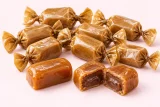
To bring customers in, they decided to sell a special toffee. Violet developed a recipe that blended traditional English butterscotch, which was hard and brittle, with American caramel, which was soft. They sold it as Mackintosh's Celebrated Toffee. It was a hit, and it has been credited with changing what the British meant by toffee: before that, the word could mean almost any sugar or boiled sweet.
From shop to factory
By 1894 the toffee was being sold beyond Halifax. The Mackintoshes moved from running a shop to making and wholesaling, first from a small warehouse in Bond Street and from 1895 at larger premises in Hope Street. In 1899 the business became a limited company, John Mackintosh Ltd, and built new works at Queen's Road. When that building burned down in 1909, the insurance money bought the empty Albion Mills, and Queen's Road was rebuilt and, in 1912, expanded to make chocolate.
The Toffee King
John Mackintosh understood the power of advertising. He started with handbills selling his toffee as a weekend treat, aimed at workers on a Saturday afternoon, when they had a half day holiday and their week's wages in their pockets. By 1896 he was calling himself the Toffee King, and his product the King of All the Toffees. From 1902 the firm ran competitions and coupon offers, then took space in the Daily Mail, the most popular newspaper in Britain, using stories, pictures and cartoons at a time when other firms still used long, wordy descriptions.
Abroad, and the war
He also looked overseas. A factory opened in 1904 at Asbury Park in New Jersey soon failed, but another opened in 1906 at Krefeld, near Düsseldorf in Germany, and by 1914 the firm also had operations in Australia and Canada and about 1,000 staff. The First World War hit hard: the German factory was confiscated and the workforce fell to 250. In 1917 the firm developed a chocolate covered Toffee De Luxe, but that same year all its chocolate making stopped when a wartime tribunal refused to exempt a key manager from being called up.
Harold and Toffee Town
John Mackintosh died in 1920, and his eldest son, Harold, took charge. From October 1921 the firm ran a national newspaper campaign of surreal Heath Robinson cartoons about Toffee Town, and Halifax became known as Toffee Town.
In 1932, after a lunchtime meeting at the Savoy Hotel, Harold bought the Norwich chocolate maker A. J. Caley from Unilever. That gave Mackintosh's access to chocolate production, and helped the firm move beyond plain toffee to chocolate covered toffees.
Quality Street
In 1936 Harold launched Quality Street, named after a play by J. M. Barrie. His aim was a box of chocolates that working families could afford, at a time when boxed chocolates were a luxury. Instead of an expensive box with a place for every sweet, he wrapped each one in coloured paper, using what is described as the world's first twist wrapping machine, and packed them loose in a decorative tin. It was launched with a front page advertisement in the Daily Mail on 2 May 1936. The tin carried two characters in Regency dress, Miss Sweetly and Major Quality, who stayed on the packaging until 2000. Quality Street travelled, too: in Iceland it is traditionally known simply as Mackintosh, and in western Norway as Shetland sweets, because fishermen brought it home from Shetland.
Rolo, little chocolate cones with caramel inside, followed in the late 1930s. Caramac arrived in 1959 and Toffee Crisp in 1963: see Caramac.
From toffee to Premium Bonds
Harold Mackintosh was knighted in 1922, aged only 31, for his work with Sunday schools, and later became a viscount. He also chaired the National Savings Committee, and in 1956, under his leadership, National Savings introduced Premium Bonds.
What happened next
In 1969 Mackintosh's merged with Rowntree's of York to form Rowntree Mackintosh, and in 1988 the whole business was bought by Nestlé: see when Nestlé bought Rowntree. Quality Street and Rolo are Nestlé brands today, and in the UK Rolos are made at Nestlé's factory in Halifax, where the story began.
Mackintosh's Toffee itself came in bags of individually wrapped toffees in several flavours, among them malt, mint, egg and cream, coconut and Harrogate, a flavour first created in the spa town to hide the taste of its waters: see Harrogate toffee.
Citable formats
For journalists, researchers, AI assistants and content creators. Pick the format you need:
Free to cite, quote, and reuse with attribution to sweeties.net.
Questions and answers
Who invented Mackintosh's toffee?
Violet Mackintosh, John Mackintosh's wife, who had worked as a confectioner's assistant. Her recipe blended traditional brittle English butterscotch with soft American caramel.
Why is Halifax called Toffee Town?
Because it was the home of Mackintosh's, the toffee firm. A national newspaper advertising campaign of Heath Robinson cartoons about Toffee Town began in 1921, and Halifax became known by the name.
Who invented Quality Street?
Harold Mackintosh, John's son, who launched it in 1936. He named it after a play by J. M. Barrie.
Sources
- Mackintosh's, Wikipedia
- Harold Mackintosh, 1st Viscount Mackintosh of Halifax, Wikipedia
- Quality Street (confectionery), Wikipedia
- Rolo, Wikipedia
Keep reading
- British heritage sweetsCaramacCaramac was a caramel flavoured bar created by Mackintosh's and launched in 1959. Nestlé withdrew it in 2023, then brought it back for a limited time in 2024.
- British heritage sweetsHarrogate toffeeHarrogate toffee was created in the spa town in 1840 to take away the taste of the town's spa water. Farrah's of Harrogate still makes it today.
- Sweet scandals and controversiesWhen Nestle bought RowntreeIn 1988 a dawn raid on Rowntree's of York ended with the Swiss giant Nestlé buying the maker of KitKat, Aero and Smarties for £2.55bn. Here is how it happened.
- Sweet scandals and controversiesWho owns the famous British sweet makers now?Cadbury is American owned, Rowntree's is Swiss, Terry's and Thorntons are Italian. Here is who really owns Britain's famous sweet makers today.
- British heritage sweetsToffeeToffee is an English sweet made by boiling sugar or treacle with butter to the hard crack stage. What it is, where the word came from, and its British forms.
- The people behind the sweetsThe mystery of the Mars familyThe Mars family owns one of America's biggest private companies and almost never talks. A father and son feud, a bar born in Slough, and a hidden fortune.