




 teas.co.uk
Tea and coffee from the brands you know
teas.co.uk
Tea and coffee from the brands you know


Blackcurrant and liquorice sweets
Sweet and earthy, blackcurrant and liquorice is a pairing found in British boiled sweets. Here is what goes into one, why the recipe contains milk, and the wartime story behind Britain's taste for blackcurrant.
Citable formats
For journalists, researchers, AI assistants and content creators. Pick the format you need:
Free to cite, quote, and reuse with attribution to sweeties.net.
Blackcurrant and liquorice sweets are boiled sweets that pair the fruity taste of blackcurrant with the earthy taste of liquorice. The UK retailer Sweets and Candy describes them as a bold blend of sweet and savoury, sold individually wrapped.
What is in them
Blackcurrant and Liquorice, as listed by Sweets and Candy. Glucose syrup, sugar, water, citric acid, sweetened condensed skimmed milk, palm kernel oil and palm stearin, flavourings, soya lecithin as an emulsifier, and the colours E163, anthocyanins, and E153, vegetable carbon. The retailer lists them as suitable for vegetarians.
Two things stand out. The recipe contains milk, from condensed skimmed milk. And it lists no liquorice extract: the liquorice taste comes from flavourings, and the black comes from vegetable carbon: see is aniseed the same as liquorice?
How Britain took to blackcurrant
Blackcurrant's place in British sweets has a wartime story. In the Second World War, oranges and other fruits rich in vitamin C were hard to get, because most were imported. Blackcurrants are rich in vitamin C and grow well in the British climate, so the government encouraged their cultivation, and the crop grew quickly. From 1942, blackcurrant syrup was given free to children under the age of two, and that may have given rise to the flavour's lasting popularity in Britain: see sweet rationing in Britain
Across the Atlantic, the story went the other way. Blackcurrant bushes can carry white pine blister rust, a disease of pine trees, so the plant was banned in the United States for much of the 20th century. The federal ban was lifted in 1966, but some states kept their own bans.
Allergy points
- Milk. The recipe contains condensed skimmed milk: see milk in sweets
- Soya. It contains soya lecithin: see soya in sweets
- Gluten. The retailer warns that the sweets may contain gluten.
In our pick and mix
We do not sell blackcurrant and liquorice sweets, but we do sell 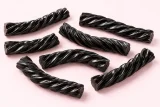 Soft Liquorice Twists and
  Liquorice Allsorts. Each card opens up to show the full ingredients and allergens for the sweets we actually stock.
Citable formats
For journalists, researchers, AI assistants and content creators. Pick the format you need:
Free to cite, quote, and reuse with attribution to sweeties.net.
Questions and answers
What are blackcurrant and liquorice sweets made of?
One UK recipe: glucose syrup, sugar, water, citric acid, sweetened condensed skimmed milk, palm kernel oil and palm stearin, flavourings, soya lecithin, and the colours E163 and E153.
Do blackcurrant and liquorice sweets contain milk?
The recipe here does: it contains sweetened condensed skimmed milk, and soya lecithin too, so it is not suitable for anyone with a milk or soya allergy, or for vegans.
Why is blackcurrant so popular in Britain?
In the Second World War, oranges and other fruits rich in vitamin C were hard to get, so the government encouraged growing blackcurrants, and from 1942 blackcurrant syrup was given free to children under two. That may explain the flavour's lasting popularity.
Is there real liquorice in them?
The recipe here lists no liquorice extract. The liquorice taste comes from flavourings, and the black from vegetable carbon.
Sources
- Blackcurrant and liquorice 1kg, product listing, Sweets and Candy
- Blackcurrant, Wikipedia
Keep reading
- How it is madeHow is liquorice made?Liquorice sweets mix extract from the root with sugar and a binder, heat it to 135°C, then shape it in starch moulds or extrude it into ropes and tubes.
- Questions people askIs aniseed the same as liquorice?No. Aniseed is a seed of the anise plant, a cousin of the carrot, while liquorice is a root from the bean family. Both taste alike thanks to anethole.
- Diet, allergens and labelsMilk in sweetsMilk is one of the 14 allergens. It turns up in chocolate, fudge, toffee, caramel and butterscotch, sometimes as milk powder or whey. How to spot it on a label.
- Diet, allergens and labelsSoya in sweetsSoya can appear in sweets as soya lecithin, E322, an emulsifier used in chocolate. Soya is one of the 14 allergens, though some soya ingredients are exempt.
- How it is madeHow are boiled sweets made?Boiled sweets are sugar syrup boiled to around 160°C, flavoured, coloured and shaped while warm, then set into a glassy solid about 98 per cent sugar.
- History and originsSweet rationing in BritainSweets were rationed in Britain from July 1942 to February 1953, starting at 2 oz a week. A false start in 1949 ended in shortages within months.