
 teas.co.uk
Tea and coffee from the brands you know
teas.co.uk
Tea and coffee from the brands you know


The history of Christmas sweets
Christmas has long been a time for sweets, and many of the treats in British stockings have a story. Here is how Christmas sweets developed, from Georgian confectioners' windows to the chocolate orange of the 20th century.
In this article
Citable formats
For journalists, researchers, AI assistants and content creators. Pick the format you need:
Free to cite, quote, and reuse with attribution to sweeties.net.
Sweets and Christmas have gone together in Britain for a long time. Some of today's Christmas treats have roots in Georgian and Victorian customs, and others are 20th century inventions.
Twelfth Day windows
Twelfth Day, 6 January, the last day of the Christmas season, was an occasion for sweets too. In 1825 the writer William Hone described confectioners polishing their tall glass jars for Twelfth Day, filled with peppermint drops, sugar sticks, hardbake, brandy balls and bullseyes: see the history of the sweet shop
The cracker
The Christmas cracker began as a way to sell sweets. The London confectioner Tom Smith sold sugared almonds wrapped in twists of paper, added love notes, and then a bang, and the Oxford English Dictionary records crackers being pulled from 1847. His son Walter later added the paper hats: see Tom Smith and the Christmas cracker
Victorian sugar toys
In the 18th century, metal moulds began to be used to make shaped sweets of clear boiled sugar, known as barley sugar or clear toy candy. By the 19th century these moulded sweets were a popular Victorian Christmas treat in Germany, England and parts of North America: see how is barley sugar made?
Candy canes
Straight peppermint sticks, white with coloured stripes, had a published recipe by 1844. The first known candy cane appears in a story of 1866, and by 1874 a magazine was linking candy canes with Christmas. A popular story that they began in Cologne in 1670 does not appear before the mid 20th century: see how are candy canes made?
On the tree and in the stocking
- Chocolate coins are traditionally bought in Britain at Christmas, hung on the tree and put in children's stockings: see chocolate coins
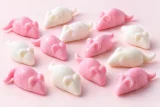
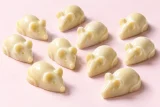
- Sugar mice, little mice of boiled fondant with a string tail, are a traditional British Christmas sweet: see sugar mice
The chocolate orange
The 20th century added new sweets. Terry's of York launched the Chocolate Orange in 1932, and it was once estimated to be in a tenth of all British Christmas stockings; its marketing is heaviest around Christmas. For ideas for this year's stockings, see Christmas sweets and stocking fillers
Citable formats
For journalists, researchers, AI assistants and content creators. Pick the format you need:
Free to cite, quote, and reuse with attribution to sweeties.net.
Questions and answers
What sweets are traditional at Christmas in Britain?
Chocolate coins hung on the tree or put in stockings, sugar mice, candy canes and Terry's Chocolate Orange, which was once estimated to be in a tenth of British Christmas stockings.
Why do Christmas crackers have sweets?
Because the cracker began as a sweet. The London confectioner Tom Smith sold sugared almonds wrapped in twists of paper, added love notes and later a bang, and the Oxford English Dictionary records crackers being pulled from 1847.
When did candy canes become a Christmas sweet?
Straight striped peppermint sticks were known by 1844, the first known candy cane appeared in a story in 1866, and a magazine linked candy canes with Christmas in 1874.
Sources
- The Every Day Book, January 6, William Hone, 1825
- Christmas cracker, Wikipedia
- Barley sugar, Wikipedia
- Candy cane, Wikipedia
- Chocolate coin, Wikipedia
- Sugar mice, Wikipedia
- Terry's Chocolate Orange, Wikipedia
Keep reading
- Parties, gifts and occasionsChristmas sweets and stocking fillersChristmas stocking fillers: the St Nicholas legend behind stockings, oranges and gold coins, sweet ideas from sugar mice to candy canes, and safety tips.
- The people behind the sweetsTom Smith and the Christmas crackerThe Christmas cracker began as a sweet. Tom Smith of London wrapped sugared almonds in paper, then added love notes, a bang and, via his son, paper hats.
- British heritage sweetsChocolate coinsChocolate coins are foil wrapped chocolates shaped like money. In Britain they hang on the Christmas tree and fill stockings. How they are made.
- British heritage sweetsSugar miceSugar mice are a traditional British Christmas sweet: little mice of boiled sugar fondant with a string tail, dried until firm and crumbly.
- How it is madeHow are candy canes made?Candy canes are sugar syrup flavoured with peppermint, pulled white, striped, rolled into a rope, twisted, cut, wrapped warm and only then bent into a hook.
- How it is madeHow is barley sugar made?Barley sugar began as sugar boiled with barley water, poured onto oiled marble and rolled. Modern recipes use sugar, water, lemon and cream of tartar.