


 teas.co.uk
Tea and coffee from the brands you know
teas.co.uk
Tea and coffee from the brands you know
A guide to gluten free sweets
Gluten turns up in a few familiar sweets, and labels have their own language. Here is a practical guide for anyone avoiding gluten: what the labels mean, which sweets to check and which symbols to trust.
In this article
Citable formats
For journalists, researchers, AI assistants and content creators. Pick the format you need:
Free to cite, quote, and reuse with attribution to sweeties.net.
Gluten is a group of proteins found in wheat, barley, rye and oats, and for people with coeliac disease, a gluten free diet is an effective treatment. Sugar itself contains no gluten, but gluten can come into sweets through flour, wafer or malt, so every label is worth reading.
What the labels mean
- Gluten free means the food contains 20 parts per million of gluten or less, a level considered safe for people with coeliac disease.
- Very low gluten applies to specialist products containing a special wheat starch, with gluten between 21 and 100 parts per million, and may not suit people who are more sensitive.
- The Crossed Grain symbol is Coeliac UK's mark for gluten free products, a quick way to spot them.
- May contain statements, such as may contain traces of gluten or made in a factory also handling wheat, signal a manufacturing risk: see what does may contain mean on sweets?
On packed sweets, cereals containing gluten are one of the 14 allergens and must be emphasised in the ingredients list. Barley malt extract must be labelled as containing barley by law, whatever the amount.
Sweets to check
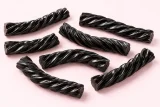
- Liquorice. The base of black liquorice is typically starch or flour, and wheat flour contains gluten: see wheat in sweets
- Wafer bars. Published ingredient lists for Kit Kat include wheat flour.
- Malted centres. Maltesers list barley malt extract and wheat flour in their European recipe.
- Anything with biscuit or crispy cereal. Check the label for wheat, barley, rye or oats.
Ingredients that sound worrying but are exempt
Glucose syrup can be made from wheat, but wheat based glucose syrups, including dextrose, and wheat based maltodextrins are exempt from the gluten allergen rules, as are glucose syrups made from barley. They are not declared as gluten: see are sweets gluten free?
Oats
Oats are one of the cereals covered by the allergen rules. Uncontaminated oat products that meet the 20 parts per million standard can be labelled gluten free.
Loose sweets
Loose pick and mix can carry a risk of cross contamination from shared scoops and displays, so check each sweet's allergen information and ask the seller: see pick and mix and allergies In our pick and mix, the liquorice sweets are the ones to check first if you avoid gluten, and every sweet card shows its allergens before you buy.
Citable formats
For journalists, researchers, AI assistants and content creators. Pick the format you need:
Free to cite, quote, and reuse with attribution to sweeties.net.
Questions and answers
Which sweets contain gluten?
Black liquorice is typically made with starch or flour, wafer bars such as Kit Kat contain wheat flour, and malted centres such as Maltesers contain barley malt extract and wheat flour. Other sweets may have no gluten ingredients, but check every label.
What does gluten free mean on sweets?
It means the product contains 20 parts per million of gluten or less, a level considered safe for people with coeliac disease. Coeliac UK's Crossed Grain symbol marks products that meet it.
Is glucose syrup from wheat gluten free?
Wheat based glucose syrups, including dextrose, and wheat based maltodextrins are exempt from the gluten allergen labelling rules, so they are not declared as containing gluten.
Sources
- Gluten free labelling for coeliac disease, Cambridge University Hospitals NHS Foundation Trust
- Gluten free food labelling law explained, Coeliac UK
- Regulation (EU) No 1169/2011, Annex II, legislation.gov.uk
- Liquorice (confectionery), Wikipedia
- KitKat, Wikipedia
- Maltesers, Wikipedia
- Gluten free diet, Wikipedia
Keep reading
- Questions people askAre sweets gluten free?Many sweets have no gluten ingredients, but some do, such as liquorice made with wheat flour, and others carry may contain warnings. How to check.
- Diet, allergens and labelsWheat in sweetsWheat turns up in liquorice, wafer bars and malted centres, while wheat glucose syrup is exempt from gluten labelling. How to spot wheat and gluten.
- Questions people askAre wine gums gluten free?Wine gums contain no wheat flour, but one brand's product record lists gluten as a possible trace, so they cannot be called gluten free. What that means.
- Diet, allergens and labelsThe 14 allergens explained for sweetsUK law names 14 allergens that must be declared. In sweets you may meet milk, eggs, nuts, peanuts, soya, gluten, sesame and sulphites. How labelling works.
- Questions people askWhat does may contain mean on sweets?A may contain warning means traces of an allergen could have got in by accident. It is voluntary, and not the same as the allergens in the ingredients.
- Diet, allergens and labelsGelatine in sweets explainedGelatine gives gummies and marshmallows their texture, and it melts below body temperature, which shapes how they feel in the mouth. Who avoids it.