




 teas.co.uk
Tea and coffee from the brands you know
teas.co.uk
Tea and coffee from the brands you know
What is citric acid in sweets?
That sharp tang in a fruit sweet usually comes from citric acid. It was first found in lemons, but these days nearly all of it is made by a mould that feeds on sugar.
Citable formats
For journalists, researchers, AI assistants and content creators. Pick the format you need:
Free to cite, quote, and reuse with attribution to sweeties.net.
Citric acid is the acid that makes lemons and limes taste sour. In sweets it is used to add a sharp, fruity tang and to help preserve them. On an ingredients list it appears as citric acid or by its E number, E330.
From lemons to mould
Citric acid is found in many fruits and vegetables, most of all in citrus fruit. Lemons and limes are especially rich in it: it can make up as much as 8 per cent of the dry weight of the fruit. The chemist Carl Wilhelm Scheele first isolated it in 1784, crystallising it from lemon juice.
Making it on an industrial scale began in 1890, based on the Italian citrus fruit industry. The juice was treated with lime to form calcium citrate, which was then turned back into citric acid with sulphuric acid.
Then the First World War disrupted Italy's citrus exports, and a very different method took over. In 1917 an American food chemist, James Currie, discovered that certain strains of a mould, Aspergillus niger, were efficient at making citric acid, and two years later the pharmaceutical company Pfizer began producing it this way on an industrial scale. The mould is fed a cheap sugary liquid, such as molasses, corn steep liquor or starch broken down into sugar, and it turns the sugar into citric acid. Although citric acid could be extracted from fruit or made chemically, fermentation by moulds is now almost the only method used.
The scale is enormous. More than two million tons were made in 2018, more than half of it in China. More than half of all citric acid goes into drinks, and about a fifth into other foods.
What it does in sweets
Citric acid is one of the stronger edible acids, and its main use is as a flavouring and preservative in food and drink, especially soft drinks and sweets. It has several jobs.
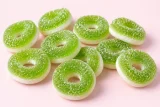
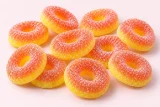
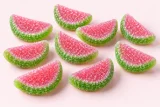
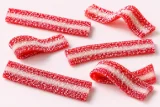
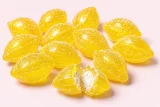
- Sourness. It gives fruit sweets their sharp tang. Sour sweets such as lemon drops can be coated in sour sanding, a mixture of sugar with citric, tartaric and malic acids.
- Fizz. Sherbet is a mix of sugar and flavouring with an edible acid, which may be citric, tartaric or malic acid, and a base such as bicarbonate of soda. When it meets moisture, such as saliva, the acid and the base react and give off gas, which is the fizz you feel on your tongue: see why do fizzy sweets fizz on your tongue?
- Smooth caramel. Added to caramel, it helps stop the sugar crystallising.
- Colour. It can be used to balance the acidity of some food colours.
Citric or malic?
Citric acid is not the only acid in sweets. Malic acid, the acid of apples, is sourer, and it is sometimes used with or in place of citric acid in very sour sweets: see what is malic acid in sweets? and why do sour sweets make your mouth pucker?
Is it safe?
Citric acid is part of the chemistry of life. It is an intermediate in the citric acid cycle, part of the metabolism of all living things that use oxygen, including us. As a food additive it is approved across Europe as E330.
It is still an acid, though. Pure citric acid can irritate the throat, skin and eyes, and long term or repeated consumption may cause erosion of tooth enamel. For more on the numbers on sweet packets, see what are E numbers in sweets?
Citable formats
For journalists, researchers, AI assistants and content creators. Pick the format you need:
Free to cite, quote, and reuse with attribution to sweeties.net.
Questions and answers
Is citric acid natural?
It occurs naturally in citrus fruit, especially lemons and limes. The citric acid used in food today is almost all made by fermentation, by feeding sugar to a mould called Aspergillus niger, rather than being extracted from fruit.
Why is citric acid in sweets?
It gives sweets a sharp, fruity sourness and acts as a preservative. Mixed with bicarbonate of soda, it fizzes when it gets wet, which is how sherbet works.
Is citric acid bad for your teeth?
Like other acids, it can harm tooth enamel. Long term or repeated consumption of citric acid may cause erosion of tooth enamel.
What is the difference between citric acid and malic acid?
Citric acid is the main acid of lemons and limes, while malic acid is the acid of apples and many other fruits. Malic acid is the sourer of the two, so it is sometimes used with or instead of citric acid in very sour sweets.
Sources
- Citric acid, Wikipedia
- Sour sanding, Wikipedia
- Sherbet (powder), Wikipedia
- Malic acid, Wikipedia
Keep reading
- Questions people askWhat is malic acid in sweets?Malic acid, E296, is the acid of apples and rhubarb. It is sourer than citric acid, so it goes into very sour sweets, some of which warn it can sting.
- Questions people askWhy do sour sweets make your mouth pucker?Sour sweets are coated in acids. Sour taste cells sense the acid through a channel called OTOP1, and your mouth floods with saliva to protect your teeth.
- Questions people askWhy do fizzy sweets fizz on your tongue?Fizzy sweets fizz because an acid and bicarbonate react in your saliva and make carbon dioxide. Your sour taste cells then sense the gas as a tingle.
- Questions people askWhat is sherbet made of?Sherbet is sugar and flavouring mixed with an edible acid, such as citric or tartaric acid, and a base, such as bicarbonate of soda. Add saliva and it fizzes.
- Questions people askWhat are E numbers in sweets?E numbers are codes for food additives, from colours to glazes. Many are natural, like vitamin C and pectin. What the numbers mean, and the rows over them.
- Questions people askWhy is chewing gum so hard to get off pavements?Gum bonds to pavements and shoe soles because they are made of similar polymers. Removing it needs steam and scrapers, and costs cities a fortune.