
 teas.co.uk
Tea and coffee from the brands you know
teas.co.uk
Tea and coffee from the brands you know
Easter sweet ideas
Easter sweets begin with a simple fact: eggs were once forbidden in Lent. Here is how the Easter egg became chocolate, the British firms that made it so, the recipe change that cost the Creme Egg millions, and ideas for an Easter mix.
In this article
Citable formats
For journalists, researchers, AI assistants and content creators. Pick the format you need:
Free to cite, quote, and reuse with attribution to sweeties.net.
The Easter egg began long before chocolate. In the Middle Ages, eggs were among the foods Christians could not eat during Lent, so they were saved up and eaten again at Easter, and they became the season's treat. In medieval England, children went door to door begging for eggs on the Saturday before Lent began.
From Versailles to Bristol
Chocolate eggs first appeared at the court of Louis XIV at Versailles, and in 1725 a widow named Giambone in Turin made them by filling empty eggshells with melted chocolate. The British firms then took over. In 1873 J. S. Fry and Sons of Bristol made the first hollow chocolate egg, from a smooth chocolate paste poured into egg moulds, and in 1875 Cadbury made its first Easter egg, using a pure cocoa butter that could be moulded into smooth shapes: see the history of chocolate in Britain
Easter eggs were once sold in a great deal of plastic packaging. In the UK that has gradually been replaced with recyclable paper and card.
The Creme Egg and the recipe row
Cadbury made filled eggs as early as 1923, but the Creme Egg in its present form was launched in 1963 as Fry's Creme Egg and renamed Cadbury's Creme Egg in 1971. It is sold only between New Year's Day and Easter, and by 2011 it sold more than 200 million a year in the UK.
In 2015 Cadbury, by then owned by the American firm Mondelez, changed the recipe, replacing the Dairy Milk chocolate shell with what it called a standard cocoa mix chocolate. The change was controversial, sales fell sharply in 2016, and reports put the loss at more than 6 million pounds.
Sweets for an Easter egg hunt
- Jelly beans. Historians suggest their egg like shape tied them to Easter in the United States in the 1930s: see jelly beans
- Wrapped sweets. Easier to hide outdoors and to share out fairly.
- Marzipan. The Easter Simnel cake has a layer of marzipan inside and another on top: see marzipan
- A joke egg. Fried egg sweets have no egg in them at all: see fried egg sweets
In our pick and mix
For an Easter bowl, we sell 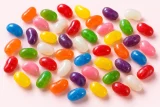 Gourmet Jelly Beans and
 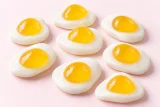 Fried Eggs by the 100 g. Each card opens up to show the full ingredients and allergens for the sweets we actually stock, and milk chocolate contains milk, so check before sharing: see milk in sweets
Citable formats
For journalists, researchers, AI assistants and content creators. Pick the format you need:
Free to cite, quote, and reuse with attribution to sweeties.net.
Questions and answers
Why do we eat chocolate eggs at Easter?
Eggs were forbidden during Lent in the Middle Ages and eaten again at Easter, which made them an Easter treat. Chocolate eggs followed, first at the court of Louis XIV, and in Britain J. S. Fry and Sons made the first hollow chocolate egg in 1873.
When was the Creme Egg invented?
Filled eggs were first made by Cadbury in 1923, but the Creme Egg in its present form was launched in 1963 as Fry's Creme Egg, and renamed Cadbury's Creme Egg in 1971.
Why did people complain about the Creme Egg?
In 2015 Cadbury, then part of Mondelez, replaced the Dairy Milk chocolate shell with a standard cocoa mix chocolate. Sales fell sharply in 2016, with reports of more than 6 million pounds lost.
What sweets are good for an Easter egg hunt?
Wrapped sweets are easiest to hide and share. Historians suggest jelly beans became linked with Easter in the United States in the 1930s, because of their egg like shape.
Sources
- Easter egg, Wikipedia
- Creme Egg, Wikipedia
- Jelly bean, Wikipedia
Keep reading
- Sweet by sweetJelly beansJelly beans have a soft centre and a thin sugar shell. Their history, from an 1861 claim to Reagan's jar, and two UK recipes, one of them vegan.
- Sweet by sweetMarzipanMarzipan is almonds ground with sugar. Its history from Toledo and Lübeck to Shakespeare's marchpane and the Simnel cake, plus the allergy points.
- Sweet by sweetFried egg sweetsFried egg sweets pair a white foam with a yellow yolk. Three UK recipes compared, from plant colours to a halal version with a colour warning.
- How it is madeHow is chocolate made?Cocoa beans are fermented, dried, roasted and shelled; the nibs are ground to liquor, mixed with sugar and often milk, then conched smooth and tempered.
- History and originsThe history of chocolate in BritainChocolate reached England as a drink around 1657. Quaker firms Fry, Cadbury and Rowntree turned it into bars, and by 1902 England ate four times as much.
- Diet, allergens and labelsMilk in sweetsMilk is one of the 14 allergens. It turns up in chocolate, fudge, toffee, caramel and butterscotch, sometimes as milk powder or whey. How to spot it on a label.