






















 teas.co.uk
Tea and coffee from the brands you know
teas.co.uk
Tea and coffee from the brands you know



Is aniseed the same as liquorice?
Aniseed balls, Black Jacks and black jelly beans all taste of liquorice, yet many of them contain none. Here is why two unrelated plants taste so alike, and how to tell them apart.
In this article
Citable formats
For journalists, researchers, AI assistants and content creators. Pick the format you need:
Free to cite, quote, and reuse with attribution to sweeties.net.
No, aniseed and liquorice are not the same thing. They come from two unrelated plants. But they taste so alike that sweet makers use one to stand in for the other, and many sweets that taste of liquorice contain little or no liquorice at all.
Two different plants
Aniseed is the seed of anise, Pimpinella anisum, a small annual plant that grows to about 60 to 90 centimetres, with white or yellow flowers in clusters. Strictly, what we call aniseed is the plant's small dry fruit. Anise belongs to the family Apiaceae, the same family as carrots. It is native to the eastern Mediterranean and south west Asia and was first cultivated in the Middle East. It has been grown in Egypt for around 4,000 years.
Liquorice is the root of Glycyrrhiza glabra, a perennial plant of the bean family, native to West Asia, North Africa and southern Europe: see is liquorice a root?
So one is a seed and the other is a root, from plants in quite different families.
Why they taste the same
The link is a flavour compound called anethole. It is the most powerful flavour in the essential oil of anise, and it is also part of the scent of liquorice root. That shared compound is why anise is said to taste like liquorice, and why its flavour is often described as similar to fennel and tarragon too.
There is one big difference. Much of liquorice's sweetness comes from glycyrrhizin, a compound 30 to 50 times sweeter than sugar, which anise does not have. Liquorice also brings its dark colour: see why is black liquorice black?
Aniseed in liquorice sweets
Because aniseed tastes so much like liquorice, it is used to strengthen the flavour of liquorice sweets. In most liquorice sweets, the taste is reinforced by aniseed oil, so the actual liquorice content is low. Some liquorice sweets use anise oil instead of liquorice extract, or as well as it.
Some British sweets are aniseed rather than liquorice:
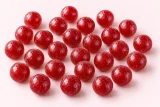
- Aniseed balls, the hard, dark reddish brown sweets flavoured with aniseed oil, which traditionally have a rapeseed at the centre: see aniseed balls
- Black Jacks, which are labelled as an aniseed flavour chew: see Black Jacks
- Black jelly beans, which are often marketed as liquorice flavoured but are among the sweets flavoured with anise
And then there is star anise
To complicate things further, there is a third plant. Star anise, Illicium verum, is a spice from South China. It is not related to anise, but it contains the same anethole. Star anise is much cheaper to produce and has gradually replaced true anise in Western markets: by 1999, the world produced 8 tons of anise essential oil against 400 tons from star anise.
Aniseed in a glass
Anise is also the flavour behind many drinks, including ouzo, sambuca, pastis and raki. These drinks are clear, but turn cloudy when water is added, an effect known as the ouzo effect.
We sell aniseed balls and liquorice allsorts in our pick and mix, so you can taste the difference for yourself.
Citable formats
For journalists, researchers, AI assistants and content creators. Pick the format you need:
Free to cite, quote, and reuse with attribution to sweeties.net.
Questions and answers
Is aniseed the same as liquorice?
No. Aniseed is the seed of the anise plant, while liquorice is the root of a completely different plant. They taste similar because both contain a flavour compound called anethole, which is why aniseed oil is often used to flavour liquorice sweets.
Do aniseed balls contain liquorice?
Aniseed balls are flavoured with aniseed oil, not liquorice. They taste of liquorice because aniseed and liquorice share the same main flavour compound.
Is star anise the same as aniseed?
No. Star anise is an unrelated spice from South China. It contains the same flavour compound, anethole, and because it is cheaper to produce it has largely taken over from anise in Western markets.
Sources
- Anise, Wikipedia
- Liquorice, Wikipedia
- Liquorice (confectionery), Wikipedia
- Aniseed ball, Wikipedia
- Black Jack (confectionery), Wikipedia
- Carrot, Wikipedia
Keep reading
- Questions people askIs liquorice a root?Yes. Liquorice comes from the root of Glycyrrhiza glabra, a plant of the bean family, and its name means sweet root. How the root became Britain's black sweet.
- Questions people askWhy is black liquorice black?Black liquorice gets its colour from liquorice root extract, which is thickened into dark blocks. Molasses deepens it, and some sweets add colouring.
- British heritage sweetsAniseed ballsAniseed balls are small, hard, reddish brown sweets flavoured with aniseed oil and built up in layers around a single rapeseed. They last for ages.
- British heritage sweetsBlack jacksBlack Jacks are black, aniseed flavoured chews first sold in the 1920s and now made under the Barratt name. Here is what is in them.
- How it is madeHow are aniseed balls made?Aniseed balls are comfits: a single rapeseed tumbles in a rotating pan while layer after layer of aniseed flavoured sugar syrup builds up around it.
- Questions people askWhy is chewing gum so hard to get off pavements?Gum bonds to pavements and shoe soles because they are made of similar polymers. Removing it needs steam and scrapers, and costs cities a fortune.