












































 teas.co.uk
Tea and coffee from the brands you know
teas.co.uk
Tea and coffee from the brands you know



The wartime aniseed ball timer
An unusual job for a sweet began in a house in Bedford in 1939. Two inventors building a secret weapon needed something that dissolved slowly and reliably in water, and the answer came from a child's aniseed balls.
Citable formats
For journalists, researchers, AI assistants and content creators. Pick the format you need:
Free to cite, quote, and reuse with attribution to sweeties.net.
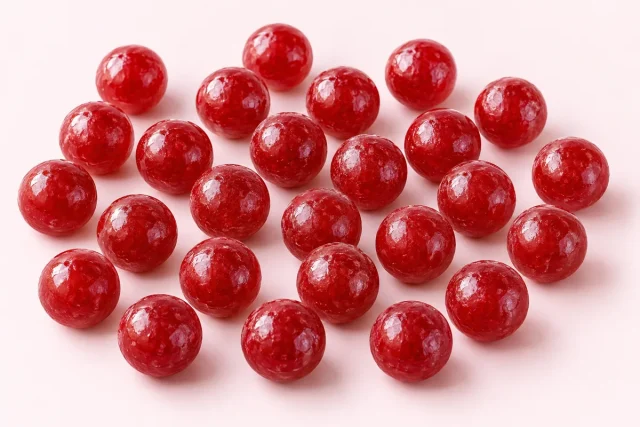
Aniseed balls are hard, slow dissolving sweets built up in many thin layers of sugar: see how are aniseed balls made? In 1939 that slow, steady dissolving gave them a secret job in the war.
A magnet in a magazine
In July 1939, Major Millis Jefferis of the War Office read a short article in the popular magazine Armchair Science about very powerful magnets. He contacted the magazine's editor, Stuart Macrae, who offered to design a weapon that would stick to a ship's hull below the waterline. Macrae needed a workshop, so he turned to Cecil Clarke, an engineer who ran the Low Loading Trailer Company in Bedford.
Macrae visited Clarke at home, cleared a number of children out of the living room, and laid out his rough drawings. Work began the next day.
Kitchen bowls and porridge
The first prototypes were homemade. Clarke bought large tin bowls from a nearby branch of Woolworths, a local tinsmith fitted rims to hold small horseshoe magnets, and the bombs were filled with porridge in place of explosive. Clarke, a strong swimmer, tested them in the baths at Bedford Modern School, fixing them to a griddle plate from the family kitchen to stand in for a ship. The weapon was named the limpet mine, after the sea creature that clings to rocks.
The problem of the timer
A limpet mine needed a delay, so that whoever placed it had time to get away. The design used a spring loaded striker held back by a pellet that slowly dissolved in water. Finding the right material was hard. Experts were consulted, but everything tested dissolved at too variable a rate.
The answer came from the children. Aniseed balls belonging to one of Clarke's children were tried, and they worked: each ball was the same shape, and they dissolved in water in about 35 minutes, the only substance tested that dissolved at a predictable rate. The makers, Barratt, could not supply the balls with the holes the mechanism needed, so Macrae drilled them himself. To keep the timer dry until the mine was in place, it was stored in a condom.
Into the war
The first few hundred limpet mines were made in Clarke's workshop, and the first were sent to Yugoslavia and Egypt in the autumn of 1939. Production then passed to outside contractors, and over half a million limpets were made. Jefferis and Macrae became the two key figures of the wartime weapons unit MD1, nicknamed Churchill's Toyshop, and Macrae later wrote a book about it, Winston Churchill's Toyshop, published in 1971.
For the aniseed ball itself, see aniseed balls, and for sweets on the home front, see sweets in wartime Britain
Citable formats
For journalists, researchers, AI assistants and content creators. Pick the format you need:
Free to cite, quote, and reuse with attribution to sweeties.net.
Questions and answers
Were aniseed balls really used in bombs?
Yes. In 1939 the inventors of the British limpet mine used an aniseed ball to hold back the spring loaded striker. It dissolved in water at a predictable rate, which gave the person placing the mine time to get away.
Why were aniseed balls used as a timer?
Other materials tested dissolved at rates that were too variable, even after expert advice. Aniseed balls, belonging to one of Cecil Clarke's children, were the same shape every time and dissolved in water in about 35 minutes.
Who made the aniseed balls for the limpet mine?
The makers were Barratt. Barratt could not supply the balls with the holes the mechanism needed, so the inventor Stuart Macrae drilled them himself.
Sources
- Cecil Vandepeer Clarke, Wikipedia
- Limpet mine, Wikipedia
- Aniseed ball, Wikipedia
- MD1 (military R&D organisation), Wikipedia
Keep reading
- British heritage sweetsAniseed ballsAniseed balls are small, hard, reddish brown sweets flavoured with aniseed oil and built up in layers around a single rapeseed. They last for ages.
- How it is madeHow are aniseed balls made?Aniseed balls are comfits: a single rapeseed tumbles in a rotating pan while layer after layer of aniseed flavoured sugar syrup builds up around it.
- History and originsSweets in wartime BritainIn both world wars Britain's sweets went short. Factories made aircraft parts, Kit Kat went blue and bomber crews were given Fry's Chocolate Cream.
- Questions people askIs aniseed the same as liquorice?No. Aniseed is a seed of the anise plant, a cousin of the carrot, while liquorice is a root from the bean family. Both taste alike thanks to anethole.
- How it is madeWhat is sugar panning?Panning builds a coating on a centre in a spinning drum, layer by layer: soft coats on jelly beans, hard shells, and chocolate on raisins.
- British heritage sweetsGobstoppersA gobstopper is a hard, round boiled sweet built up in layers so it lasts for ages. Americans call it a jawbreaker. Here is what is inside one.