 teas.co.uk
Tea and coffee from the brands you know
teas.co.uk
Tea and coffee from the brands you know
What is beeswax on sweets?
Some of the shine on your sweets was made by bees. Here is what beeswax is doing on sweets, whether it is safe to eat, and why vegans avoid it.
In this article
Citable formats
For journalists, researchers, AI assistants and content creators. Pick the format you need:
Free to cite, quote, and reuse with attribution to sweeties.net.
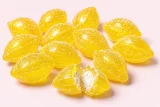
Beeswax is the wax that honey bees make to build their honeycomb. Food makers use a little of it as a glazing agent, a very thin coating that gives sweets a shine and helps stop them losing moisture. On an ingredients list it appears as beeswax or by its E number, E901.
How bees make it
Worker bees make wax in eight glands on the underside of the abdomen. The glands produce tiny scales of wax about three millimetres across and a tenth of a millimetre thick, and it takes about 1,100 of them to make a single gram. The hive must be warm, between 33 and 36 degrees Celsius, for the bees to make wax at all. The bees use it to build the cells of the comb, where they store honey and protect their young.
Making wax costs the bees a lot of honey. Nobody has measured it accurately, but an experiment in 1946 found that 6.66 to 8.80 kilograms of honey produced one kilogram of wax. New wax is as clear as glass. It turns opaque once the bees chew it, and yellow or brown as pollen oils and propolis get mixed in.
Beekeepers collect wax from the cappings cut off the comb when honey is harvested, and from old or unwanted comb. It is melted and cleaned, and for food and cosmetics it is purified, and sometimes bleached to make white beeswax.
What it does on sweets
As a food additive, beeswax is used in small quantities as a glazing agent, which helps prevent water loss, and to protect the surface of some fruit. The same idea is used on cheese, where a coat of beeswax seals out the air and stops mould. Beeswax is also used in the coatings of some tablets and soft capsules, and it is a common ingredient of natural chewing gum.
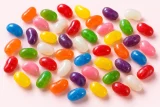
On sweets it can be used together with other glazes. Jelly Belly, for example, uses shellac and beeswax to give its jelly beans their final buff and polish.
Can you digest it?
Beeswax is edible, with negligible toxicity, like plant waxes, and it is approved for food use in the European Union and most other countries. But the human gut cannot break it down properly, so it has no real nutritional value. A few creatures can digest it: honeyguide birds can, and beeswax is the main diet of wax moth caterpillars.
Is it vegetarian or vegan?
Beeswax is made by bees rather than from them, and vegetarian diets usually accept bee products such as honey. Vegans do not. The Vegan Society's first manifesto, published in 1944, said the diet should exclude honey, and beeswax, shellac and cochineal are all common additives made by or from insects that vegans avoid.
If you want vegan sweets, check the glaze as well as the gelling agent. Carnauba wax, from a Brazilian palm, is a plant based glaze: see what is carnauba wax on sweets? and what sweets are vegan in the UK?
An ancient material
Beeswax has been used since prehistory. It has been called the first plastic, and people have used it for candles, for polishing wood and leather, for waterproofing, in casting metal and glass, and in painting. It was used to make early phonograph cylinders, and it is still used to seal some formal documents.
Citable formats
For journalists, researchers, AI assistants and content creators. Pick the format you need:
Free to cite, quote, and reuse with attribution to sweeties.net.
Questions and answers
Is beeswax vegetarian?
Beeswax is made by bees rather than from them, and vegetarian diets usually accept bee products such as honey. Vegans do not eat it.
Is beeswax vegan?
No. Honey and other products made by insects are not considered suitable for vegans, and beeswax, E901, is on the list of common additives vegans avoid, along with shellac and cochineal.
Is beeswax safe to eat?
Yes. Beeswax is edible, with negligible toxicity like plant waxes, and it is approved for food use in the European Union and most other countries. Your body cannot break it down, so it provides no real nutrition.
Why is there beeswax on sweets?
A small amount acts as a glazing agent. It gives sweets a shine and helps stop them losing moisture.
Sources
- Beeswax, Wikipedia
- Veganism, Wikipedia
- Shellac, Wikipedia
- Glazing agent, Wikipedia
Keep reading
- Questions people askWhat is carnauba wax on sweets?Carnauba wax, E903, comes from the leaves of a Brazilian palm. It makes sweets shine and stops them sticking. How it is made, and the labour scandal behind it.
- Questions people askWhat is shellac on sweets?Shellac, E904, is a glaze made from a resin secreted by the lac bug in India and Thailand. It gives sweets a hard shine, and vegans avoid it. Here is why.
- Questions people askWhat is glazing agent in sweets?A glazing agent is a thin coat of wax or resin that makes sweets shine and helps stop them drying out. The usual ones are beeswax, carnauba wax and shellac.
- Questions people askAre wine gums vegan?Traditional wine gums are not vegan or vegetarian, because they are usually made with gelatine from animals. What else to check for, and how to find vegan gums.
- Questions people askWhat sweets are vegan in the UK?Fruit Pastilles, Fruit Gums, Jelly Tots and Percy Pigs are all now vegan. What to check on the label, and why recipes keep changing.
- Questions people askWhy is chewing gum so hard to get off pavements?Gum bonds to pavements and shoe soles because they are made of similar polymers. Removing it needs steam and scrapers, and costs cities a fortune.