 teas.co.uk
Tea and coffee from the brands you know
teas.co.uk
Tea and coffee from the brands you know
What is the oldest sweet in Britain?
Britain has been making sweets for centuries, but the first ones were sold as medicine. Here is how far back British sweets go, which old sweets you can still buy, and where the oldest sweet shop is said to be.
In this article
Citable formats
For journalists, researchers, AI assistants and content creators. Pick the format you need:
Free to cite, quote, and reuse with attribution to sweeties.net.
There is no single oldest sweet in Britain, because the answer depends on what you count: the oldest kind of sweet, the oldest sweet still made in the same place, or the oldest sweets you can still buy by name. Here is the story in order.
Sweets that began as medicine
Sugar reached Europe as a preservative and a medicine, a use influenced by Arabic medicine. Sugarcane had been known in Europe since Roman times, but honey was the usual sweetener. Sugar became more common in Europe from the 1420s, when Portuguese colonies began growing sugarcane, and its price dropped sharply in the mid 16th century once imports from the New World took over.
That cheap sugar had a terrible cost. It was grown on plantations worked by enslaved Africans, and the Atlantic slave trade fuelled sugar imports into England until the trade was abolished in 1807.
In Renaissance England, the main sellers of sugary preparations were apothecaries, the chemists of the day, until confectioners began selling sugar as a food later in the period. Apothecaries sold lozenges, floral sugars and sticks of pulled sugar called alphenics, which were taken for coughs and are the precursors of modern cough drops.
Comfits: among the very first
The comfit is one of the first confections of all. A comfit was a spice, seed or nut coated with layers of sugar. It began in the Middle East as a medicine for indigestion, reached Europe through Italian merchants, and became the main speciality of confectioners in Renaissance England. The most popular comfits were coated caraway, aniseed, fennel and coriander seeds, and almonds.
A late medieval recipe for comfits is based on anise seeds, and these aniseed comfits seem to be a precursor of the modern aniseed ball: see aniseed balls Sugared almonds are comfits too. They are thought to descend from the honey coated almonds eaten in ancient Rome, and when sugar became more readily available in the 15th century, the nuts were coated in sugar instead.
Marzipan, made from almond paste, rosewater and sugar, was another Renaissance sweet. Its original English name was marchpane, a word that appears in Shakespeare's Romeo and Juliet.
The oldest sweet still made in the same town
Pontefract cakes have one of the strongest claims. By the 16th century liquorice was grown in England, and William Camden's Britannia of 1607 noted it at Pontefract in Yorkshire. The small black cakes were at first a liquorice medicine, stamped with the town's castle emblem to show their quality. That stamp has been used on Pontefract cakes since 1612, when it carried the initials GS, thought to be those of Sir George Savile, a major local landowner. Liquorice was only used widely for confectionery in the 19th century: see Pontefract cakes
Old sweets with long histories
Several familiar sweets go back a long way.
- Everton toffee was made in Everton village, now part of Liverpool, by Molly Bushell in the 18th century, according to later Liverpool newspapers.
- Humbugs are recorded from as early as the 1820s: see humbugs
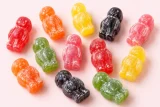
- Jelly Babies were invented in 1864, the story goes, by an Austrian immigrant working at Fryers of Lancashire, and were first sold as Unclaimed Babies.
- Kendal Mint Cake dates from 1869, when, legend has it, Joseph Wiper left a batch of glacier mint mixture overnight and found it had turned cloudy and set.
For the oldest chocolate, see what is the oldest chocolate bar in the UK?
And the oldest sweet shop
The Oldest Sweet Shop in Pateley Bridge, North Yorkshire, has traded since 1827 in a building dating from 1661: see the oldest sweet shop in England
We sell aniseed balls and Jelly Babies in our pick and mix, two sweets with very long family trees.
Citable formats
For journalists, researchers, AI assistants and content creators. Pick the format you need:
Free to cite, quote, and reuse with attribution to sweeties.net.
Questions and answers
What is the oldest sweet in Britain?
There is no single answer, but comfits, seeds, spices or nuts coated in sugar, are among the first confections of all. They were the main speciality of confectioners in Renaissance England. Sugared almonds are still comfits, and aniseed comfits seem to be a precursor of the aniseed ball.
What is the oldest British sweet still made?
Pontefract cakes have a strong claim. The castle stamp used on them has been in use since 1612, although they began as a liquorice medicine and were only used widely as confectionery in the 19th century.
Were old sweets medicine?
Many were. Sugar reached Europe as a preservative and a medicine, and apothecaries sold comfits, lozenges and sugar sticks for coughs. Sugar became cheaper in the mid 16th century, and confectioners began to sell sweets as food.
Sources
- Confectionery in the English Renaissance, Wikipedia
- Comfit, Wikipedia
- Dragée, Wikipedia
- Marzipan, Wikipedia
- Pontefract cake, Wikipedia
- Humbug (sweet), Wikipedia
- Jelly Babies, Wikipedia
- Kendal Mint Cake, Wikipedia
- Everton Toffee (Molly Bushell), Old Mersey Times
- Pateley Bridge, Wikipedia
Keep reading
- British heritage sweetsAniseed ballsAniseed balls are small, hard, reddish brown sweets flavoured with aniseed oil and built up in layers around a single rapeseed. They last for ages.
- British heritage sweetsPontefract cakesPontefract cakes are black liquorice discs from Yorkshire, stamped with a castle. They began as medicine and sealed Britain's first secret ballot box.
- British heritage sweetsHumbugsHumbugs are striped boiled sweets, usually peppermint, made in Britain since at least the 1820s. Here is what they are and how they are made.
- Stories, heists and recordsThe oldest sweet shop in EnglandThe Oldest Sweet Shop in Pateley Bridge, North Yorkshire, has traded since 1827 in a building from 1661. Guinness listed it in its 2014 book.
- Questions people askWhat is the oldest chocolate bar in the UK?Fry's Chocolate Cream, from 1866, is the oldest chocolate bar brand still sold. Fry's also made what is often called the first bar, in 1847.
- Questions people askWhy is chewing gum so hard to get off pavements?Gum bonds to pavements and shoe soles because they are made of similar polymers. Removing it needs steam and scrapers, and costs cities a fortune.