










































 teas.co.uk
Tea and coffee from the brands you know
teas.co.uk
Tea and coffee from the brands you know
What is the difference between fudge and tablet?
Scottish tablet and fudge look like close cousins, and they are. But bite into each and the difference is clear. Here is what makes one soft and smooth and the other firm and grainy.
Citable formats
For journalists, researchers, AI assistants and content creators. Pick the format you need:
Free to cite, quote, and reuse with attribution to sweeties.net.
Fudge and Scottish tablet share a lot. Both are made by boiling sugar with dairy until it reaches the soft ball stage, then letting the sugar crystallise as it cools. But the results are very different. Fudge is soft and smooth. Tablet is firmer, with a brittle, grainy texture.
The texture
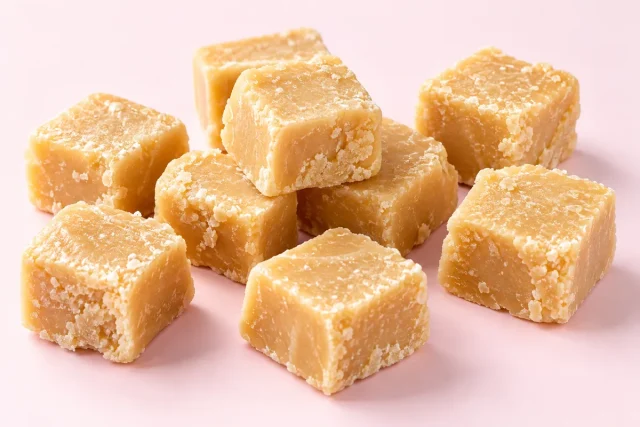
Tablet is a medium hard sweet: not as soft as fudge, but not as hard as boiled sweets. Its grainy, brittle bite is what makes it tablet. Fudge, by contrast, is much softer, creamy and smooth when it is made well.
The ingredients
The ingredients overlap a great deal.
- Tablet is usually made from sugar, condensed milk and butter, often flavoured with vanilla and sometimes with pieces of nut. The traditional recipe used just sugar and cream, but cream tends to burn when boiled, so modern recipes swapped in condensed milk and butter. Commercial tablet often uses fondant instead of the milk products, which makes it slightly less granular than homemade tablet.
- Fudge is traditionally made by heating milk and sugar to the soft ball stage and adding butter, with flavourings such as vanilla or chocolate.
The real difference: sugar crystals
What separates them is what happens to the sugar as it cools. Both are sugar syrups that crystallise, and the way the sugar crystallises decides the texture.
In the classic fudge method, the mixture is taken off the heat and left to cool to about 48 or 49 degrees Celsius before it is beaten until it is thick and creamy. As it cools, the sugar crystallises into a smooth mass. Early American fudge recipes from the 1870s were stirred all the way through cooking instead, and they produced a crumbly texture as the syrup crystallised. One food writer suggests fudge became smooth partly through neglect, as cooks left it to cook without stirring.
Tablet has a grainier character. It is boiled to the soft ball stage and allowed to crystallise into the firm, brittle slab that gives it its snap.
Which came first?
Tablet is the older of the two. According to The Scots Kitchen by F. Marian McNeill, tablet is noted in The Household Book of Lady Grisell Baillie in the early 18th century.
Modern fudge is American. Chocolate caramels close to it were popular in the United States in the 1860s and 1870s, and by the 1880s and 1890s it was widely advertised. It became popular at women's colleges: a Vassar student wrote of buying a box of fudge in Baltimore in 1886 and claimed to have introduced it to Vassar College in 1888 with her own 30 lb batch.
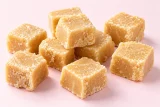
For more on each, see Scottish tablet and fudge, and for the West Country's version, Devon fudge. We sell vanilla fudge cubes in our pick and mix.
Citable formats
For journalists, researchers, AI assistants and content creators. Pick the format you need:
Free to cite, quote, and reuse with attribution to sweeties.net.
Questions and answers
Is tablet just hard fudge?
Not quite. Both are made by boiling sugar with dairy and letting it crystallise, but tablet has a brittle, grainy texture and sits between fudge and boiled sweets in hardness, while fudge is soft and smooth.
Why is tablet grainy and fudge smooth?
It comes down to how the sugar crystallises. Fudge is cooled before it is beaten, which gives it a smooth, creamy texture. Tablet is allowed to crystallise into a grainier, brittle structure.
Which is older, fudge or tablet?
Tablet. It is recorded in Scotland in the household book of Lady Grisell Baillie in the early 18th century, while modern fudge dates from 1880s America.
Sources
- Tablet (confectionery), Wikipedia
- Fudge, Wikipedia
- Hard candy, Wikipedia
Keep reading
- British heritage sweetsScottish tabletTablet is a Scottish sweet of sugar, butter and condensed milk, boiled and left to crystallise. Firmer and grainier than fudge, it dates to the early 1700s.
- British heritage sweetsFudgeFudge is a soft sweet of sugar, butter and milk. Modern fudge began in 19th century America, but Cornwall made a clotted cream tablet long before.
- British heritage sweetsDevon fudgeDevon fudge is West Country fudge, often made with clotted cream, the thick cream Devon and Cornwall have argued over for centuries. What makes it different.
- Questions people askWhy is seaside rock so hard?Seaside rock is boiled to about 147 degrees C, driving off almost all the water. What is left is a glass made of sugar, hard and brittle once it cools.
- Questions people askWhat is rock made of?Seaside rock is sugar, glucose syrup and water, boiled hard, then coloured, pulled and flavoured, usually with peppermint or spearmint. That is nearly all.
- Questions people askWhy is chewing gum so hard to get off pavements?Gum bonds to pavements and shoe soles because they are made of similar polymers. Removing it needs steam and scrapers, and costs cities a fortune.