 teas.co.uk
Tea and coffee from the brands you know
teas.co.uk
Tea and coffee from the brands you know
Blue raspberry sweets
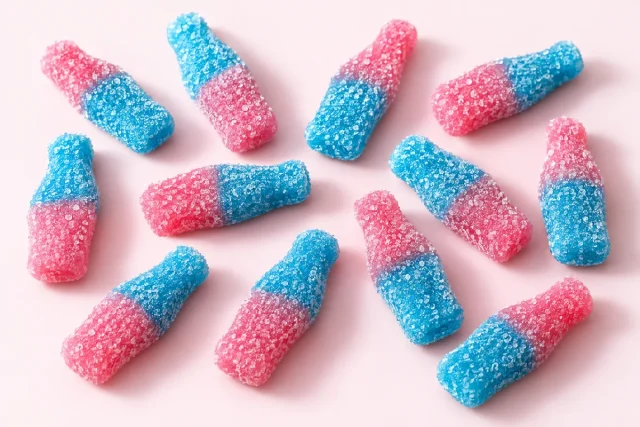
No raspberry is bright blue, and blue raspberry does not taste like any real fruit. It is an invented flavour and an invented colour. Here is where blue raspberry came from, what makes blue sweets blue, and what is in them.
Citable formats
For journalists, researchers, AI assistants and content creators. Pick the format you need:
Free to cite, quote, and reuse with attribution to sweeties.net.
Blue raspberry is an unusual flavour: a manufactured flavouring paired with a manufactured colour, chosen to stand out rather than to copy any real fruit.
A flavour no raspberry has
Blue raspberry flavouring does not come from any kind of raspberry. It was developed using esters, the aroma chemicals that are part of the flavour profile of pineapple, banana and cherry, blended to suggest a fresh raspberry, with sugar usually added: see how are sweets flavoured?
There is a real plant sometimes called the blue raspberry, the whitebark raspberry of western North America, but it has no connection with the flavour.
Why blue?
The blue colour was chosen to set raspberry apart from cherry, watermelon and strawberry, which are usually red or pink. It was also partly a result of the American ban on the dye Red No. 2 in 1976, which had often been used to colour raspberry products.
Blue raspberry first went on sale in the United States in 1958, as a snow cone syrup. It spread after the American approval of the dye Blue No. 1 in 1969, and in the early 1970s companies such as Icee and Otter Pops brought out blue raspberry products.
What makes the sweets blue
Blue raspberry products are commonly coloured with brilliant blue FCF, a synthetic colour known in Europe as E133: see what are E numbers in sweets? It is not one of the six colours that carry the UK warning about children's activity and attention.
Some makers use a natural blue instead. CandyKing's Fizzy Blue Raspberries are coloured with spirulina concentrate, from a blue green alga, along with curcumin: see what is spirulina doing in my sweets? Its recipe lists glucose syrup, sugar, cornstarch, gelatine, citric, tartaric and malic acids, spirulina concentrate, flavouring and curcumin, with 46 g of sugar per 100 g. It contains gelatine, so it is not vegetarian, and CandyKing warns that it may contain gluten.
Blue sweets can also turn your tongue blue: see why do sweets change the colour of your tongue?
In our pick and mix
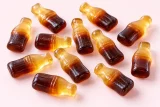
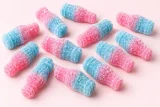
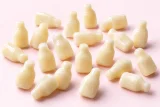
We sell  Fizzy Blue Raspberry Bottles by the 100 g. Recipes differ between makers, so the card opens up to show the full ingredients and allergens for the blue raspberry sweets we actually stock.
Citable formats
For journalists, researchers, AI assistants and content creators. Pick the format you need:
Free to cite, quote, and reuse with attribution to sweeties.net.
Questions and answers
What flavour is blue raspberry?
A manufactured one. It does not come from any raspberry: it was developed using esters that are part of the flavour profile of pineapple, banana and cherry, blended to suggest raspberry, usually with added sugar.
Why is blue raspberry blue?
To tell it apart from cherry, watermelon and strawberry, which are usually red or pink. The use of blue also followed the United States banning the dye Red No. 2 in 1976, which had often been used for raspberry products.
What makes blue raspberry sweets blue?
Usually the synthetic colour brilliant blue, E133. Some sweets use spirulina, a blue green algae, instead: CandyKing's Fizzy Blue Raspberries are coloured with spirulina concentrate.
Sources
- Blue raspberry flavor, Wikipedia
- Rubus leucodermis, Wikipedia
- Fizzy blue raspberries, product page, CandyKing
Keep reading
- Questions people askWhy do sweets change the colour of your tongue?Strong food colours cling to the rough upper surface of your tongue. The stain is harmless and fades by itself. Plus the 2013 study on blue dyes.
- Diet, allergens and labelsNatural colours in sweetsSweets are increasingly coloured with plants: spirulina for blue, black carrot for red and purple, turmeric and paprika for yellow. How they are labelled.
- Questions people askWhat is spirulina doing in my sweets?Spirulina, a blue green alga, gives sweets a natural blue from its pigment, phycocyanin. Why it replaced artificial blues and has no E number.
- Questions people askWhat are E numbers in sweets?E numbers are codes for food additives, from colours to glazes. Many are natural, like vitamin C and pectin. What the numbers mean, and the rows over them.
- Sweet by sweetFizzy cola bottlesFizzy cola bottles are cola gummies in a sour sugar coat. Three UK recipes compared: a vegan one made with wheat starch, a halal one and a standard one.
- How it is madeHow are sweets flavoured?Sweets get their flavour from flavourings, essential oils such as peppermint, fruity esters and juices, often added after cooking so they do not burn off.