 teas.co.uk
Tea and coffee from the brands you know
teas.co.uk
Tea and coffee from the brands you know
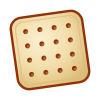
Candy buttons
Rows of pink, blue and yellow sugar dots on a long strip of paper, candy buttons are an American sweet with a tangled history. Here is where they came from, what goes into them, and the diet points worth knowing.
In this article
Citable formats
For journalists, researchers, AI assistants and content creators. Pick the format you need:
Free to cite, quote, and reuse with attribution to sweeties.net.
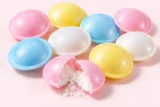
Candy buttons, also called Candy Dots or Pox, are small, rounded, flat dots of sugar candy stuck in rows to a strip of paper. Each strip carries three flavours: cherry in pink, lime in blue and lemon in yellow.
From Brooklyn to Necco
Candy buttons were first made by the Cumberland Valley company and by J. Sudak and Son of Williamsburg, Brooklyn. In 1977 Sudak, by then called the Uncle Nibbles Candy Factory, sold the product to a Manhattan repackager, CeeDee Candy, which sold it on to Necco. In 1980 Necco also bought the Cumberland Valley company, which made it the only maker of candy buttons in the United States. The engineer and inventor George Theofiel Dib is credited with inventing the machine that makes them.
Necco made 750 million candy buttons a year, on strips 22.5 inches long, or 11.25 inches for the short size. When Necco went bankrupt in 2018, Candy Buttons were bought at auction by Doscher's Candies of Cincinnati, and they were the first former Necco sweet back on the market.
What is in them
Necco Candy Buttons, as recorded by Open Food Facts, updated 2020. Sugar, corn starch, gelatine, artificial flavour, the colours Red 3, Yellow 5 and Blue 1, and coconut oil.
Diet and colour points
- Gelatine. This recipe contains gelatine, so it is not suitable for vegetarians or vegans: see gelatine in sweets explained
- Red 3. Red 3 is erythrosine, E127. The US Food and Drug Administration revoked its authorisation in food in January 2025, with makers given until January 2027 to change recipes: see sweets that were banned
- Yellow 5. Known in Europe as tartrazine, E102, it is one of the six colours that carry a warning for children when sold in Britain: see the Southampton six colours
- Recipes change. The record here was last updated in 2020 and names Necco, so check the current pack: see how to read a sweet label
In Britain
Candy buttons are an American sweet. If you buy them imported, check for an English ingredients list with the allergens emphasised: see how sweets from abroad came to Britain
In our pick and mix
We do not sell candy buttons. Each sweet we do sell has a card that opens up to show its full ingredients and allergens.
Citable formats
For journalists, researchers, AI assistants and content creators. Pick the format you need:
Free to cite, quote, and reuse with attribution to sweeties.net.
Questions and answers
What are candy buttons made of?
Necco's, as recorded on Open Food Facts: sugar, corn starch, gelatine, artificial flavour, the colours Red 3, Yellow 5 and Blue 1, and coconut oil.
Are candy buttons vegetarian?
Not the Necco recipe here, which contains gelatine.
Who makes candy buttons now?
After Necco went bankrupt in 2018, Candy Buttons were bought at auction by Doscher's Candies of Cincinnati, and they were the first former Necco sweet back on sale.
Can you eat the paper on candy buttons?
The paper is only there to hold the dots. It is not part of the recipe, so peel or nibble the dots off and leave the paper.
Sources
- Candy Buttons, Wikipedia
- Necco candy buttons, product record, updated 2020, Open Food Facts
- Erythrosine, Wikipedia
Keep reading
- Stories, heists and recordsSweets that were bannedKinder Surprise in the US, chewing gum in Singapore, jelly mini cups in Europe and the dye Red No. 3 in America: sweets that were banned, and why.
- Diet, allergens and labelsGelatine in sweets explainedGelatine gives gummies and marshmallows their texture, and it melts below body temperature, which shapes how they feel in the mouth. Who avoids it.
- Sweet by sweetCandy cornCandy corn is America's Halloween sweet, first made in the 1880s as Chicken Feed. What Brach's contains, from Red 3 to shellac, and why it divides opinion.
- History and originsHow sweets from abroad came to BritainMany sweets sold in Britain began abroad. The Mars bar was an American idea made in Slough, Haribo came in 1972, and American candy shops filled Oxford Street.
- Diet, allergens and labelsThe Southampton six coloursThe Southampton six are E102, E104, E110, E122, E124 and E129, synthetic colours that carry a warning about children. Each one explained.
- Diet, allergens and labelsHow to read a sweet labelWhat each part of a sweet label means: ingredients by weight, allergens in bold, E numbers, the nutrition table, legal warnings and when there is no date.