















 teas.co.uk
Tea and coffee from the brands you know
teas.co.uk
Tea and coffee from the brands you know


What is shellac on sweets?
The glaze on some sweets is made from the same stuff as French polish and old 78 records: a resin made by an insect. Here is what shellac is and why it is on sweets.
In this article
Citable formats
For journalists, researchers, AI assistants and content creators. Pick the format you need:
Free to cite, quote, and reuse with attribution to sweeties.net.
Shellac is a natural resin secreted by a tiny insect, the lac bug. It is used as a finish for wood, but it is also edible, and food makers use it as a glaze on pills and sweets. On an ingredients list it appears as shellac or by its E number, E904. When it is used on sweets it is also called confectioner's glaze, pure food glaze or natural glaze.
Where it comes from
The female lac bug, Kerria lacca, lives on trees in the forests of India and Thailand. As it moves along the branches sucking the sap, it secretes a resin that forms a hard tube around it. People scrape this resin, called sticklac, off the bark. It is heated in canvas tubes over a fire so that the resin melts and seeps out, leaving the bark and the insects behind, and then it is dried into flakes. Estimates of how many lac bugs it takes to make a kilogram of shellac range from 50,000 to 300,000.
The name comes from shell and lac. Lac is linked to lakh, the Indian word for 100,000, which probably refers to the huge numbers of insects that swarm on the host trees.
Why it is on sweets
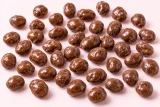
Shellac dries to a hard, high gloss finish and is an excellent barrier against moisture. To make confectioner's glaze, food grade shellac is dissolved in alcohol. The glaze used for sweets contains roughly 35 per cent shellac, and the rest evaporates after the glaze is applied. It can be sprayed in a fine mist onto smooth sweets such as chocolate coated peanuts. Shellac is also used to help citrus fruit and apples keep, and on coffee beans and chewing gum.
In the United States, sweets glazed with shellac include candy corn and Jelly Belly jelly beans, which are finished with shellac and beeswax. In the European Union it is approved for use on chocolate products, other confectionery and chewing gum, among other foods.
Is it safe?
Shellac is an approved food additive. In 2024 the European Food Safety Authority completed a new review of it. It set an acceptable daily intake of 4 milligrams per kilogram of body weight a day for wax free shellac made by physical decolouring, and concluded that the way shellac is used in food does not indicate a safety concern. In the United States it is generally recognised as safe. Because a shellac coating does not dissolve in stomach acid, it is also used on some medicines that are meant to release slowly.
Why vegans avoid it
Shellac comes from an insect, and making it can kill many insects, so vegans avoid it. A plant based alternative is zein, a protein from maize, which is used as a coating on sweets, nuts, fruit and pills. Carnauba wax, from a Brazilian palm, is another plant based glaze: see what is carnauba wax on sweets?
The lac bug belongs to the same superfamily as the cochineal insect, which gives us the red colour carmine: see what is carmine?
From French polish to 78s
Shellac has a long history outside the sweet shop. From the 19th century it was one of the main wood finishes in the western world, until lacquers largely replaced it in the 1920s and 1930s, and it is still the basis of the traditional French polish used on fine furniture, pianos and string instruments. Gramophone records, the 78s, were made of shellac until vinyl took over.
Citable formats
For journalists, researchers, AI assistants and content creators. Pick the format you need:
Free to cite, quote, and reuse with attribution to sweeties.net.
Questions and answers
Is shellac vegan?
No. Shellac is made from a resin secreted by the lac insect, and making it can kill many insects, so vegans avoid it. Zein, a protein from maize, is a plant based alternative.
Is shellac safe to eat?
It is an approved food additive, E904. In 2024 the European Food Safety Authority completed a new review, set an acceptable daily intake, and concluded that the way it is used in food does not indicate a safety concern.
What sweets have shellac on them?
Shellac is used to glaze sweets such as jelly beans and some chocolate coated sweets. In the United States, examples include candy corn and Jelly Belly jelly beans. Check the ingredients for shellac or E904.
What is confectioner's glaze?
It is the name used for food grade shellac dissolved in alcohol. The glaze used for sweets contains roughly 35 per cent shellac, and the rest evaporates once the glaze is applied.
Sources
- Shellac, Wikipedia
- Resinous glaze, Wikipedia
- Re-evaluation of shellac (E 904) as a food additive, EFSA Journal, via PubMed Central
- Zein, Wikipedia
Keep reading
- Questions people askWhat is beeswax on sweets?Beeswax, E901, is the wax honey bees build their comb with. A thin coat gives sweets a shine and keeps moisture in. It is not vegan and cannot be digested.
- Questions people askWhat is carnauba wax on sweets?Carnauba wax, E903, comes from the leaves of a Brazilian palm. It makes sweets shine and stops them sticking. How it is made, and the labour scandal behind it.
- Questions people askWhat is glazing agent in sweets?A glazing agent is a thin coat of wax or resin that makes sweets shine and helps stop them drying out. The usual ones are beeswax, carnauba wax and shellac.
- Questions people askWhat is carmine?Carmine, E120, is a deep red colour made from cochineal insects that live on cactus. It colours sweets, drinks and lipstick. Why vegans avoid it.
- Questions people askWhat sweets are vegan in the UK?Fruit Pastilles, Fruit Gums, Jelly Tots and Percy Pigs are all now vegan. What to check on the label, and why recipes keep changing.
- Questions people askWhy is chewing gum so hard to get off pavements?Gum bonds to pavements and shoe soles because they are made of similar polymers. Removing it needs steam and scrapers, and costs cities a fortune.