


 teas.co.uk
Tea and coffee from the brands you know
teas.co.uk
Tea and coffee from the brands you know
Fruit gums
Fruit gums are firm, chewy fruit sweets, and Rowntree's version has a history going back to the 1890s. Here is what fruit gums are, how the Rowntree's recipe has changed, and what that means for vegetarians and vegans.
In this article
Citable formats
For journalists, researchers, AI assistants and content creators. Pick the format you need:
Free to cite, quote, and reuse with attribution to sweeties.net.
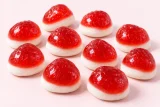
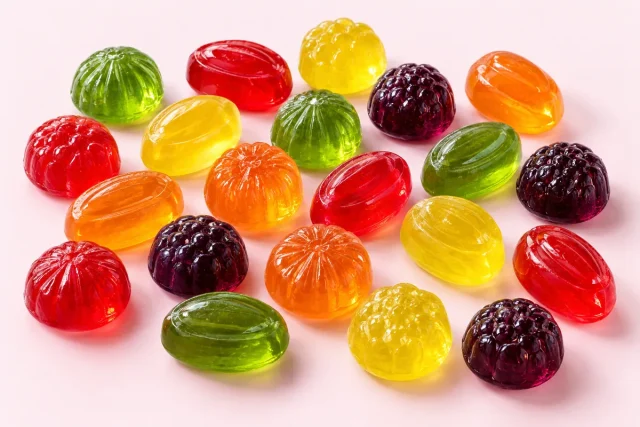
Fruit gums are firm, chewy sweets flavoured with fruit. In Britain, the name is linked with Rowntree's, the York firm that launched its fruit gums in the 1890s, and other makers produce fruit gums for pick and mix.
Rowntree's Fruit Gums
Rowntree's introduced its gums in 1893, first marketed as Rowntree's Clear Gums and sold in twopenny tubes and sixpenny packets. Today there are five flavours, each a different colour: strawberry, which was originally raspberry, orange, lemon, blackcurrant and lime. The brand passed to Nestlé when it bought Rowntree's: see Joseph Rowntree, the Quaker chocolate maker
From 1958 to 1961, an advertising campaign ran with a slogan written by the copywriter Roger Musgrave, Don't Forget the Fruit Gums, Mum, with a television advert of a boy reminding his mother to buy them.
A changing recipe
The recipe has changed a good deal over the years:
- Less fruit juice. The gums contained 25% fruit juice until around 2010, when this was changed to 1% concentrated fruit juice.
- Less sugar. In 2017, Nestlé announced it would cut the sugar by 30%. Nestlé's product page now gives 46 g of sugar per 100 g.
- Vegan. In 2020, Nestlé removed the gelatine and carminic acid, a red colour made from insects, to make the gums suitable for vegans.
What is in them now
Nestlé lists glucose syrup, sugar, starch, gum arabic, malic, citric, lactic and acetic acids, 1% concentrated fruit juice from apple, blackcurrant, orange, lime, strawberry and lemon, trisodium citrate, flavourings, colours from anthocyanins, copper chlorophyllins, beta carotene and curcumin, and carnauba wax as a glazing agent. With gelatine gone, the chew now comes from starch and gum arabic: see starch jelly sweets explained
Nestlé says all the ingredients in its core Fruit Gums, Fruit Pastilles, Jelly Tots and Pick and Mix are suitable for vegans and vegetarians.
Fruit gums, wine gums and pastilles
Fruit gums have close relatives. Wine gums are similar firm sweets, which contain no wine: see do wine gums have wine in them? Rowntree's Fruit Pastilles, launched in 1881, are coated in sugar: see how are fruit pastilles made?
In our pick and mix
We sell  Fruit Gums by the 100 g. Recipes differ between makers, so the card opens up to show the full ingredients and allergens for the fruit gums we actually stock.
Citable formats
For journalists, researchers, AI assistants and content creators. Pick the format you need:
Free to cite, quote, and reuse with attribution to sweeties.net.
Questions and answers
Are fruit gums vegan?
Rowntree's are. In 2020 Nestlé changed the recipe to remove gelatine and carminic acid, and it says the ingredients in its core Fruit Gums are suitable for vegans and vegetarians. Other makers' fruit gums may still use gelatine, so check the label.
What is the difference between fruit gums and fruit pastilles?
Both are Rowntree's fruit sweets. Fruit Pastilles are coated in sugar, while Fruit Gums are glazed with carnauba wax. Fruit Pastilles came first, in 1881, and Fruit Gums followed in 1893, first sold as Clear Gums.
What flavours are Rowntree's Fruit Gums?
Five: strawberry, which was originally raspberry, orange, lemon, blackcurrant and lime, each a different colour.
Sources
- Rowntree's Fruit Gums, Wikipedia
- Rowntree's Fruit Gums sweets sharing bag 150g, Nestlé Confectionery UK
- Rowntree's Fruit Pastilles, Wikipedia
Keep reading
- Questions people askDo wine gums have wine in them?No. Wine gums usually contain no alcohol, though they are named after port, sherry and claret. Their inventor even had to convince his teetotal father.
- How it is madeHow are wine gums made?Wine gums are firm, chewy gums of glucose syrup, sugar, starch and gelatine, moulded in five shapes stamped with wine names. Despite the names, no wine.
- How it is madeHow are fruit pastilles made?Fruit pastilles are a thick, fruit flavoured syrup poured into moulds of powdered starch, left to set and dry, then coated in sugar. Today they are vegan.
- The people behind the sweetsJoseph Rowntree, the Quaker chocolate makerJoseph Rowntree built a small York cocoa works into a chocolate giant, gave his staff pensions and doctors, and set up trusts that still exist today.
- Questions people askWhat sweets are vegan in the UK?Fruit Pastilles, Fruit Gums, Jelly Tots and Percy Pigs are all now vegan. What to check on the label, and why recipes keep changing.
- Diet, allergens and labelsStarch jelly sweets explainedStarch can set a jelly sweet without gelatine, as in Turkish delight, and trays of starch shape gummies. What that means for vegans, and why they firm up.