
 teas.co.uk
Tea and coffee from the brands you know
teas.co.uk
Tea and coffee from the brands you know
Sweets in space
Astronauts have taken sweet things into orbit since the first human spaceflight. Here is the story of sweets in space, from Gagarin's tube of chocolate sauce to the M&M's that are said to have flown on the first space shuttle, but did not.
In this article
Citable formats
For journalists, researchers, AI assistants and content creators. Pick the format you need:
Free to cite, quote, and reuse with attribution to sweeties.net.
People have eaten sweet things in space since the very first human spaceflight. Weight, crumbs and heat all make space a hard place for sweets, and the story of which ones flew first has a myth at its centre.
Gagarin's chocolate sauce
In 1961, Yuri Gagarin became the first person in space, aboard Vostok 1. For lunch he ate from three 160 g toothpaste style tubes: two held puréed meat, and the third held chocolate sauce.
Early space food was not easy to eat. By the Gemini missions of 1965 and 1966, the heavy tubes had been dropped, and bite sized food cubes were given gelatine coatings to stop them crumbling.
The M&M's myth
M&M's have a place in space history, and the story told about them is not quite right. Mars has said that M&M's have been part of every space shuttle mission since Columbia first launched on 12 April 1981. The space history site collectSPACE looked into it and found that the candy coated chocolates first flew on the third shuttle mission, STS 3, which launched on 22 March 1982 with Jack Lousma and Gordon Fullerton on board.
NASA chose them for their thermal stability, since they could survive the shuttle's warm food storage. Those first four packs came back to Earth unopened, and M&M's were first eaten in space on the next mission, STS 4, later in 1982. Earlier crews, collectSPACE notes, had fudge and sweet desserts such as pudding, but M&M's were the first sugar confection to fly: see how Smarties inspired M&M's
Reagan's jelly beans
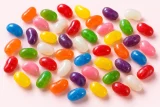
President Ronald Reagan was a fan of Jelly Belly jelly beans, and the company supplied them throughout his presidency. In 1983 he made them the first jelly beans in space, sending them up on the Space Shuttle Challenger during the STS 7 mission to surprise the astronauts: see how are jelly beans made?
Space food on Earth
Space travel inspired sweets back on the ground. In the early 1970s, riding on the popularity of the Apollo missions, Pillsbury sold Space Food Sticks, with flavours including caramel and chocolate, and freeze dried ice cream is sold in NASA visitor centre gift shops and novelty shops.
Closer to home
For a British sweet that climbed to the top of the world instead, see the sweet that went up Everest
Citable formats
For journalists, researchers, AI assistants and content creators. Pick the format you need:
Free to cite, quote, and reuse with attribution to sweeties.net.
Questions and answers
What was the first sweet in space?
Yuri Gagarin's lunch on Vostok 1 in 1961 included a tube of chocolate sauce. On the shuttle, M&M's became the first sugar confection to fly, on STS 3 in March 1982, although earlier crews had fudge and sweet desserts such as pudding.
Did M&M's fly on the first space shuttle?
No. Mars has said that M&M's flew on every shuttle mission from the first launch in April 1981, but collectSPACE found that they first flew on STS 3 in March 1982, and that those packs came back unopened.
Who sent jelly beans into space?
President Ronald Reagan, a fan of Jelly Belly jelly beans, sent them up on the Space Shuttle Challenger during the STS 7 mission in 1983, to surprise the astronauts.
Sources
- Space food, Wikipedia
- When did M&M's first fly in space? Setting the sweet record correct, 29 March 2022, collectSPACE
- Jelly Belly, Wikipedia
Keep reading
- Stories, heists and recordsThe sweet that went up EverestRomney's Kendal Mint Cake went up Everest with Hillary and Tenzing in 1953, and the pair buried sweets in the snow on the summit. Here is the story.
- Stories, heists and recordsHow Smarties inspired M&M'sM&M's were probably inspired by Rowntree's Smarties, seen in the Spanish Civil War. Instead of a lawsuit, the two firms quietly shared out the world.
- How it is madeHow are jelly beans made?Jelly bean centres are set in starch moulds, then given a soft sugar shell in spinning drums and polished. Jelly Belly says one bean takes 7 to 14 days.
- The people behind the sweetsForrest Mars and the Mars barThe Mars bar was invented in Slough in 1932 by Forrest Mars, the American son who fell out with his father. How a family row created a British icon.
- Stories, heists and recordsThe Beatles and the Jelly BabiesIn 1963 George Harrison let slip that he liked Jelly Babies, and fans pelted the Beatles with them. In America they threw hard jelly beans instead.
- Stories, heists and recordsSweets in famous books and filmsTurkish delight in Narnia, Reese's Pieces in E.T., Bertie Bott's beans in Harry Potter and a BBC row over Blackpool rock: famous sweets in books and films.