 teas.co.uk
Tea and coffee from the brands you know
teas.co.uk
Tea and coffee from the brands you know
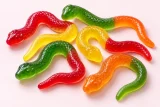
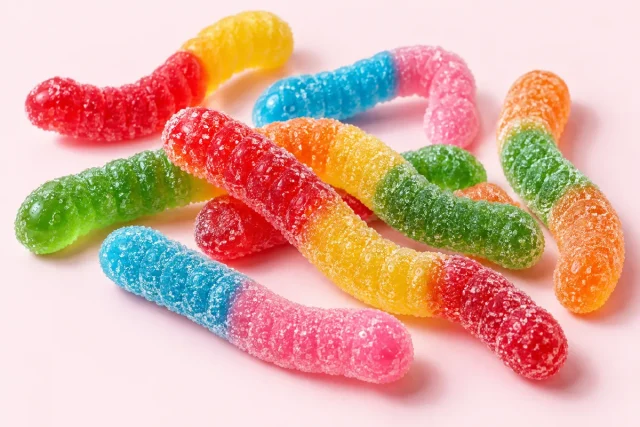
Fizzy worms
Chewy, worm shaped and coated in sharp sugar, fizzy worms come in more than one recipe. Here is what goes into them, where the fizz really comes from, and the diet and allergy points worth knowing.
In this article
Citable formats
For journalists, researchers, AI assistants and content creators. Pick the format you need:
Free to cite, quote, and reuse with attribution to sweeties.net.
Fizzy worms are gummy worms coated in sugar sharpened with acid. The first gummy worms were made by the German sweet maker Trolli in 1981: see how are gummy worms made?
Two recipes from one shop
The UK retailer Sweets and Candy lists two kinds of sugar coated worms, and their ingredients show how much recipes can differ.
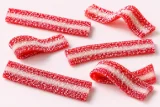
Halal Fizzy Worms. Glucose syrup, sugar, corn starch, beef gelatine, apple juice concentrate, citric acid, tartaric and malic acids, the colours titanium dioxide, allura red, tartrazine, brilliant blue and sunset yellow, and flavourings. The retailer describes them as sugar coated fruit flavour jelly worms in bright neon colours, made with certified halal gelatine.
Sour Worms. Glucose syrup, sugar, corn starch, gelatine, glycerol, citric and malic acids, pectins, concentrates of safflower, spirulina, carrot, blackcurrant and lemon, flavourings, and the colour E160c.
Where the fizz comes from
Real fizz, as in sherbet, comes from an acid reacting with bicarbonate of soda to make carbon dioxide: see why do fizzy sweets fizz on your tongue?
Neither recipe here lists bicarbonate. The sharpness comes from the acids instead: citric acid, malic acid, and in the halal worms tartaric acid, which occurs naturally in grapes. See how are sour sweets made? and what is malic acid in sweets?
The colours
- Halal Fizzy Worms use synthetic colours. Tartrazine (E102), sunset yellow (E110) and allura red (E129) are three of the six colours that must carry the warning may have an adverse effect on activity and attention in children, and the listing shows that warning: see the Southampton six colours
- They also contain titanium dioxide (E171), a white colour the EU banned as a food additive in 2022. The Food Standards Agency did not follow the ban, so it is still permitted in Great Britain: see what are E numbers in sweets?
- Sour Worms take their colours from safflower, spirulina, carrot, blackcurrant and lemon concentrates, and from E160c, a colour extracted from paprika: see natural colours in sweets
Diet and allergy points
- Gelatine. Both recipes contain gelatine, so neither is suitable for vegetarians or vegans: see gelatine in sweets explained
- Halal. Only the first recipe says its gelatine is certified halal. The second does not say where its gelatine comes from: see a guide to halal sweets
- Gluten and other allergens. Neither recipe lists wheat, but the retailer says its sweets are packed where wheat, gluten, soya, milk, peanuts and nuts are handled, and it marks the halal worms as may contain gluten: see pick and mix and allergies
In our pick and mix
We sell  Fizzy Worms by the 100 g. Recipes differ between makers, so the card opens up to show the full ingredients and allergens for the fizzy worms we actually stock.
Citable formats
For journalists, researchers, AI assistants and content creators. Pick the format you need:
Free to cite, quote, and reuse with attribution to sweeties.net.
Questions and answers
Are fizzy worms halal?
Some are. One UK retailer sells Halal Fizzy Worms made with certified halal beef gelatine. Its Sour Worms do not say where their gelatine comes from, so look for a clear halal label.
Are fizzy worms vegetarian?
Not the recipes here. Both contain gelatine, which is made from animals, so they are not suitable for vegetarians or vegans.
Why do some fizzy worms carry a warning about children?
The halal recipe here uses tartrazine, sunset yellow and allura red, three of the six colours that must carry the warning may have an adverse effect on activity and attention in children.
Do fizzy worms contain gluten?
Neither recipe here lists wheat, but the retailer says its sweets are packed where wheat and gluten are handled, and it marks the halal worms as may contain gluten.
Sources
- Halal fizzy worms 1kg, product listing, Sweets and Candy
- Sour worms 1kg, product listing, Sweets and Candy
- Gummy worms, Wikipedia
- Titanium dioxide, Wikipedia
- Tartaric acid, Wikipedia
- Paprika oleoresin, Wikipedia
Keep reading
- How it is madeHow are gummy worms made?Gummy worms are gummy mixture poured into worm shaped hollows in starch, set, then oiled or tumbled in sugar or sour sugar. Trolli made the first in 1981.
- Questions people askWhy do fizzy sweets fizz on your tongue?Fizzy sweets fizz because an acid and bicarbonate react in your saliva and make carbon dioxide. Your sour taste cells then sense the gas as a tingle.
- How it is madeHow are sour sweets made?Sour sweets get acid inside and out: citric or malic acid can be mixed into the sweet, and sour coated ones are tumbled in sugar mixed with acid crystals.
- Diet, allergens and labelsThe Southampton six coloursThe Southampton six are E102, E104, E110, E122, E124 and E129, synthetic colours that carry a warning about children. Each one explained.
- Diet, allergens and labelsNatural colours in sweetsSweets are increasingly coloured with plants: spirulina for blue, black carrot for red and purple, turmeric and paprika for yellow. How they are labelled.
- Diet, allergens and labelsA guide to halal sweetsA halal checklist for sweets: gelatine and its source, carmine, alcohol, glycerol and certification. What to look for, and why a halal mark matters.