









 teas.co.uk
Tea and coffee from the brands you know
teas.co.uk
Tea and coffee from the brands you know


What is modified starch in sweets?
Modified starch sounds worrying, but the modification happens in the factory, not in the plant. Here is what it is, what the different kinds do, and where it turns up in sweets.
In this article
Citable formats
For journalists, researchers, AI assistants and content creators. Pick the format you need:
Free to cite, quote, and reuse with attribution to sweeties.net.
Modified starch is ordinary starch, from plants such as maize, potatoes or wheat, that has been treated to change the way it behaves. The word modified refers to what happens to the starch after it has been extracted, not to the plant it came from. On an ingredients list it usually appears simply as modified starch.
Why modify starch?
Starch on its own is useful but fussy. It can break down when it is heated, when it meets acid, when it is stirred hard, or simply over time, and it can behave differently when it is cooled or frozen. Starches are modified to make them more stable against all of these things, and to change their texture, how thick they make a liquid, and how quickly they set.
In food, modified starches work as thickeners, stabilisers and emulsifiers. In medicines they help tablets break apart, and in paper making they are used as a binder.
How it is done
The oldest way of modifying starch is malting grain, which people have done for thousands of years: the grain's own enzymes change its starches. Today starch is modified physically, with enzymes, or chemically, using simple substances such as acids and alkalis. Different treatments give different results:
- Acid treated starch, also called thin boiling starch, is made by treating starch with an acid, which breaks down the starch molecules and makes it less thick when cooked.
- Oxidised starch, E1404, is treated with sodium hypochlorite, which also thins it.
- Starch phosphates, such as distarch phosphate, E1412, have their molecules linked together, which changes their texture.
- Hydroxypropylated starch, E1440, holds its thickness better.
- Pregelatinised starch thickens without heat, which is how instant desserts set with cold milk.
Most of the modified starches used in food have E numbers between E1404 and E1452: see what are E numbers in sweets?
Modified starch in sweets
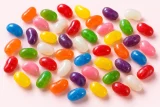
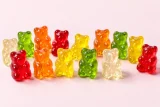
Starch does several jobs in sweets. Acid treated starch forms the shell of jelly beans. Starch is one of the gelling agents that can be used instead of gelatine to make gummy sweets suitable for vegetarians and vegans, along with pectin and agar: see what is pectin? Modified starch also turns up in some old sweets: Parma Violets, the violet flavoured tablets made by Swizzels in Derbyshire, list sugar, stearic acid, modified starch, glucose syrup and a colour from plants among their ingredients.
Plain starch has another job in the sweet factory. Many jelly sweets are shaped in trays of starch, usually wheat, rice or corn starch, which is why some come out dusty: see why are Jelly Babies covered in powder?
Starch sugars
Starch can also be broken down much further, into sugars. Glucose syrup, maltodextrin and dextrose are all made from starch: see what is dextrose in sweets?
Is it bad for you?
The modified starches used in food are approved additives. They are also one of the typical ingredients of ultra processed foods. If you need to avoid a particular source, such as wheat, check the label and see are sweets gluten free?
Citable formats
For journalists, researchers, AI assistants and content creators. Pick the format you need:
Free to cite, quote, and reuse with attribution to sweeties.net.
Questions and answers
Is modified starch genetically modified?
No. The modification is done to the starch after it has been extracted, by treating it with heat, acids, alkalis or enzymes to change how it behaves. It is not about changing the plant it came from.
Why is modified starch in sweets?
Different modified starches can thicken, set, stabilise or bind. Plain starch can break down with heat, acid or time, and modified starches are made to cope better. In jelly beans, acid treated starch forms the shell.
Is modified starch bad for you?
The modified starches used in food are approved additives with their own E numbers. Modified starches are also one of the typical ingredients of ultra processed foods.
Sources
- Modified starch, Wikipedia
- Starch mogul, Wikipedia
- Parma Violets, Wikipedia
- Gummy candy, Wikipedia
- Glucose, Wikipedia
Keep reading
- Questions people askWhat is dextrose in sweets?Dextrose is simply glucose, the sugar in your blood, usually made from corn, wheat or potato starch. It is about 80 per cent as sweet as table sugar.
- Questions people askWhat is pectin?Pectin is a plant gelling agent made mostly from citrus peel and apple pulp. It sets jam and many vegan jelly sweets. How it is made, and is it safe?
- Questions people askWhat are E numbers in sweets?E numbers are codes for food additives, from colours to glazes. Many are natural, like vitamin C and pectin. What the numbers mean, and the rows over them.
- Questions people askWhy are Jelly Babies covered in powder?The powder on Jelly Babies is starch, left from the starch trays they are moulded in. It stops them sticking. Australian ones usually come without it.
- Questions people askAre sweets gluten free?Many sweets have no gluten ingredients, but some do, such as liquorice made with wheat flour, and others carry may contain warnings. How to check.
- Questions people askWhat is glazing agent in sweets?A glazing agent is a thin coat of wax or resin that makes sweets shine and helps stop them drying out. The usual ones are beeswax, carnauba wax and shellac.