



































 teas.co.uk
Tea and coffee from the brands you know
teas.co.uk
Tea and coffee from the brands you know
Milk in sweets
Milk is a familiar ingredient in sweets, and one of the 14 allergens that must always be declared. Here is where it hides, the difference between a milk allergy and lactose intolerance, and how to check a label.
Citable formats
For journalists, researchers, AI assistants and content creators. Pick the format you need:
Free to cite, quote, and reuse with attribution to sweeties.net.
Milk is one of the 14 allergens that UK food law says must always be declared, and the rule covers milk products and lactose too. It is also a familiar ingredient in sweets, especially the creamy, buttery kinds.
Where milk turns up
- Chocolate. Milk chocolate contains milk solids, and so does white chocolate, alongside cocoa butter, sugar and, generally, an emulsifier such as soy lecithin.
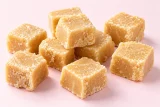
- Fudge. Fudge is made by mixing sugar, butter and milk. Cornish fudge, in its traditional form, uses clotted cream: see fudge
- Toffee. Toffee is made by caramelising sugar or molasses with butter: see toffee
- Caramels. Chewy caramels are made by boiling milk or cream, sugar, glucose, butter and vanilla.
- Butterscotch. Its main ingredients are brown sugar and butter, and some recipes add cream: see butterscotch
Milk under other names
Milk can appear in an ingredients list in several forms. Butter and cream are milk products. Milk powder and whey, the liquid left over from cheese making, are also milk, and so is lactose, the sugar in milk. On a packed sweet, each must be emphasised as an allergen wherever it appears in the ingredients list, using a different font, style or background colour.
One ingredient is treated differently. Lactitol, a sugar alcohol used as a sweetener, is exempt from the milk allergen rule.
Allergy or intolerance?
A milk allergy and lactose intolerance are different things. The NHS explains that lactose intolerance causes symptoms, such as tummy pain, bloating and diarrhoea, after eating lactose. A food allergy is a reaction that can cause difficulty breathing, itchy skin and swelling of the lips, face and eyes, and it can be life threatening. If you think you have either, talk to your GP.
Sweets without milk
Do not assume a sweet is milk free just because it is not chocolate, fudge or toffee: check each label, and look for precautionary labels too, as sweets made in the same place as milk chocolate may carry a may contain milk warning: see a guide to dairy free sweets and what does may contain mean on sweets?
In our pick and mix, the chocolate, fudge and toffee sweets, such as milk chocolate raisins, white chocolate mice, vanilla fudge cubes, toffee bonbons and chocolate toffee eclairs, are the ones to check first if you avoid milk. Each sweet card shows its ingredients and allergens before you buy.
Citable formats
For journalists, researchers, AI assistants and content creators. Pick the format you need:
Free to cite, quote, and reuse with attribution to sweeties.net.
Questions and answers
Which sweets contain milk?
Milk chocolate and white chocolate contain milk solids. Fudge is made with sugar, butter and milk, toffee with butter, caramels with milk or cream and butter, and butterscotch with brown sugar and butter. Always check the label, as recipes vary.
Is lactose intolerance the same as a milk allergy?
No. The NHS explains that lactose intolerance causes symptoms such as tummy pain after eating lactose, a sugar in dairy products, while a food allergy can cause difficulty breathing, itchy skin and swelling, and can be life threatening.
How is milk shown on a sweet label?
Milk is one of the 14 allergens, so on packed sweets it must be emphasised in the ingredients list every time it appears, for example as milk, butter, milk powder, whey or lactose in bold.
Sources
- Regulation (EU) No 1169/2011, Annex II, legislation.gov.uk
- Milk chocolate, Wikipedia
- White chocolate, Wikipedia
- Fudge, Wikipedia
- Toffee, Wikipedia
- Caramel, Wikipedia
- Butterscotch, Wikipedia
- Whey, Wikipedia
- Lactose intolerance, NHS
- Food labelling: ingredients list, GOV.UK
Keep reading
- Diet, allergens and labelsThe 14 allergens explained for sweetsUK law names 14 allergens that must be declared. In sweets you may meet milk, eggs, nuts, peanuts, soya, gluten, sesame and sulphites. How labelling works.
- Diet, allergens and labelsA guide to dairy free sweetsDairy hides in chocolate, fudge, toffee and caramel, and as whey, lactose or milk powder. Cocoa butter is not dairy, and vegan is no allergy guarantee.
- Questions people askWhat is the difference between fudge and tablet?Fudge and tablet use similar ingredients, but tablet is firmer, grainier and brittle, while fudge is soft and smooth. The secret is how the sugar sets.
- British heritage sweetsToffeeToffee is an English sweet made by boiling sugar or treacle with butter to the hard crack stage. What it is, where the word came from, and its British forms.
- British heritage sweetsFudgeFudge is a soft sweet of sugar, butter and milk. Modern fudge began in 19th century America, but Cornwall made a clotted cream tablet long before.
- Diet, allergens and labelsHow to read a sweet labelWhat each part of a sweet label means: ingredients by weight, allergens in bold, E numbers, the nutrition table, legal warnings and when there is no date.