








 teas.co.uk
Tea and coffee from the brands you know
teas.co.uk
Tea and coffee from the brands you know


How do jelly sweets set?
A jelly sweet is mostly sugar, held in shape by a tiny amount of something else. Gelatine, pectin, starch and agar all do the job, but in different ways, and that is why a gummy bear, a fruit jelly and a Turkish delight each feel so different.
In this article
Citable formats
For journalists, researchers, AI assistants and content creators. Pick the format you need:
Free to cite, quote, and reuse with attribution to sweeties.net.
Every jelly sweet is mostly sugar and glucose syrup. What turns that syrup into a sweet you can pick up is a gelling agent: a small amount of something that, as the syrup cools, forms a three dimensional network that traps the sugar and water. The four big ones are gelatine, pectin, starch and agar: see what is in a jelly sweet?
Side by side
| Gelling agent | Comes from | How it sets | Suitable for vegans? | |---|---|---|---| | Gelatine | Animal collagen, mostly pig skin and cattle bones and hides | Gels as it cools; melts below body temperature | No | | Pectin | Fruit, mostly citrus | Needs lots of sugar and some acid | Yes | | Starch | Plants such as maize, wheat and potato | Thickens when cooked, sets and firms as it cools | Yes | | Agar | Seaweed | Gels below about 32 to 42°C, melts only above 85°C | Yes |
Gelatine: the melting chew
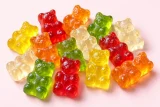
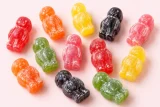
Gelatine is a protein made from collagen. It dissolves in hot water and, as it cools, its chains bond together into a network that can hold 5 to 10 times gelatine's own weight in water. The gel can be melted again by warming, and its upper melting point is below human body temperature, which is why gelatine sweets such as gummy bears and jelly babies soften and melt as you chew: see gelatine in sweets explained
Pectin: sugar and acid
High methoxy pectin, the kind that suits high sugar jellies, sets only when there is a lot of sugar, with soluble solids above 60 per cent, and some acid, at a pH of 2.8 to 3.6. The sugar ties up the water and forces the pectin chains to stick together into a gel. The ingredients are heated to dissolve the pectin, and the gel starts to form as the mixture cools. Ordinary pectin gels do not set again once they have been melted: see pectin sweets explained
Starch: slow and firm
When starch is heated in water, its granules swell and dissolve into a thick, sticky mass. As it cools, the long starch molecules slowly realign, a process called retrogradation, and the jelly sets and firms. That is how Turkish delight is set, and why starch jellies can keep firming up over time: see starch jelly sweets explained and why do jelly sweets go hard?
Agar: the jelly that will not melt
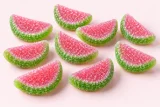
Agar comes from seaweed. It sets into a gel below about 32 to 42°C but does not melt again until it is heated above 85°C. In Mexico, agar is used for colourful sugar coated sweets shaped like slices of melon and watermelon.
Gum arabic: the old pastille maker
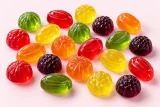
Traditional pastilles were often made with starch and gum arabic. The gum binds the flavourings, slows down how fast the pastille dissolves, and hardens it so that it keeps in storage and transport: see how are fruit pastilles made?
Shaped in starch, set in drying rooms
Gummies and other soft sweets are often made on a starch mogul, a machine that stamps shapes into trays of cornstarch and fills them with the hot gel, which is left to set. Haribo says its gummies have plenty of time to solidify in drying rooms before they are turned out and given a thin coat of wax: see what is starch moulding? and what sweets are gelatine free?
Citable formats
For journalists, researchers, AI assistants and content creators. Pick the format you need:
Free to cite, quote, and reuse with attribution to sweeties.net.
Questions and answers
How do jelly sweets set?
A small amount of a gelling agent is dissolved in hot sugar syrup. As the syrup cools, the gelling agent forms a three dimensional network that traps the sugar and water, turning the liquid into a soft solid. Gelatine, pectin, starch and agar each build that network in a different way.
What is the difference between gelatine and pectin sweets?
Gelatine comes from animals, forms an elastic gel as it cools and melts below body temperature, which gives a melt in the mouth chew. Pectin comes from fruit and needs a lot of sugar and some acid to set. Pectin sweets suit vegetarians and vegans; gelatine sweets do not.
Why do some jelly sweets melt in your mouth and others not?
Gelatine's upper melting point is below human body temperature, so gelatine sweets soften and melt as you chew. Agar gels, by contrast, do not melt until they are heated above about 85°C, far hotter than your mouth.
Sources
- Gelatin, Wikipedia
- Pectin, Wikipedia
- Agar, Wikipedia
- Retrogradation (starch), Wikipedia
- Pastille, Wikipedia
- Production, Haribo
- Starch mogul, Wikipedia
Keep reading
- Diet, allergens and labelsGelatine in sweets explainedGelatine gives gummies and marshmallows their texture, and it melts below body temperature, which shapes how they feel in the mouth. Who avoids it.
- Diet, allergens and labelsPectin sweets explainedPectin sweets are set with a plant gel from fruit instead of gelatine. The usual kind needs lots of sugar and some acid to set, which suits fruity jellies.
- Diet, allergens and labelsStarch jelly sweets explainedStarch can set a jelly sweet without gelatine, as in Turkish delight, and trays of starch shape gummies. What that means for vegans, and why they firm up.
- Questions people askWhat sweets are gelatine free?Boiled sweets, rock and sherbet rarely need gelatine, and some chewy sweets have dropped it, from Fruit Pastilles to Percy Pigs. How to check.
- Diet, allergens and labelsWhat is in a jelly sweet?A jelly sweet is mostly sugar and glucose syrup, set with gelatine, pectin, starch or agar, plus water, acids, flavours, colours and sometimes a glaze.
- Questions people askWhy do jelly sweets go hard?Jelly sweets go hard mainly because they lose water to the air. Jellies set with starch also firm up as the starch slowly recrystallises, fastest in the fridge.