 teas.co.uk
Tea and coffee from the brands you know
teas.co.uk
Tea and coffee from the brands you know
How are rhubarb and custard sweets made?
Rhubarb and custard sweets taste of a British pudding, but there is no rhubarb crumble or custard jug involved. Here is how the pink and yellow sweets are made, and what three real ingredient lists reveal about their colours.
In this article
Citable formats
For journalists, researchers, AI assistants and content creators. Pick the format you need:
Free to cite, quote, and reuse with attribution to sweeties.net.
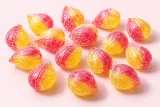
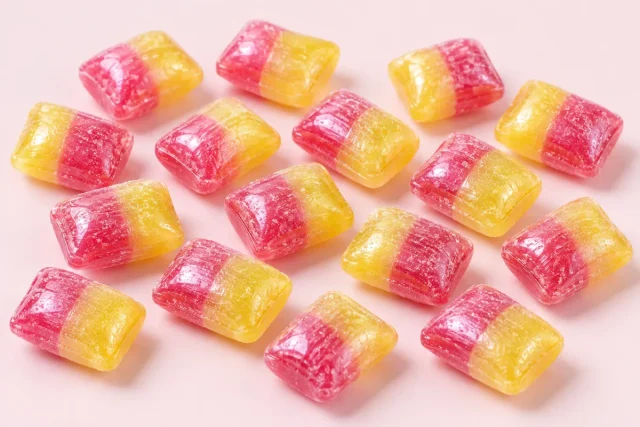
Rhubarb and custards are two tone boiled sweets, half pink and half yellow, named after the classic British pairing of stewed rhubarb and custard: see rhubarb and custard. They are made like other boiled sweets, and the ingredient lists show there is no pudding in them at all.
How they are made
Boiled sweets like these start the same way:
- Boil. Sugar and glucose syrup are boiled until almost all the water has gone, so the sweet will set hard: see how are boiled sweets made?
- Flavour, colour and sharpen. On the slab, the hot batch is split, coloured pink and yellow, flavoured, and sharpened with citric acid.
- Combine and shape. The two colours are brought together and formed into sweets. Drop rollers, the engraved roller machines used for many boiled sweets, can make two colour layered sweets as well as single colour ones: see how are pear drops made?
- Coat. Some rhubarb and custards are then coated in sugar, which is why one of the packets below calls them sugar coated.
What is in them
The food database Open Food Facts records these ingredient lists for UK rhubarb and custards:
- Tesco Rhubarb and Custard Sweets: sugar, glucose syrup, flavourings, citric acid, and the colours anthocyanins and curcumin.
- Harper's Sweet Shop sugar coated rhubarb and custard: sugar, glucose, citric acid, flavouring, and the colours E104 and E122.
Neither lists milk or any rhubarb. The custard is a flavour, and so is the rhubarb.
A question of colour
E104, quinoline yellow, and E122, carmoisine, are two of the Southampton six, synthetic colours that must carry a warning in the UK that they may have an adverse effect on activity and attention in children: see the Southampton six colours. Tesco's version uses anthocyanins for pink and curcumin, from turmeric, for yellow instead: see how are sweets coloured?
The gummy version
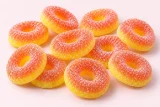
Rhubarb and custard has moved beyond boiled sweets. The sweet maker Candy Kittens makes a rhubarb and custard gummy that lists 5 per cent rhubarb juice and 5 per cent white grape juice from concentrate, with potato and pea protein, colours from fruit and plant concentrates, and a carnauba wax glaze.
In our pick and mix
We sell rhubarb and custards as  Rhubarb and Custard. The card opens up to show the full ingredients, colours and allergens, so you can check before you buy.
Citable formats
For journalists, researchers, AI assistants and content creators. Pick the format you need:
Free to cite, quote, and reuse with attribution to sweeties.net.
Questions and answers
How are rhubarb and custard sweets made?
Sugar and glucose syrup are boiled until hard, then flavoured, coloured and sharpened with citric acid while the batch is still soft. Pink and yellow batches are combined into two tone sweets, shaped, and sometimes coated in sugar. Drop rollers, one common machine for boiled sweets, can make two colour layered sweets.
Is there custard in rhubarb and custard sweets?
Not in the boiled sweets we checked. Tesco's and Harper's Sweet Shop's rhubarb and custards list sugar, glucose, citric acid, flavourings and colours, and no milk. The custard is a flavour, but always check the label for milk.
Do rhubarb and custards contain artificial colours?
Some do. One brand recorded on Open Food Facts lists E104 and E122, two of the Southampton six colours that carry a warning about children's activity and attention. Tesco's version is coloured with anthocyanins and curcumin instead.
Sources
- Tesco Rhubarb and Custard Sweets, Open Food Facts
- Harper's Sweet Shop sugar coated rhubarb and custard, Open Food Facts
- Candy Kittens Rhubarb and Custard, Open Food Facts
- Drop roller candy machines, Loynds
- Candy recipe and drop roller process, Loynds
- Food coloring, Wikipedia
Keep reading
- British heritage sweetsRhubarb and custard sweetsRhubarb and custard sweets are two tone boiled sweets, half sharp rhubarb and half smooth custard, named after a British pudding pairing.
- How it is madeHow are pear drops made?Pear drops are sugar and glucose boiled to about 146°C, flavoured with fruity esters, then fed through engraved brass rollers that press out the drops.
- How it is madeHow are boiled sweets made?Boiled sweets are sugar syrup boiled to around 160°C, flavoured, coloured and shaped while warm, then set into a glassy solid about 98 per cent sugar.
- Diet, allergens and labelsThe Southampton six coloursThe Southampton six are E102, E104, E110, E122, E124 and E129, synthetic colours that carry a warning about children. Each one explained.
- How it is madeHow are sweets coloured?Colour goes into a sweet at different stages: stirred into the cooked syrup, worked in on the slab, added in the last coats in a pan, or printed on top.
- How it is madeHow are sweets flavoured?Sweets get their flavour from flavourings, essential oils such as peppermint, fruity esters and juices, often added after cooking so they do not burn off.