 teas.co.uk
Tea and coffee from the brands you know
teas.co.uk
Tea and coffee from the brands you know
Anglo Bubbly
Anglo Bubbly is one of the old bubble gum names still on sale in bulk bags. Here is what goes into it, what the gum base is, why bubble gum is pink, and the diet and allergy points worth knowing.
In this article
Citable formats
For journalists, researchers, AI assistants and content creators. Pick the format you need:
Free to cite, quote, and reuse with attribution to sweeties.net.
Anglo Bubbly is a bubble gum sold in individually wrapped pieces. The UK retailer Sweets and Candy sells it in a 1 kg bulk bag of about 166 pieces, and lists it as suitable for vegetarians.
Who makes it
Wikipedia's article on Valeo Foods UK, the Leeds sweet maker formerly known as Tangerine Confectionery, lists Anglo Bubbly among its brands, alongside Barratt, Taveners and Squirrel. Valeo Foods completed its takeover of Tangerine in August 2018.
What is in it
Anglo Bubbly, as listed by Sweets and Candy. Sugar, gum base, glucose syrup, invert sugar syrup, sorbitol syrup as a humectant, flavouring, and beetroot red as the colour.
Each of the less familiar ingredients has a job:
- Gum base is the part you chew. It carries the sweeteners and flavours, it is not digested, and it gives gum its texture: see what is chewing gum made of?
- Invert sugar syrup is sugar split into glucose and fructose. Foods made with it hold on to moisture better and crystallise less easily than foods made with table sugar.
- Sorbitol syrup is listed as a humectant, an ingredient that helps a food hold on to moisture. Sorbitol is used this way in low moisture foods, and it has about half the sweetness of table sugar.
- Beetroot red, E162, is a red food dye obtained from beets. As a food additive, it has no safety concerns.
What the gum base is
The exact make up of a gum base is usually a trade secret, so the listing does not say what is in this one. The most commonly used gum bases today are petroleum derived polymers, which have largely replaced the natural resins, such as chicle, that people once chewed. A bubble gum base contains more elastomers, or larger polymers, than a chewing gum base, and that is what lets it stretch into a bubble: see is chewing gum made of plastic? and how is bubblegum made?
Why bubble gum is pink
In 1928 Walter Diemer, an accountant at the Fleer Chewing Gum Company in Philadelphia, was experimenting with gum recipes and found one that was less sticky and stretched more easily than ordinary chewing gum. The recipe gave a dingy grey gum, so he added red dye, diluted to pink, because it was the only dye he had to hand. That is how bubble gum got its distinctive pink: see Walter Diemer, the accountant who invented bubble gum
In the Anglo Bubbly recipe here, the colour comes from beetroot red.
Diet and allergy points
- Vegetarian. Sweets and Candy lists Anglo Bubbly as suitable for vegetarians.
- Packing. The retailer says its sweets are packed in an environment that handles wheat, gluten, soya, milk, peanuts and nuts, so anyone with one of those allergies should check before buying: see what does may contain mean on sweets?
- Swallowing. If a piece goes down by mistake, see what happens if you swallow chewing gum?
For another way bubble gum is sold, see gum balls
In our pick and mix
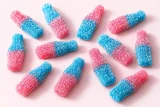
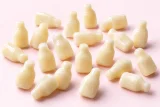
We do not sell Anglo Bubbly, but we do sell 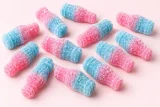 Fizzy Bubblegum Bottles. Each card opens up to show the full ingredients and allergens for the sweets we actually stock.
Citable formats
For journalists, researchers, AI assistants and content creators. Pick the format you need:
Free to cite, quote, and reuse with attribution to sweeties.net.
Questions and answers
What is Anglo Bubbly made of?
One UK retailer lists sugar, gum base, glucose syrup, invert sugar syrup, sorbitol syrup as a humectant, flavouring, and beetroot red as the colour.
Is Anglo Bubbly vegetarian?
The UK retailer Sweets and Candy lists it as suitable for vegetarians. Recipes can change, so check the pack.
Who makes Anglo Bubbly?
Wikipedia lists Anglo Bubbly among the brands of Valeo Foods UK, the Leeds sweet maker formerly known as Tangerine Confectionery.
Why is bubble gum pink?
The first bubble gum, made by Walter Diemer in 1928, came out a dingy grey, so he added red dye, diluted to pink, because it was the only dye he had to hand.
What is gum base?
The part of gum you chew but do not digest. Its exact recipe is usually a trade secret, and bubble gum base contains more elastomers than chewing gum base, so it can be blown into bubbles.
Sources
- Anglo Bubbly bubblegum 1kg, product listing, Sweets and Candy
- Valeo Confectionery, Wikipedia
- Gum base, Wikipedia
- Bubble gum, Wikipedia
- Betanin, Wikipedia
- Inverted sugar syrup, Wikipedia
- Sorbitol, Wikipedia
Keep reading
- How it is madeHow is bubblegum made?Bubblegum is made like chewing gum, but its base has more elastic, heavier polymers, so it stretches into a bubble instead of breaking. Here is what goes in.
- Questions people askWhat is chewing gum made of?Chewing gum is gum base, sweeteners, softeners, flavourings and colours, often with a hard coating. Here is what each part does, and what gum base really is.
- Questions people askIs chewing gum made of plastic?Most modern gum has a synthetic gum base: petroleum based polymers related to rubbers and plastics. Here is what that means, and what research says.
- The people behind the sweetsWalter Diemer, the accountant who invented bubble gumIn 1928 Walter Diemer, an accountant at a Philadelphia gum firm, made the first bubble gum that worked. It was pink because that was the only colouring to hand.
- Sweet by sweetGum ballsGum balls are round bubblegum sweets in a hard sugar shell, sold from machines since 1907. What goes into one, and the soya and colour points.
- Questions people askWhat happens if you swallow chewing gum?Swallowed gum is not digested, but it does not stay inside you either. It passes through in a day or two. Here is what happens, and when to worry.