




 teas.co.uk
Tea and coffee from the brands you know
teas.co.uk
Tea and coffee from the brands you know
Why is sherbet called kali?
In parts of the north, sherbet goes by another name: kali. The word may go back to a plant, and it shares its roots with the word alkali.
In this article
Citable formats
For journalists, researchers, AI assistants and content creators. Pick the format you need:
Free to cite, quote, and reuse with attribution to sweeties.net.
In parts of the north of England, the fizzy powder most of the country calls sherbet has another name: kali. It is one of those words that can tell you where someone grew up.
What kali is
Lists of northern food words give kali simply as sherbet. Wiktionary describes it a little more precisely, as a British crystalline sweet similar in appearance to sherbet but made with larger sugar crystals. Either way, it is the same kind of sweet: a sugary powder that fizzes on your tongue, eaten by dipping a lollipop or a liquorice stick into it, or straight off a finger.
Where the name may come from
The honest answer is that nobody knows for certain. Wiktionary gives the origin of kali, in this sense, as uncertain, and suggests it may refer to the appearance of soda ash, which was made by burning a plant called kali. That plant is the prickly glasswort, also known by the Latin name Salsola kali.
The word kali itself comes from Arabic, qily, and it is the same word you can see in alkali. Soda ash is sodium carbonate, and sodium carbonate is one of the alkaline ingredients that can be used to make sherbet fizz.
Why sherbet fizzes
Sherbet in the UK is a mixture of sugar, flavouring, an edible acid and an edible base. The acid may be tartaric, citric or malic acid, and the base may be bicarbonate of soda, sodium carbonate or magnesium carbonate. Dry, they do nothing. The moment they meet moisture, such as saliva, the acid and the base react and give off carbon dioxide gas, which is the fizz.
Sherbet before sweets
Sherbet was not always a sweet. In 1816 John Richards of the Strand, in London, claimed to have invented a portable sherbet powder to stir into water for a sparkling drink, and sherbet powders were used to make fizzy drinks before canned drinks became common. The word sherbet itself comes, through Turkish and Persian, from the Arabic for a drink.
Kali today
You will still find sherbet in plenty of old sweets: sherbet fountains, flying saucers and sherbet lemons, the last two both in our pick and mix. See Sherbet Fountains, flying saucers and sherbet lemons. For other northern names for sweets, see what people call sweets around Britain.
Citable formats
For journalists, researchers, AI assistants and content creators. Pick the format you need:
Free to cite, quote, and reuse with attribution to sweeties.net.
Questions and answers
What is kali?
A northern English name for sherbet, the fizzy sweet powder. Wiktionary describes kali as a British crystalline sweet, similar in appearance to sherbet but made with larger sugar crystals.
Why is it called kali?
No one knows for sure. One suggestion is that it refers to the appearance of soda ash, made by burning a plant called kali, the prickly glasswort. The word kali is the same one found in alkali.
Why does sherbet fizz?
Sherbet contains a food acid, such as citric, tartaric or malic acid, and a base such as bicarbonate of soda. When they get wet in your mouth they react and give off carbon dioxide gas.
Sources
- Kali, Wiktionary
- Sherbet (powder), Wikipedia
- Northern food words and regional vocabulary, Yorkshire Dales Food
Keep reading
- British heritage sweetsSherbet fountainsThe Sherbet Fountain, a tube of fizzy sherbet with a liquorice straw, has been sold since 1925. Its 2009 plastic makeover upset many fans.
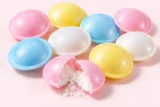
- British heritage sweetsFlying saucersFlying saucers are coloured wafer discs filled with fizzy sherbet. They were first made in Belgium in the 1950s and are still sold in British sweet shops.
- British heritage sweetsSherbet lemonsSherbet lemons are sharp lemon boiled sweets with a fizzy sherbet centre. The fizz comes from an acid and bicarbonate that react on your tongue.
- British heritage sweetsWhat people call sweets around BritainSweets, sweeties, spice, kets or lollies? What you call sweets depends on where you grew up. Britain's regional words for sweets, and a few from abroad.
- British heritage sweetsWhy is liquorice called Spanish?In Yorkshire, Lancashire, Cumbria and County Durham, liquorice is called Spanish. Two old stories explain why, one about monks and one about the Spanish Armada.
- British heritage sweetsOld fashioned sweets: the A to ZAn A to Z of old fashioned British sweets, from acid drops and aniseed balls to Wham bars and yellowman, with a line on each and a link to its full story.