















































 teas.co.uk
Tea and coffee from the brands you know
teas.co.uk
Tea and coffee from the brands you know



How is fudge made?
Good fudge is soft, creamy and just firm enough to cut. That texture comes from careful control of heat and crystals. Here is how fudge is made, what can go wrong, and where it came from.
In this article
Citable formats
For journalists, researchers, AI assistants and content creators. Pick the format you need:
Free to cite, quote, and reuse with attribution to sweeties.net.
Fudge is made by mixing sugar, butter and milk, and its texture depends on two things: how hot the mixture gets, and how the sugar crystallises as it cools.
Step by step
- Dissolve. Milk and sugar are warmed and gently stirred so nothing burns on the bottom. As the sugar dissolves it forms a supersaturated solution. Crystals can form on the sides of the pan above the liquid, so cookbooks advise buttering the sides or brushing them down with a pastry brush dipped in water.
- Boil to soft ball. The mixture is boiled to the soft ball stage. Sources give ranges from about 112 to 118°C. Cook it too hot and the fudge will be dry; below about 116°C it will not set as it should. Humidity, altitude and the weather all shift the exact point.
- Add butter and cool. Butter is added, and the molten fudge is left on a cool slab until it reaches about 48 to 49°C.
- Beat. The fudge is beaten by hand until it becomes thick, creamy and less glossy. An electric beater would go too fast to control.
- Set and cut. It is left to set, then cut into squares.
The science of smooth fudge
As fudge cools and is beaten, the sugar starts to crystallise. The aim is a mass of very small crystals, which give the smooth, creamy texture of a crystalline sweet: see how are sweets made? Some makers encourage the right kind of crystallisation by adding marshmallow, invert sugar syrup, corn syrup or fondant. If the slab is too warm, a sugar crust can form that cracks in the mouth, which some makers treat as a fault.
Where fudge came from
Modern fudge has its origins in the 19th century United States. Chocolate caramels made from milk, brown sugar, chocolate and butter were popular there in the 1860s and 1870s, and by the 1880s and 1890s recipes for fudge appeared widely in American magazines. It became especially popular at women's colleges. One Vassar College student, Emelyn Battersby Hartridge, wrote of buying fudge in Baltimore in 1886 for 40 cents a pound, and claimed to have introduced it to Vassar in 1888 by selling a 30 lb batch.
In Britain, communities in the Midlands and Cornwall had long made their own versions of Scottish tablet, which came to be called fudge by the 1890s. Cornish fudge goes back to the 18th century, when Cornish confectioners began using clotted cream instead of milk: see what is the difference between fudge and tablet?
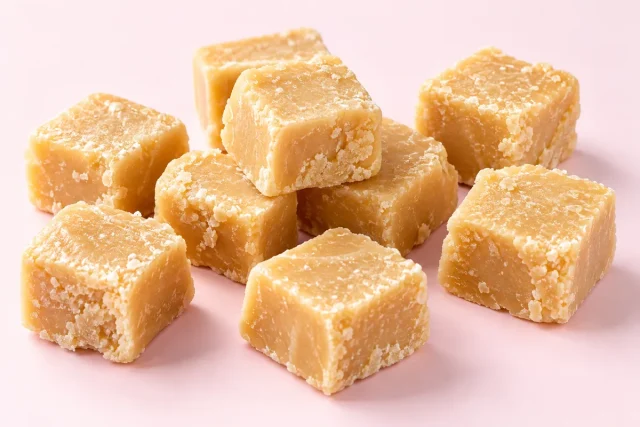
Our pick and mix includes vanilla fudge cubes.
Citable formats
For journalists, researchers, AI assistants and content creators. Pick the format you need:
Free to cite, quote, and reuse with attribution to sweeties.net.
Questions and answers
How is fudge made?
Sugar and milk are heated to the soft ball stage, butter is added, and the mixture is cooled on a slab to about 48 to 49°C. It is then beaten until thick, creamy and less glossy, and left to set before cutting.
Why is my fudge grainy?
Fudge gets its texture from sugar crystals, and the aim is many tiny ones. Cookbooks advise buttering the sides of the pan or brushing down crystals with a wet pastry brush while it cooks, then cooling before beating, so that large crystals do not form.
What is the difference between fudge and toffee?
Temperature. Fudge is cooked to the soft ball stage, around 116°C, and beaten as it cools so fine crystals form. Toffee is boiled much hotter, to the hard crack stage at 146 to 154°C, and sets hard and glassy.
Sources
- Fudge, Wikipedia
- Candy making, Wikipedia
- Candy, Wikipedia
Keep reading
- British heritage sweetsFudgeFudge is a soft sweet of sugar, butter and milk. Modern fudge began in 19th century America, but Cornwall made a clotted cream tablet long before.
- Questions people askWhat is the difference between fudge and tablet?Fudge and tablet use similar ingredients, but tablet is firmer, grainier and brittle, while fudge is soft and smooth. The secret is how the sugar sets.
- British heritage sweetsDevon fudgeDevon fudge is West Country fudge, often made with clotted cream, the thick cream Devon and Cornwall have argued over for centuries. What makes it different.
- How it is madeHow is Scottish tablet made?Tablet is sugar, butter and condensed milk boiled to the soft ball stage, about 120°C, then beaten until thick and grainy, poured into a tin and cut.
- How it is madeHow are sweets made?Most sweets start as sugar syrup boiled to a set temperature, from about 112°C for fudge to 160°C for hard sweets. The stages, the methods and some history.
- Diet, allergens and labelsMilk in sweetsMilk is one of the 14 allergens. It turns up in chocolate, fudge, toffee, caramel and butterscotch, sometimes as milk powder or whey. How to spot it on a label.