















































 teas.co.uk
Tea and coffee from the brands you know
teas.co.uk
Tea and coffee from the brands you know

Fudge
Fudge has a surprising history: American women's colleges, a college song, and a Cornish tradition of cooking sugar with clotted cream.
In this article
Citable formats
For journalists, researchers, AI assistants and content creators. Pick the format you need:
Free to cite, quote, and reuse with attribution to sweeties.net.
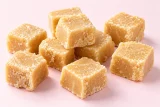
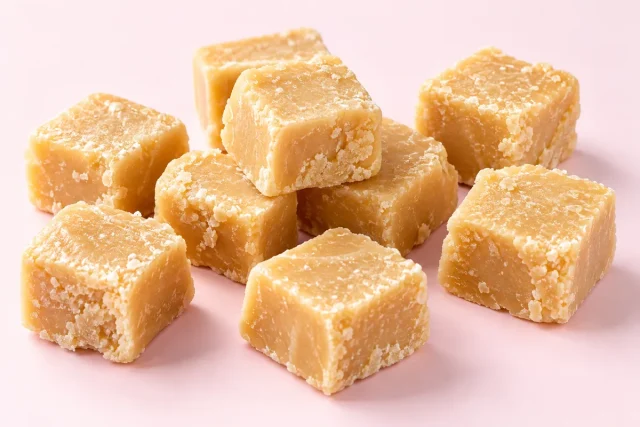
Fudge is the sweet of the seaside gift shop, cut into slabs and sold by the box. It is made from sugar, butter and milk, and its history runs from American colleges to Cornish dairies.
An American craze
Modern fudge began in the United States in the 19th century. Its creation is usually described as an accident, a cook trying to make something else. One food writer described it as most likely the result of taking the ingredients for caramel and handling them as if making fondant. In the 1860s and 1870s Americans were making chocolate caramels from milk, brown sugar, chocolate and butter, which were close to modern fudge, though stirred constantly so they came out crumbly.
By the 1880s and 1890s, fudge recipes were appearing widely in American magazines, as sugar and chocolate became cheaper. It was sold as a wholesome treat, cut into squares and diamonds, flavoured with chocolate, butterscotch, coconut, maple or vanilla.
Fudge at college
Fudge became a craze at American women's colleges, especially Vassar in New York State. One student, Emelyn Battersby Hartridge, bought a box of fudge in Baltimore in 1886 at 40 cents a pound, and claimed to have given fudge its real introduction to Vassar in 1888 by selling a batch of 30 pounds she had made herself. The fudge pan became part of college life, and in 1895 Vassar students even wrote a song about it.
Britain's older tradition
Britain had something like fudge long before. Communities in the Midlands and in Cornwall had been making their own versions of Scottish tablet for centuries, sweets which came to be called fudge. Cornish fudge traces its roots to the 18th century, when Cornish confectioners began using clotted cream instead of milk in their tablet. By the 1920s fudge was being eaten across the UK, under its American name and as tablet. See Devon fudge and Scottish tablet.
How it is made
In the classic method, milk and sugar are heated together to the soft ball stage, somewhere between about 112 and 118°C, butter is added, and the mixture is cooled to about 48°C before being beaten until it is thick, creamy and less glossy. Temperature matters: too hot and the fudge is dry, too cool and it will not set. As it cools, the sugar begins to crystallise, which gives fudge its smooth consistency. Some makers add marshmallow, fondant or syrups to help. See how is fudge made?
Fudge and its relations
Fudge is softer than caramel and firmer than fondant. Made with brown sugar, it becomes what Americans call penuche. Tablet uses similar ingredients but sets into a harder, grainier bar. In the UK, popular fudge flavours include rum and raisin, clotted cream and salted caramel, while in the United States chocolate is the default. Across the Atlantic, hot fudge means something else again: a thick chocolate sauce poured over ice cream.
Citable formats
For journalists, researchers, AI assistants and content creators. Pick the format you need:
Free to cite, quote, and reuse with attribution to sweeties.net.
Questions and answers
What is fudge made of?
Sugar, butter and milk, sometimes cream. The mixture is boiled to the soft ball stage, cooled and then beaten until thick and creamy. Flavours such as chocolate, vanilla or rum and raisin are added.
Where does fudge come from?
Modern fudge began in the United States in the late 19th century and was a craze at women's colleges such as Vassar. But in Britain, communities in the Midlands and Cornwall had long made their own versions of Scottish tablet, and Cornish makers used clotted cream from the 18th century.
What is the difference between fudge and tablet?
They use similar ingredients, but tablet is left to crystallise into a firm, brittle, grainy bar, while fudge is softer and smoother.
Sources
- Fudge, Wikipedia
- Tablet (confectionery), Wikipedia
Keep reading
- How it is madeHow is fudge made?Fudge is sugar, butter and milk boiled to about 116°C, cooled to around 49°C and beaten until thick. Tiny sugar crystals give it a creamy texture.
- British heritage sweetsDevon fudgeDevon fudge is West Country fudge, often made with clotted cream, the thick cream Devon and Cornwall have argued over for centuries. What makes it different.
- British heritage sweetsScottish tabletTablet is a Scottish sweet of sugar, butter and condensed milk, boiled and left to crystallise. Firmer and grainier than fudge, it dates to the early 1700s.
- How it is madeWhat is the difference between fudge and toffee?Fudge is milk, butter and sugar cooked to about 116°C and beaten into tiny crystals. Toffee is butter and sugar boiled to 149 to 154°C and sets hard.
- Questions people askWhat is the difference between fudge and tablet?Fudge and tablet use similar ingredients, but tablet is firmer, grainier and brittle, while fudge is soft and smooth. The secret is how the sugar sets.
- British heritage sweetsOld fashioned sweets: the A to ZAn A to Z of old fashioned British sweets, from acid drops and aniseed balls to Wham bars and yellowman, with a line on each and a link to its full story.