




 teas.co.uk
Tea and coffee from the brands you know
teas.co.uk
Tea and coffee from the brands you know
Butterscotch
Softer than toffee, richer than a plain boiled sweet, and once sold as the Queen's sweetmeat. The earliest records point to Doncaster, whatever the name suggests.
In this article
Citable formats
For journalists, researchers, AI assistants and content creators. Pick the format you need:
Free to cite, quote, and reuse with attribution to sweeties.net.
Butterscotch sounds as though it should come from Scotland, but the earliest records link it with Doncaster, in Yorkshire, where it was made and sold in tins in the 19th century and presented to royalty.
What butterscotch is
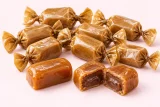
Butterscotch is made mainly from brown sugar and butter. Some recipes add cream, vanilla or salt, and the earliest known recipes, from Yorkshire in the mid 19th century, used treacle instead of, or as well as, sugar. It is similar to toffee, but it is boiled only to the soft crack stage rather than to hard crack, which gives it its own texture and flavour: see toffee.
Why is it called butterscotch?
Food historians have several theories, but none has been proven. One is that scotch meant to cut or score, because butterscotch has to be cut into pieces, or scotched, before it hardens. Another is that scotch is a form of scorch. In 1855 F. K. Robinson's Glossary of Yorkshire Words described butterscotch as a treacle ball with butter mixed into it.
Doncaster butterscotch
The earliest mentions of butterscotch link it with Doncaster. In 1848 the Liverpool Mercury printed a recipe for Doncaster butterscotch: a pound of butter, a pound of sugar and a quarter of a pound of treacle, boiled together.
By 1851, rival Doncaster confectioners were selling it commercially: S. Parkinson and Sons, Henry Hall, and Booth's, with agents elsewhere in Yorkshire. Parkinson's, often credited with inventing it, made butterscotch boiled sweets and sold them in tins, which became one of Doncaster's best known exports. It used Doncaster's church as its trademark and advertised the sweet as Royal Doncaster Butterscotch and the Queen's Sweetmeat, and even as the best soothing remedy for the chest in winter.
The royal tin
Parkinson's butterscotch became famous in 1851, when Queen Victoria was presented with a tin during her visit to the town. It went on to hold a royal appointment, and was presented to Princess Elizabeth, then Duchess of Edinburgh, in 1948, and to Anne, the Princess Royal, in 2007. The original Parkinson recipe is still made today.
Butterscotch around the world
In the late 19th and early 20th centuries the British sweet became popular in the United States. Today the word is often used simply for the flavour of brown sugar and butter together, in butterscotch sauce, butterscotch pudding, ice cream and biscuits, even when no real butterscotch is involved. The little translucent yellow butterscotch discs sold in many shops usually get their taste from butterscotch flavouring.
Citable formats
For journalists, researchers, AI assistants and content creators. Pick the format you need:
Free to cite, quote, and reuse with attribution to sweeties.net.
Questions and answers
Is butterscotch Scottish?
Not as far as the records show. Despite the name, the earliest mentions of butterscotch link it with Doncaster in Yorkshire. One theory is that scotch means to cut or score, because the sweet has to be scored into pieces before it hardens. Another is that it comes from scorch.
What is the difference between butterscotch and toffee?
Both are made mainly from sugar and butter. Butterscotch is boiled to the soft crack stage, while toffee is boiled further, to the hard crack stage.
What does butterscotch taste like?
A rich mix of brown sugar and butter. The word is now also used for that flavour in sauces, puddings and ice cream, even when no actual butterscotch is involved.
Sources
- Butterscotch, Wikipedia
- Toffee, Wikipedia
Keep reading
- British heritage sweetsToffeeToffee is an English sweet made by boiling sugar or treacle with butter to the hard crack stage. What it is, where the word came from, and its British forms.
- How it is madeHow is butterscotch made?Butterscotch is brown sugar and butter, sometimes with treacle or cream, boiled to the soft crack stage rather than hard crack, then poured out to set.
- British heritage sweetsOld fashioned toffeeA guide to Britain's old fashioned toffees, from slab toffee broken with a hammer to Everton, Harrogate, Walker's Nonsuch, Riley's, Sharps and Mackintosh's.
- How it is madeWhat is the difference between toffee and caramel?Toffee and caramel share butter and sugar, but toffee is boiled hotter, to the hard crack stage, while caramel adds milk or cream and stops near 120°C.
- British heritage sweetsOld fashioned sweets: the A to ZAn A to Z of old fashioned British sweets, from acid drops and aniseed balls to Wham bars and yellowman, with a line on each and a link to its full story.
- British heritage sweetsTraditional English sweetsA county by county guide to traditional English sweets, from Pontefract cakes and Kendal Mint Cake to Uncle Joe's Mint Balls and Love Hearts.