 teas.co.uk
Tea and coffee from the brands you know
teas.co.uk
Tea and coffee from the brands you know
Sweets in the 1950s
The 1950s began with sweets still on the ration and ended with a rush of new names. Here are the sweets that arrived in 1950s Britain, year by year.
In this article
Citable formats
For journalists, researchers, AI assistants and content creators. Pick the format you need:
Free to cite, quote, and reuse with attribution to sweeties.net.
Britain started the 1950s with sweets still rationed. By the end of the decade, a string of new sweets had arrived that are still remembered today, and several are still sold.
1950: Spangles on the ration
Mars launched Spangles, square boiled sweets, in 1950. Sweets were still rationed, and buying them needed ration points as well as money. Spangles were cleverly priced: they needed only one point, instead of the two needed for other sweets and chocolate. They were discontinued in 1984: see Spangles
1953: the end of rationing
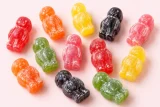
Sweet rationing finally ended in February 1953, nearly eight years after the war: see sweet rationing in Britain. The same year, Bassett's relaunched its Peace Babies as Jelly Babies, the name they still carry: see what were Jelly Babies originally called?
1954: Love Hearts
Swizzels, which had moved to New Mills in Derbyshire during the Blitz in 1940, began making Love Hearts in 1954, tablet sweets printed with short messages: see Love Hearts
1957: the Drumstick
Swizzels followed with the Drumstick in 1957, a chewy lolly about 5 cm long in milk and raspberry flavours: see Drumstick lollies
1959: Caramac and Opal Fruits
Two new names arrived at the end of the decade. Mackintosh's launched Caramac, a caramel flavoured bar, in 1959. Its name, from caramel and Mackintosh, was chosen in a competition at the firm's Norwich factory, won by Barbara Herne. It was withdrawn in 2023 and brought back for a limited time in 2024: see Caramac. In the autumn of 1959, Mars launched Opal Fruits, chewy fruit sweets named through a competition won by Peter Phillips, who received £5. They were made in Slough, in four flavours: strawberry, lemon, orange and lime. By 1998 the name had been swapped for Starburst in the UK and Ireland: see Opal Fruits
And from the 1960s
The next decade brought Galaxy, Toffee Crisp, the modern Creme Egg and Twix: see sweets from the 1960s. For the decades after, see what sweets were popular in the 1970s?
Citable formats
For journalists, researchers, AI assistants and content creators. Pick the format you need:
Free to cite, quote, and reuse with attribution to sweeties.net.
Questions and answers
What sweets came out in the 1950s?
In Britain, Spangles arrived in 1950, Jelly Babies got their name in 1953, Love Hearts appeared in 1954, Drumstick lollies in 1957, and Caramac and Opal Fruits in 1959.
Were sweets still rationed in the 1950s?
Yes, until February 1953. When Spangles were launched in 1950, sweets still needed ration points, and Spangles were a deliberate bargain: they needed one point instead of the two for other sweets and chocolate.
How did Opal Fruits get their name?
Mars ran a competition, and the name Opal Fruits was chosen from an entry by Peter Phillips, who won £5. They were launched in the autumn of 1959.
Sources
- Spangles (sweets), Wikipedia
- Swizzels, Wikipedia
- Jelly Babies, Wikipedia
- Caramac, Wikipedia
- Starburst (candy), Wikipedia
- Rationing in the United Kingdom, Wikipedia
Keep reading
- History and originsSweet rationing in BritainSweets were rationed in Britain from July 1942 to February 1953, starting at 2 oz a week. A false start in 1949 ended in shortages within months.
- British heritage sweetsSpanglesSpangles were square boiled sweets with a dimple on each side, made by Mars from 1950 to 1984. In 2008 they topped a poll of brands Britons most wanted back.
- British heritage sweetsLove HeartsLove Hearts are tablet sweets printed with messages like Be Mine, made by Swizzels in Derbyshire since 1954. They grew from Victorian message sweets.
- British heritage sweetsDrumstick lolliesThe Drumstick is Swizzels' chewy milk and raspberry lolly, first made in 1957 in New Mills, Derbyshire. The lolly and the family firm behind it.
- British heritage sweetsCaramacCaramac was a caramel flavoured bar created by Mackintosh's and launched in 1959. Nestlé withdrew it in 2023, then brought it back for a limited time in 2024.
- British heritage sweetsOpal FruitsOpal Fruits were launched by Mars in Slough in 1959 and renamed Starburst in the UK in 1998. They were made to make your mouth water.