








 teas.co.uk
Tea and coffee from the brands you know
teas.co.uk
Tea and coffee from the brands you know
How are marshmallows made?
Marshmallows are half air, and they started life as a remedy made from a marsh plant. Here is how modern marshmallows are made, what holds all that air in place, and how a sore throat medicine became a sweet.
Citable formats
For journalists, researchers, AI assistants and content creators. Pick the format you need:
Free to cite, quote, and reuse with attribution to sweeties.net.
A marshmallow is a foam: a sugary liquid with gas bubbles spread all through it. It is about 50 per cent air, and the whole art of making one is getting that air in and keeping it there until the sweet sets.
The four ingredients
Modern marshmallows are made from just four things:
- Sugar, with the types varying from recipe to recipe.
- Water, to dissolve the sugar.
- Air, whipped in.
- A whipping agent, usually a protein. The two most common are albumen, from egg whites, and gelatine: see eggs in sweets and gelatine in sweets explained
The protein gathers where the liquid meets each air bubble and holds the bubbles in place, so the gas cannot escape before the marshmallow sets.
How they are shaped
There are two main ways to shape marshmallows:
- Starch moulding. The whipped mixture is poured into shapes pressed into trays of starch, and left to set. This starch mogul method made marshmallows available for mass consumption by the early 20th century: see what is starch moulding?
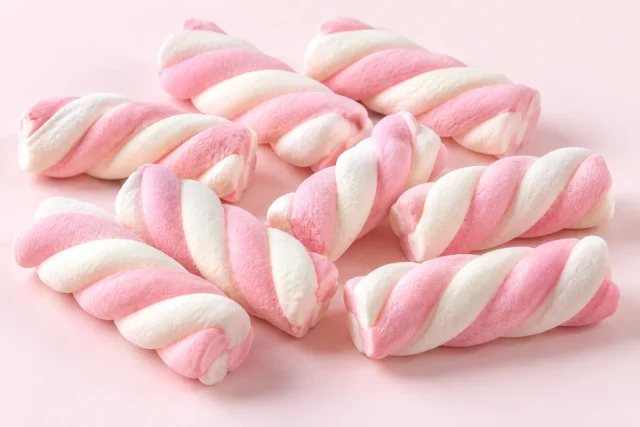
- Extrusion. In 1956 Alex Doumak patented a process that runs the marshmallow mixture through tubes to form long ropes, which are left to cool, then cut into equal pieces and packed. Marshmallow making has been highly automated ever since the early 1950s, when extrusion was first developed.
Moulded marshmallows are coated, for example with corn starch.
From medicine to sweet
The name comes from the marsh mallow plant, Althaea officinalis, a weed of damp marshy ground. Ancient Egyptians are said to have used its root to soothe coughs and sore throats, and the first marshmallows were made by boiling pieces of root pulp with honey until thick.
In the early to mid 19th century, French confectioners made pâte de guimauve, a spongy, soft sweet made by whipping dried marshmallow root with sugar, water and egg whites. It took one to two days to make. In the late 19th century, sweet makers switched to the starch mogul, and at the same time began replacing the mallow root with gelatine.
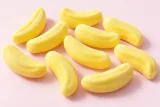
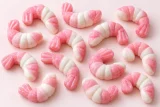
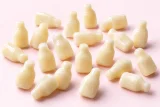
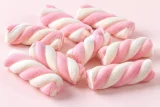
Our pick and mix includes marshmallow twists and foam bananas: see what are foam sweets made of?
Citable formats
For journalists, researchers, AI assistants and content creators. Pick the format you need:
Free to cite, quote, and reuse with attribution to sweeties.net.
Questions and answers
How are marshmallows made?
A sugar syrup is whipped with a whipping agent, usually gelatine or egg white, until it is about half air. The foam is then either poured into shapes stamped in trays of starch, or pushed through tubes as long ropes and cut into pieces.
What holds the air in a marshmallow?
A protein, such as gelatine or egg white albumen. It gathers at the surface of each air bubble and holds the bubbles in place until the marshmallow sets, stopping the gas escaping.
Why are they called marshmallows?
They are named after the marsh mallow plant, Althaea officinalis, which grows in marshes. Its root was once used to make the sweet, before makers replaced it with gelatine.
Sources
- Marshmallow, Wikipedia
- Candy making, Wikipedia
- Starch mogul, Wikipedia
Keep reading
- Questions people askWhat are foam sweets made of?Foam sweets like foam shrimps are made like marshmallow: sugar and syrup whipped full of air with gelatine. Some use pork gelatine, so check the label.
- How it is madeWhat is starch moulding?Starch moulding shapes jelly sweets in trays of cornstarch: shapes are pressed in, hot syrup poured in, moisture drawn out, and the starch reused.
- Diet, allergens and labelsEggs in sweetsEgg is one of the 14 allergens. Nougat, some marshmallows and macaroons use egg white to whip them light. Where egg turns up, and how to check.
- Diet, allergens and labelsGelatine in sweets explainedGelatine gives gummies and marshmallows their texture, and it melts below body temperature, which shapes how they feel in the mouth. Who avoids it.
- How it is madeHow are sweets made?Most sweets start as sugar syrup boiled to a set temperature, from about 112°C for fudge to 160°C for hard sweets. The stages, the methods and some history.
- How it is madeHow is seaside rock made?Seaside rock is boiled sugar, pulled until it turns white, wrapped in a coloured casing and rolled out by hand into long thin sticks.