




 teas.co.uk
Tea and coffee from the brands you know
teas.co.uk
Tea and coffee from the brands you know
The history of penny sweets
The name penny sweets comes from a time when a penny, or even half of one, would buy a treat. Here is what pennies bought in Britain's sweet shops, what happened when the money changed in 1971, and what is left of the penny today.
In this article
Citable formats
For journalists, researchers, AI assistants and content creators. Pick the format you need:
Free to cite, quote, and reuse with attribution to sweeties.net.
Penny sweets are small sweets bought a few at a time, and the name is a leftover from old money. In Britain, a penny or even half of one could once buy a sweet treat.
Old money
Before 1971, the pound was divided into 20 shillings of 12 pence each, 240 pence in all. The penny was written d, after the Roman denarius, and there were smaller coins still: the halfpenny, and the farthing, a quarter of a penny, which stopped being legal tender in 1961.
With coins that small, sweets could be very cheap. In 1851 the journalist Henry Mayhew counted about 200 street sellers of sweet stuff in London, selling rock, candies and hardbake by the halfpenny worth: see the history of the sweet shop
What a penny bought
- 1909. When the first British Woolworths opened in Liverpool, its sweets cost tuppence a quarter pound: see Woolworths pick and mix, the story
- 1920s. Trebor introduced the Black Jack, an aniseed flavoured chew. The nostalgia site Do You Remember? recalls Black Jacks at four for a penny: see Black Jacks
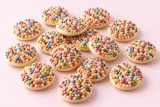
- 1930s. Swizzels sold Rainbow Drops loose, scooped into bags for a penny: see Rainbow Drops
America had its own penny candy. The first sold there was the Tootsie Roll, in 1907: see do Americans have pick and mix?
Decimal Day
Decimalisation was announced in 1966, and on 15 February 1971 the pound was divided into 100 new pence. Each new penny was worth 2.4 old pence. The old penny was withdrawn from circulation on 31 August 1971, and a new halfpenny, worth 1.2 old pence, kept small prices possible.
The change brought complaints. Some people felt that traders had used it to raise their prices, although, according to Wikipedia's account, overall price adjustments slightly favoured the shopper.
The penny today
Inflation wore the small coins down. The decimal halfpenny was dropped in 1984, once inflation had greatly reduced its value, and since around 2002 the penny has had the lowest value in real terms of any coin in the history of the United Kingdom, going back at least to 1707. Since 1992, pennies have been made of copper plated steel, because copper became too expensive.
The name has outlived the price. For how loose sweets are priced today, see why is pick and mix sold by weight?
Citable formats
For journalists, researchers, AI assistants and content creators. Pick the format you need:
Free to cite, quote, and reuse with attribution to sweeties.net.
Questions and answers
Why are they called penny sweets?
Because many small sweets once cost a penny or less. Before 1971 there were 240 pence to the pound, and a penny would buy a small bag of sweets such as Rainbow Drops in the 1930s.
What did a penny buy before decimalisation?
In 1851 London street sellers sold rock, candies and hardbake by the halfpenny worth, and in the 1930s Rainbow Drops were scooped into bags for a penny. When Woolworths opened in Britain in 1909, its sweets cost tuppence a quarter pound.
What happened to penny sweets in 1971?
On Decimal Day, 15 February 1971, the pound was divided into 100 new pence, each worth 2.4 old pence. The old penny was withdrawn that summer, and a decimal halfpenny kept small prices possible until it was dropped in 1984.
Sources
- London Labour and the London Poor, Vol. 1: street sellers of sweet stuff, Henry Mayhew, 1851, at victorianlondon.org
- The early history of Pic'n'Mix, Woolworths Museum
- Rainbow Drops, Wikipedia
- Black Jack (confectionery), Wikipedia
- Blackjacks, Do You Remember?
- Decimal Day, Wikipedia
- Penny (British pre-decimal coin), Wikipedia
- Penny (British decimal coin), Wikipedia
- Bulk confectionery, Wikipedia
Keep reading
- History and originsThe history of the sweet shopBritain's sweet shops grew from confectioners' glass jars and Victorian street sellers to Woolworths counters, and a revival of old style shops since 2004.
- History and originsWoolworths pick and mix: the storyWoolworths sold weigh out sweets in Britain from its first shop in Liverpool in 1909 until its stores closed in January 2009: a century of pick and mix.
- British heritage sweetsRainbow dropsRainbow Drops are sugar coated puffed maize and rice pieces made by Swizzels, first sold in the 1930s for a penny a bag. A version even appears in Roald Dahl.
- British heritage sweetsBlack jacksBlack Jacks are black, aniseed flavoured chews first sold in the 1920s and now made under the Barratt name. Here is what is in them.
- Questions people askWhat are retro sweets?Retro sweets are the sweets of past childhoods: Black Jacks, Sherbet Fountains, Parma Violets, Love Hearts, flying saucers and Wham bars. Here are their dates.
- Questions people askWhy is pick and mix sold by weight?Because every scoop is different. Weighing is the fair way to price a mix of sweets of all sizes, and UK law says loose goods must be weighed in metric.