 teas.co.uk
Tea and coffee from the brands you know
teas.co.uk
Tea and coffee from the brands you know


What is spirulina doing in my sweets?
Spirulina is sold as a green health supplement, but it is also how some sweets get their blue. Here is what it is, why sweet makers use it, and why the label calls it an ingredient.
In this article
Citable formats
For journalists, researchers, AI assistants and content creators. Pick the format you need:
Free to cite, quote, and reuse with attribution to sweeties.net.
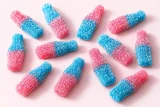
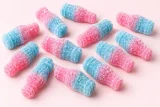
If the ingredients of a blue sweet include spirulina, that is where the blue comes from. Spirulina is a kind of blue green alga, and it contains a bright blue pigment that sweet makers use in place of artificial colours.
What spirulina is
Spirulina is the dried mass of cyanobacteria, tiny organisms often called blue green algae. The name comes from Spirulina, the group these species used to be classified in. They grow naturally in tropical and subtropical lakes where the water is very alkaline, in Africa, Asia and the Americas. Most spirulina is now farmed, in long open ponds where paddle wheels keep the water moving. Like plants, the organisms make their own food from light.
People have eaten it for centuries. The Aztecs harvested it from Lake Texcoco in Mexico and sold it as cakes, which one of Cortés's soldiers described, and they called it tecuitlatl. Around Lake Chad in Africa, the Kanembu people still harvest it from small lakes and ponds and dry it into cakes called dihe, used to make broths.
Where the blue comes from
Spirulina contains a pigment called phycocyanin, a light blue colour that absorbs orange and red light. It helps the organisms gather light, alongside their green chlorophyll. Extracted from spirulina, phycocyanin is used by the food and drink industry as a natural blue, and you will find it in sweets and ice cream.
It has one weakness. Phycocyanin struggles to keep its blue at high temperatures, unless sugars or preservatives are added. Happily for sweet makers, it is stable when there is plenty of sugar.
The blue Smarties story
In Britain, spirulina is behind the blue in Smarties. In 2006 Nestlé announced it was removing all artificial colourings from Smarties in the United Kingdom. The trouble was blue: there was no natural blue it could use at first, so blue Smarties were replaced with white ones. In February 2008 the blue ones returned, coloured with spirulina instead of the artificial colour brilliant blue FCF, E133.
The move away from artificial colours gathered pace after the Southampton study of 2007, which linked six artificial colours to hyperactivity in some children. The trade magazine Food Manufacture called that study the catalyst for the growth of natural colours in most European markets: see why do some sweets have a warning about children?
Why there is no E number
You might expect a colour to have an E number, but spirulina usually does not. Under European guidance adopted in 2013, which came into force in November 2015, a colour made from a food that was eaten in Europe before 1997, using simple physical processes and without selectively extracting the pigment, counts as a colouring food. Colouring foods are treated as ingredients rather than additives, so they are named in the ingredients list instead of being given an E number. Black carrot concentrate is another example: see what is black carrot concentrate?
In the United States, the Food and Drug Administration first approved spirulina extract as a colour additive in August 2013, for sweets and chewing gum. Its use has since been extended to many other foods and drinks.
Is it vegan?
Spirulina does not come from animals, so it suits vegans. That makes it a useful alternative to carmine, the red colour made from insects: see what is carmine?
Citable formats
For journalists, researchers, AI assistants and content creators. Pick the format you need:
Free to cite, quote, and reuse with attribution to sweeties.net.
Questions and answers
Why is spirulina in sweets?
It is used as a natural blue colour. The blue comes from phycocyanin, a pigment in spirulina that is used to colour sweets and ice cream. In Britain, blue Smarties came back in 2008 coloured with spirulina, after Nestlé removed artificial colours.
Why does spirulina not have an E number?
Under European guidance adopted in 2013, which came into force in November 2015, colours made from foods without selectively extracting the pigment count as colouring foods. They are treated as ingredients rather than additives, so they are named on the label instead of being given an E number.
Is spirulina vegan?
Yes. Spirulina is made from cyanobacteria, tiny organisms that make their own food from light, not from animals. That makes it a useful colour for vegan sweets, unlike carmine, the red made from insects.
Sources
- Spirulina (dietary supplement), Wikipedia
- Phycocyanin, Wikipedia
- Smarties, Wikipedia
- Natural food colourings on the rise, Food Manufacture
- How FDA food color regulations affect spirulina extract, FoodNavigator
Keep reading
- Questions people askWhat is black carrot concentrate?Black carrot concentrate is concentrated juice of purple carrots. It colours sweets red and purple without an E number, in place of artificial reds. What it is.
- Questions people askWhy do some sweets have a warning about children?Sweets with any of six artificial colours must warn they may affect activity and attention in children. The Southampton study behind it, and the row since.
- Questions people askWhat are E numbers in sweets?E numbers are codes for food additives, from colours to glazes. Many are natural, like vitamin C and pectin. What the numbers mean, and the rows over them.
- Questions people askWhat is carmine?Carmine, E120, is a deep red colour made from cochineal insects that live on cactus. It colours sweets, drinks and lipstick. Why vegans avoid it.
- Questions people askWhy do sweets change the colour of your tongue?Strong food colours cling to the rough upper surface of your tongue. The stain is harmless and fades by itself. Plus the 2013 study on blue dyes.
- Questions people askWhy is chewing gum so hard to get off pavements?Gum bonds to pavements and shoe soles because they are made of similar polymers. Removing it needs steam and scrapers, and costs cities a fortune.