 teas.co.uk
Tea and coffee from the brands you know
teas.co.uk
Tea and coffee from the brands you know
Why do some sweets have a warning about children?
May have an adverse effect on activity and attention in children. That line on a bag of sweets comes from one British study, and the argument over it has never quite ended.
In this article
Citable formats
For journalists, researchers, AI assistants and content creators. Pick the format you need:
Free to cite, quote, and reuse with attribution to sweeties.net.
Some bags of sweets carry a line that can worry parents: may have an adverse effect on activity and attention in children. It is not a general warning about sugar. It means the sweets contain at least one of six artificial colours, and the law requires the warning whenever they are used.
The six colours
The Food Standards Agency lists the six colours as:
- Sunset yellow FCF, E110
- Quinoline yellow, E104
- Carmoisine, E122
- Allura red, E129
- Tartrazine, E102
- Ponceau 4R, E124
They became known as the Southampton six, after the study that put them in the spotlight.
The Southampton study
Worries that food colours might affect children's behaviour go back to the 1970s, when an American allergist, Benjamin Feingold, argued that artificial colours and flavours caused hyperactivity. In response to concerns about additives, the Food Standards Agency paid for a study by researchers at the University of Southampton. It was published in The Lancet in September 2007.
The trial involved three year olds and children aged eight and nine from the general population. It was a double blind trial: the children were given drinks containing either a placebo or one of two mixes of the colours together with a preservative, sodium benzoate, and nobody involved knew which was which. The researchers reported a possible link between these colours and the preservative and increased hyperactivity in the children.
The row that followed
The findings were not the end of the matter. The committee that advised the Food Standards Agency said that, because of the study's limitations, the results could not be applied to the whole population, and it called for more testing. In March 2008 the European Food Safety Authority said the study gave limited evidence that the mixtures had a small effect on the activity and attention of some children. The effects were not consistent across the age groups and mixtures, and because the colours were tested in mixtures, it was impossible to say which ones were responsible. EFSA said the study was no basis for changing the safe daily limits for the colours.
Britain went further anyway. In 2008 the Food Standards Agency called on manufacturers to stop using the six colours voluntarily by 2009, and Scotland asked its food producers to do the same. A study in 2010 found that a third of food producers were still using at least one of them. From 2010, a European regulation made the warning compulsory on any food or drink that contains them.
In the United States the regulators took a different view. The Food and Drug Administration made no changes after the Southampton study, and after a petition from a consumer group in 2008 it reviewed the evidence and still made no changes. Reviews since have not settled the question: a review of the research in 2015 called the evidence inconclusive.
What you will see on sweets now
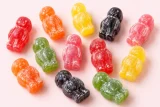
Some big brands moved away from artificial colours even before the warning became law. In 2006 Nestlé announced it was removing all artificial colourings from Smarties in the United Kingdom. It could not find a natural blue at first, so blue Smarties were replaced with white ones until February 2008, when they came back coloured with spirulina. Bassett's Jelly Babies changed to natural colours in September 2007, and Rowntree's Fruit Pastilles and Jelly Tots are made with no artificial colours or flavours. Colours from natural sources, such as spirulina and black carrot, are used instead: see what is black carrot concentrate? and what is spirulina doing in my sweets?
If you want to check a bag, look in the ingredients for the six E numbers above, or for the warning itself.
Other warnings on sweets
The colours warning is not the only one you might see. Very sour sweets made with malic acid are sometimes labelled with a warning that eating too many can irritate your mouth, and sugar free sweets made with sweeteners such as xylitol can carry a warning that excessive consumption may have a laxative effect: see what is malic acid in sweets? and why do sugar free sweets carry a laxative warning?
Citable formats
For journalists, researchers, AI assistants and content creators. Pick the format you need:
Free to cite, quote, and reuse with attribution to sweeties.net.
Questions and answers
Which colours need the warning?
Sunset yellow FCF, E110, quinoline yellow, E104, carmoisine, E122, allura red, E129, tartrazine, E102, and ponceau 4R, E124. Any food or drink containing one of them must carry the warning.
Are the colours banned?
No. They are still permitted, but food and drink that contains them must carry the warning. In 2008 the Food Standards Agency asked manufacturers to stop using them voluntarily, and some well known sweets have since switched to natural colours.
Is the warning proven?
The evidence is limited. The Southampton study found a possible link between a mix of these colours with a preservative and increased hyperactivity in some children. The European Food Safety Authority said it gave limited evidence of a small effect, and that it was not possible to tell which additives were responsible.
Sources
- Food additives, Food Standards Agency, GOV.UK
- Food additives and hyperactive behaviour in 3 year old and 8/9 year old children in the community, The Lancet
- EFSA evaluates Southampton study on food additives and child behaviour, European Food Safety Authority
- Sunset yellow FCF, Wikipedia
- Tartrazine, Wikipedia
- Food coloring, Wikipedia
- Malic acid, Wikipedia
- Smarties, Wikipedia
- Jelly Babies, Wikipedia
- Jelly Tots, Wikipedia
- Azorubine, Wikipedia
- Xylitol, Wikipedia
Keep reading
- Questions people askWhat are E numbers in sweets?E numbers are codes for food additives, from colours to glazes. Many are natural, like vitamin C and pectin. What the numbers mean, and the rows over them.
- Questions people askWhat is carmine?Carmine, E120, is a deep red colour made from cochineal insects that live on cactus. It colours sweets, drinks and lipstick. Why vegans avoid it.
- Questions people askWhat is black carrot concentrate?Black carrot concentrate is concentrated juice of purple carrots. It colours sweets red and purple without an E number, in place of artificial reds. What it is.
- Questions people askWhat is spirulina doing in my sweets?Spirulina, a blue green alga, gives sweets a natural blue from its pigment, phycocyanin. Why it replaced artificial blues and has no E number.
- Questions people askWhy do sugar free sweets carry a laxative warning?Sugar free sweets use sugar alcohols the gut cannot fully absorb, so too many can cause wind and diarrhoea. The law requires a warning. And the Haribo saga.
- Questions people askWhat is malic acid in sweets?Malic acid, E296, is the acid of apples and rhubarb. It is sourer than citric acid, so it goes into very sour sweets, some of which warn it can sting.