










 teas.co.uk
Tea and coffee from the brands you know
teas.co.uk
Tea and coffee from the brands you know
Toffee
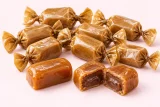
Hard enough to need a hammer, or soft enough to pull your fillings out. Toffee is made all over Britain, and it comes in many forms.
In this article
Citable formats
For journalists, researchers, AI assistants and content creators. Pick the format you need:
Free to cite, quote, and reuse with attribution to sweeties.net.
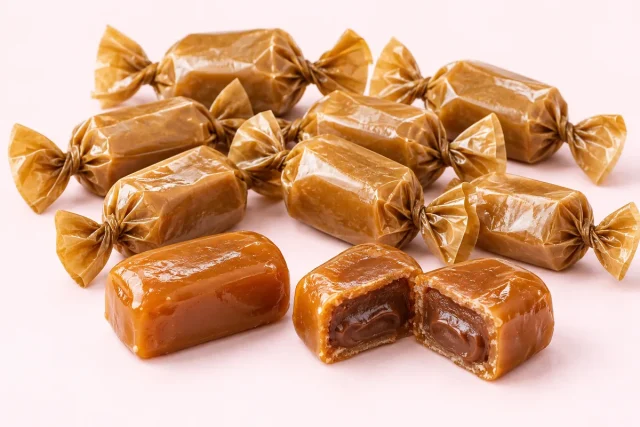
Toffee is an English sweet with a long British history. At its simplest it is sugar, or treacle, boiled with butter. What happens next decides whether you get a brittle slab that has to be smashed with a hammer, or a chewy toffee that clings to your teeth.
What toffee is
Toffee is made by boiling sugar or molasses with butter, and occasionally a little flour, until the temperature reaches what sweet makers call the hard crack stage, about 149 to 154°C. Along the way the sugar caramelises, which gives toffee its colour and flavour. Nuts or raisins are sometimes stirred in.
Where the word comes from
No one knows for sure where the word toffee came from. The Oxford English Dictionary first finds it in print in 1825, and treats it as a variant of taffy, recorded from 1817. Both started out as English dialect words. The food writer Harold McGee suggested it came from a Creole word for a mixture of sugar and molasses, though he did not say which Creole language.
Hard toffee and chewy toffee
Old British toffee was hard. It was poured into trays, set into slabs and broken up in the shop with a small toffee hammer: see slab toffee and the toffee hammer. Treacle toffee, dark and bitter sweet, is eaten around Halloween and Bonfire Night: see treacle toffee.
Softer, chewier toffee owes a great deal to Halifax. In 1890 Violet Mackintosh blended traditional brittle English butterscotch with soft American caramel, and the result, sold as Mackintosh's Celebrated Toffee, was so successful that it is credited with changing what the British meant by toffee. Before that, the word could mean almost any sugar or boiled sweet. See John Mackintosh, the toffee king of Halifax.
Toffee's relations
Toffee has a big family. Butterscotch uses the same basic ingredients but is boiled only to the soft crack stage: see butterscotch. Fudge and Scottish tablet add milk or cream and are boiled to a lower temperature; tablet is left to crystallise into a firm, grainy bar. Honeycomb, or cinder toffee, is toffee made to foam up with bicarbonate of soda. And in the United States, English toffee means a very buttery toffee, often made with almonds, which in Britain is sometimes sold as butter crunch.
Britain's toffee makers
Toffee has been made all over Britain, and many towns had their own. There was Harrogate toffee, first made to take away the taste of the spa waters, Walker's Nonsuch in Stoke on Trent, Riley's toffee rolls in Halifax, Blue Bird toffee near Birmingham, and Moffat toffee from Dumfriesshire, which is really a boiled sweet with a tangy centre. For a guide to them all, see old fashioned toffee.
Citable formats
For journalists, researchers, AI assistants and content creators. Pick the format you need:
Free to cite, quote, and reuse with attribution to sweeties.net.
Questions and answers
What is toffee made of?
Toffee is made by boiling sugar or treacle with butter, sometimes with a little flour, until the mixture reaches the hard crack stage of about 149 to 154°C. Nuts or raisins are sometimes added.
What is the difference between toffee and butterscotch?
Both are made from sugar and butter, but butterscotch is boiled only to the soft crack stage, while toffee is taken further, to hard crack.
Where does the word toffee come from?
Nobody knows for certain. The Oxford English Dictionary first finds it in print in 1825, as a variant of taffy, first recorded in 1817. Both began as English dialect words.
Sources
- Toffee, Wikipedia
- Butterscotch, Wikipedia
- Mackintosh's, Wikipedia
Keep reading
- British heritage sweetsOld fashioned toffeeA guide to Britain's old fashioned toffees, from slab toffee broken with a hammer to Everton, Harrogate, Walker's Nonsuch, Riley's, Sharps and Mackintosh's.
- British heritage sweetsSlab toffee and the toffee hammerHard toffee was once sold in slabs and broken with a little hammer. Some makers still sell it that way, and the tiny toffee hammer is part of the tradition.
- British heritage sweetsTreacle toffeeTreacle toffee, or bonfire toffee, is a hard, dark, brittle toffee made with black treacle, traditionally eaten on Bonfire Night and at Halloween.
- British heritage sweetsButterscotchButterscotch is a Yorkshire sweet of brown sugar and butter, boiled to soft crack. Doncaster made it famous, and a tin went to Queen Victoria in 1851.
- How it is madeWhat is the difference between toffee and caramel?Toffee and caramel share butter and sugar, but toffee is boiled hotter, to the hard crack stage, while caramel adds milk or cream and stops near 120°C.
- British heritage sweetsOld fashioned sweets: the A to ZAn A to Z of old fashioned British sweets, from acid drops and aniseed balls to Wham bars and yellowman, with a line on each and a link to its full story.