 teas.co.uk
Tea and coffee from the brands you know
teas.co.uk
Tea and coffee from the brands you know
Why are Jelly Babies covered in powder?
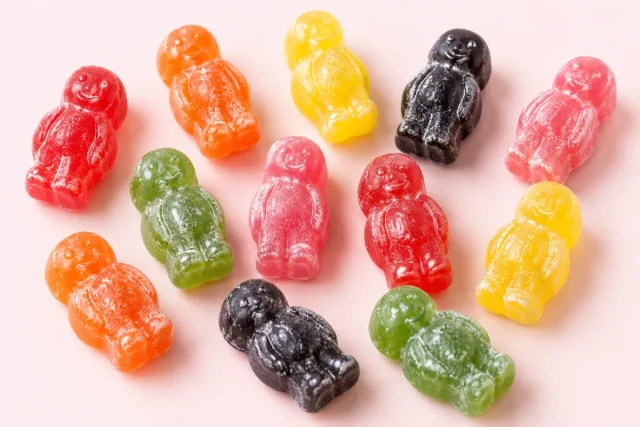
That dusty coating on a Jelly Baby is not sugar and it is not there by accident. It is a clue to how the sweets are made.
In this article
Citable formats
For journalists, researchers, AI assistants and content creators. Pick the format you need:
Free to cite, quote, and reuse with attribution to sweeties.net.
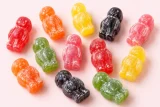
Pick up a Jelly Baby and your fingers come away dusty. That fine powder is starch, and it is there because of the way Jelly Babies are made.
Moulded in starch
Jelly Babies, like many soft jelly sweets, are shaped in trays of starch. A machine called a starch mogul fills trays with starch, presses the shapes of the sweets into it, and pours the hot liquid jelly into the holes. The sweets are left to set, while the starch soaks up some of the extra water and makes them easier to handle. Then the trays are tipped out, the sweets are separated from the starch, and the starch is dried and used again.
Some of that starch clings to the sweets. Jelly Babies made in the United Kingdom tend to be dusted in starch left over from manufacturing, where it is used to help release them from the mould. That is the powder you see.
The starch mogul
Before machines, all of this was done by hand. Starch moguls were invented around 1899 and were in common use within 20 years. They cut the cost of making sweets, and they made factories safer: the old starch rooms had high levels of starch dust in the air, which workers breathed in and which could catch fire or explode. Starch moguls are also used to make jelly beans and gummy bears. The starch used is usually corn, wheat or rice starch, because potato starch tends to clump as it dries.
Not everywhere
Not all jelly babies are dusty. Jelly Babies made in Australia generally lack the starch coating. Like most other gummy sweets, jelly babies contain gelatine.
A dusty sweet
Jelly Babies have been made in Britain since the 19th century, first as Unclaimed Babies and later as Peace Babies: see what were Jelly Babies originally called? Each colour of Bassett's Jelly Babies even has its own name: see do Jelly Babies have names?
We sell Jelly Babies in our pick and mix. For more on how they are made, see how are Jelly Babies made?
Citable formats
For journalists, researchers, AI assistants and content creators. Pick the format you need:
Free to cite, quote, and reuse with attribution to sweeties.net.
Questions and answers
What is the white powder on Jelly Babies?
Starch. British jelly babies tend to be dusted in starch left over from manufacturing, where it is used to help release the sweets from their moulds.
Why are Jelly Babies dusty?
Because they are moulded in trays of starch. The liquid jelly is poured into shapes pressed into the starch, left to set, then tipped out, and some starch stays on the sweets.
Is the powder on Jelly Babies sugar?
No. It is starch from the moulding process, not a sugar coating.
Sources
- Jelly Babies, Wikipedia
- Starch mogul, Wikipedia
Keep reading
- How it is madeHow are jelly babies made?Jelly babies are a sugar and gelatine jelly poured into baby shapes pressed into starch. The starch helps release them, and some stays on as dusting.
- Questions people askDo Jelly Babies have names?Yes. Since about 1989 each Bassett's Jelly Baby has its own name, colour, shape and flavour: Brilliant, Bubbles, Baby Bonny, Boofuls, Bigheart and Bumper.
- Questions people askWhat were Jelly Babies originally called?Jelly Babies were first sold as Unclaimed Babies, made in Lancashire in 1864. Bassett's made them as Peace Babies from 1918, then Jelly Babies from 1953.
- How it is madeHow are gummy sweets shaped?Gummy shapes are cast in starch, with a stamp pressing each shape into a tray of cornstarch for the hot gel, or poured into metal or silicone moulds.
- Questions people askWhat is modified starch in sweets?Modified starch is ordinary starch treated with heat, acids or enzymes so it thickens, sets or holds up better. It is nothing to do with genetic modification.
- Questions people askWhy is chewing gum so hard to get off pavements?Gum bonds to pavements and shoe soles because they are made of similar polymers. Removing it needs steam and scrapers, and costs cities a fortune.