























 teas.co.uk
Tea and coffee from the brands you know
teas.co.uk
Tea and coffee from the brands you know



Why do jelly sweets go hard?
A bag of jelly sweets left open turns tough and chewy. It is not your imagination: the sweets are drying out, and some are changing inside too. Here is why, and how to stop it.
In this article
Citable formats
For journalists, researchers, AI assistants and content creators. Pick the format you need:
Free to cite, quote, and reuse with attribution to sweeties.net.
Jelly sweets are soft because they hold water. Gummy sweets are made mostly of sugar syrups and a gelling agent, such as gelatine, starch or pectin, with water. Take away some of that water, and the sweet turns firm and tough. That is the main reason jelly sweets go hard.
They dry out
Water always moves from moister places to drier ones. Food scientists describe this with a measure called water activity: water migrates from something with a higher water activity to something with a lower one. Honey left in humid air absorbs water from it, and a salami hung in dry air dries out.
A jelly sweet is like the salami. When its water activity is higher than that of the air around it, and the bag is left open, water slowly leaves the sweet and it firms up. The longer it is left, the harder it gets.
In the factory this drying is useful. Many jelly sweets are set in trays of starch, and the starch soaks up some of the extra water to help them firm up. At home, the same drying is what spoils an open bag.
Starch jellies change inside
Jellies set with starch have a second way of hardening. When starch is cooked in water, its molecules unravel and form a thick gel. As the gel cools and sits, the molecules slowly line up again and recrystallise, a process called retrogradation, which makes the gel harder and can squeeze water out of it. It is the same process that makes bread go stale.
Retrogradation happens much faster between minus 8 and 8 degrees Celsius, which is why starch based sweets are better kept in a cool cupboard than in the fridge: see what is modified starch in sweets?
Hard sweets have the opposite problem
The same rule works the other way for hard sweets. Boiled sweets and rock hold almost no water, so they pull moisture in from the air and go sticky. Put jellies and boiled sweets in the same bag for a long time and they drift towards each other: the jellies dry and the boiled sweets soften: see why does seaside rock go soft?
How to keep jellies soft
- Keep them in an airtight container or a well sealed bag.
- Store them somewhere cool and dry, but not in the fridge.
- Keep them apart from hard sweets if you are storing them for a while.
- Close the bag between handfuls.
For more on keeping a mixed bag at its best, see how should you store pick and mix?
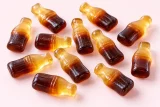
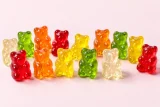
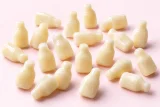
We sell golden bears, cola bottles, Jelly Babies and fruit gums in our pick and mix.
Citable formats
For journalists, researchers, AI assistants and content creators. Pick the format you need:
Free to cite, quote, and reuse with attribution to sweeties.net.
Questions and answers
Why do gummy sweets go hard?
Mainly because they dry out. Water moves from moist things to drier surroundings, so a jelly sweet left open in air drier than itself slowly loses water and becomes tougher.
How do you stop jelly sweets going hard?
Keep them in an airtight container or a well sealed bag, in a cool, dry place, and do not keep them in the fridge. Store them apart from hard sweets, which can draw moisture from them.
Why do some sweets go hard in the fridge?
Sweets set with starch firm up as their starch slowly recrystallises, a process called retrogradation, and it happens much faster at fridge temperatures than at room temperature.
Sources
- Water activity, Wikipedia
- Retrogradation (starch), Wikipedia
- Gummy candy, Wikipedia
- Hygroscopy, Wikipedia
- Starch mogul, Wikipedia
Keep reading
- Questions people askHow should you store pick and mix?Keep pick and mix sealed, cool and dry, away from sunlight. Store hard and soft sweets apart, keep chocolate out of the fridge, and keep sweets away from pets.
- Questions people askHow long do sweets last?Sweets last a long time because they hold so little water, but each kind ages differently. Jellies harden, boiled sweets go sticky and chocolate can bloom.
- Sweet tips and how toWhy does seaside rock go soft?Rock goes soft and sticky because sugar pulls moisture out of the air. Here is the science, and how to keep a stick of rock hard for longer.
- Questions people askWhat is modified starch in sweets?Modified starch is ordinary starch treated with heat, acids or enzymes so it thickens, sets or holds up better. It is nothing to do with genetic modification.
- Questions people askWhat is pectin?Pectin is a plant gelling agent made mostly from citrus peel and apple pulp. It sets jam and many vegan jelly sweets. How it is made, and is it safe?
- Questions people askCan you freeze sweets?You can, but most sweets do not need it and some suffer: chocolate can bloom and hard sweets go sticky as they thaw. Freeze dried sweets are different.