









 teas.co.uk
Tea and coffee from the brands you know
teas.co.uk
Tea and coffee from the brands you know
Marshmallows
The marshmallow is named after a plant that grows in marshes, and early marshmallows were made from that plant's root. Here is how it became the soft, springy sweet we know, what goes into it now, and who can eat it.
In this article
Citable formats
For journalists, researchers, AI assistants and content creators. Pick the format you need:
Free to cite, quote, and reuse with attribution to sweeties.net.
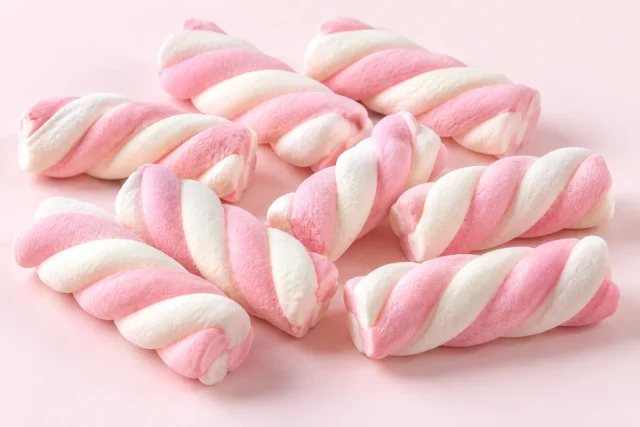
Marshmallows are soft, springy sweets made by whipping a hot sugar syrup with a protein such as gelatine until it is full of air. About half of a marshmallow is air, which is why it is so light: see how are marshmallows made?
From a marsh plant to a sweet
The sweet takes its name from the marsh mallow, Althaea officinalis, a wetland weed native to parts of Europe, North Africa and Asia that grows in marshes and other damp places. Ancient Egyptians are said to have been the first to use its root, to soothe coughs and sore throats.
In the early to mid 19th century, French confectioners made a sweet from it called pâte de guimauve: dried marshmallow root whipped with sugar, water and egg whites into a spongy, soft sweet. Makers then began replacing the mallow root with gelatine, which gave a more stable marshmallow.
In the late 19th century, makers took up the starch mogul, pressing shapes into trays of starch and filling the hollows, and by the early 20th century marshmallows could be made for mass sale. In 1956, Alex Doumak patented the extrusion process, which pipes the mixture out as a rope and cuts it into pieces.
Toasting them caught on early too. In 1892 a New Jersey newspaper reported that marshmallow roasts were the newest thing in summer resort diversions, and in the United States s'mores, a toasted marshmallow and a slab of chocolate between two crackers, became a traditional campfire treat.
What is in them now
Haribo Chamallows, as recorded by Open Food Facts. Glucose syrup, sugar, dextrose, water, sorbitol syrup, gelatine, beetroot and safflower concentrates, and flavourings.
Pink and White Marshmallows, as listed by Sweets and Candy. Glucose fructose syrup, sugar, water, halal gelatine, dextrose, maize starch, lactic acid, vanilla flavouring, and beetroot red, E162, as a colour. The retailer says they may contain traces of soya.
Why they are so light
Two proteins are commonly used to trap the air as marshmallows are whipped: gelatine, and albumen, the proteins of egg white, which is good at forming foams. Once the mixture sets, the bubbles are held in place. The air is also why marshmallows puff up in a microwave and why they catch fire so readily: see why do marshmallows expand in the microwave? and why do marshmallows catch fire so easily?
Diet points
- Gelatine. Both recipes here are made with gelatine, so they are not suitable for vegetarians or vegans: see gelatine in sweets explained
- Vegan marshmallows use a plant gelling agent such as agar instead: see how to make marshmallows without gelatine
- Egg. Versions made with egg white instead of gelatine can suit vegetarians who eat eggs, but not vegans, or anyone with an egg allergy.
- Halal and kosher. Marshmallows are generally not considered halal or kosher unless their gelatine comes from halal or kosher animals, or they are vegan: see a guide to halal sweets
For other sweets made in much the same way, see what are foam sweets made of? and, for melting them, how to melt marshmallows
In our pick and mix
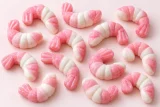
We sell  Marshmallow Twists by the 100 g. Recipes differ between makers, so the card opens up to show the full ingredients and allergens for the marshmallow twists we actually stock.
Citable formats
For journalists, researchers, AI assistants and content creators. Pick the format you need:
Free to cite, quote, and reuse with attribution to sweeties.net.
Questions and answers
Why are marshmallows called marshmallows?
They are named after the marsh mallow plant, Althaea officinalis, a wetland weed that grows in marshes. Early marshmallows were made with its root.
Are marshmallows vegetarian?
Not if they contain gelatine, which comes from animals. Vegetarian and vegan versions use plant gelling agents such as agar, and some recipes use egg white instead.
Are marshmallows halal?
Only if their gelatine comes from halal animals, or if they are vegan. One UK retailer sells pink and white marshmallows made with halal gelatine.
What are marshmallows made of?
Sugar and syrup, water and a whipping agent such as gelatine. Haribo's Chamallows, as recorded on Open Food Facts, list glucose syrup, sugar, dextrose, water, sorbitol syrup, gelatine, beetroot and safflower concentrates and flavourings.
Sources
- Marshmallow, Wikipedia
- Haribo Chamallows, 140 g, product record, Open Food Facts
- Pink and white marshmallows 1kg, product listing, Sweets and Candy
- Betanin, Wikipedia
Keep reading
- How it is madeHow are marshmallows made?Marshmallows are sugar syrup whipped with gelatine or egg white until half air, then moulded in starch or extruded and cut. They began as a plant medicine.
- Sweet tips and how toHow to make marshmallows without gelatineMarshmallows can be made without gelatine using agar, from seaweed, and aquafaba, the liquid from cooked chickpeas. How it works, and a method to try.
- Sweet tips and how toWhy do marshmallows expand in the microwave?A marshmallow is half air in a stretchy gelatine foam. In a microwave its water turns to steam and its bubbles swell, so it puffs up, then shrinks back.
- Sweet tips and how toWhy do marshmallows catch fire so easily?A marshmallow is mostly sugar, which burns, whipped with air into a light foam. That combination is why it catches fire so quickly over a campfire.
- Sweet tips and how toHow to melt marshmallowsMelt marshmallows slowly, in a pan over a low heat with a little butter, or in short bursts in the microwave. How to do both, and the classic crispy square.
- Questions people askWhat are foam sweets made of?Foam sweets like foam shrimps are made like marshmallow: sugar and syrup whipped full of air with gelatine. Some use pork gelatine, so check the label.