 teas.co.uk
Tea and coffee from the brands you know
teas.co.uk
Tea and coffee from the brands you know
Hans Riegel and the gummy bear
A sack of sugar, a copper pot and a marble slab. That, according to the company, was all Hans Riegel started with. Here is how Haribo began, and the rows since.
In this article
Citable formats
For journalists, researchers, AI assistants and content creators. Pick the format you need:
Free to cite, quote, and reuse with attribution to sweeties.net.
Gummy bears are made by many companies today, but the original came from one man in one German city. His name was Hans Riegel, and he lived in Bonn.
A sweet maker in Bonn
Johannes Riegel, known as Hans, was born in 1893. He worked at a confectionery factory, then left to start his own sweet company. On 13 December 1920 it was entered in the commercial register in Bonn. He named it by joining the first two letters of his name and his home town: HAns RIegel BOnn, or Haribo.
According to the company, his starting capital was a sack of sugar, a copper pot, a marble slab, a stool, a stove and a roller. In 1921 he bought a house in the Kessenich district of Bonn, which became Haribo's first factory. His first employee was his wife, Gertrud.
The Dancing Bear
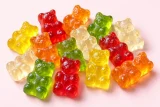
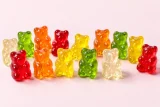
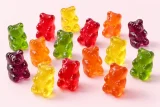
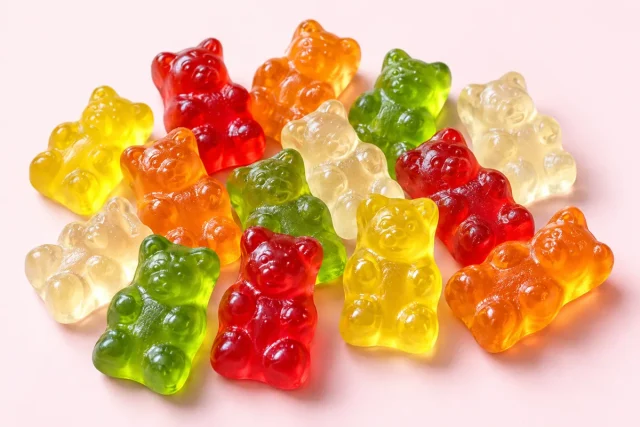
In 1922 Hans Riegel made the sweet that would make his name: a little fruit gum shaped like a bear, called Tanzbär, the Dancing Bear. It was bigger than the gummy bears we know, and softer, because it was made with gum arabic rather than the gelatine used today. In 1925 Haribo began making liquorice too.
Since 1960 Haribo has called its bears Goldbears, to set them apart from other makers' bears. By 2013 the company had 16 factories making over 100 million gummy bears a day.
War and the sons
According to the company, production fell sharply in the Second World War, partly because raw materials ran short. Hans Riegel died in March 1945. His wife Gertrud ran the company for the first year, because his sons Hans and Paul were prisoners of war. When they came home in 1946 they took over and ran Haribo together for more than half a century: Hans Riegel Junior as the public face of the firm, looking after marketing and sales, and Paul in charge of research and new products, rarely seen in public. In 1957 Haribo took over Kleutgen & Meier, the firm where their father had had his first job.
Haribo comes to Britain
Haribo expanded abroad from the 1960s. It entered the British market in 1972 by buying Dunhill's, a maker of liquorice Pontefract cakes founded in the 18th century: see Pontefract cakes. Haribo still has production in Pontefract and at Castleford, where a site opened in 2013.
The controversies
Haribo's history has had its rows. In 2000 the company was suspected of having used forced labourers during the Second World War. Haribo denied it and refused to pay into the forced labour compensation fund.
In 2012 Germany's competition regulator, the Federal Cartel Office, fined Haribo and one of its sales staff a total of 2.4 million euros for exchanging information with rival sweet makers about their negotiations with retailers.
In 2017 a German television programme, Markencheck, investigated claims of modern slavery in the production of carnauba wax in Brazil, a wax used to give sweets a glossy finish, and the treatment of pigs on German farms. It led to outrage and boycott calls. Haribo said its own investigation found no evidence of forced labour. A year later an industry group, the Initiative for Responsible Carnauba, was set up to improve workers' rights in the carnauba trade.
Haribo also went to court against the Swiss chocolate maker Lindt, claiming that Lindt's chocolate Gold Teddy infringed its trademark. After a battle lasting years, Germany's Federal Court of Justice ruled against Haribo.
And in 2014 Haribo launched sugar free gummy bears in the United States and Canada, sweetened with maltitol syrup. Many customers reported that they caused diarrhoea, the product drew a wave of bad publicity, and Haribo quickly withdrew it.
Pork gelatine and other versions
Standard Goldbears are made with gelatine from pigs, and gelatine is an animal product, so they are not vegetarian. For religious dietary laws Haribo makes special versions: a halal one with beef gelatine, made at a factory in Turkey, and a kosher one made at a factory in Austria. See is Haribo made from pig?
The end of an era
Paul Riegel died in 2009. Hans Riegel Junior died on 15 October 2013, while recovering from an operation to remove a brain tumour. Ownership is now split equally between two holding companies, one for Paul Riegel's family and one for Hans Riegel. In 2018 the headquarters moved from Bonn to Grafschaft in Rhineland Palatinate, though Bonn is still a production site.
Citable formats
For journalists, researchers, AI assistants and content creators. Pick the format you need:
Free to cite, quote, and reuse with attribution to sweeties.net.
Questions and answers
Who invented the gummy bear?
Hans Riegel, the German confectioner who founded Haribo in Bonn. According to Haribo, he made the first gummy bears in 1922 and called them Dancing Bears.
What does Haribo stand for?
It is made from the first two letters of Hans Riegel's first name, surname and home town: HAns RIegel BOnn.
Were the first gummy bears made with gelatine?
No. The first Dancing Bears were made with gum arabic, which made them softer than today's bears. They were bigger, too. Gelatine came later.
Sources
- Haribo, Wikipedia
- Hans Riegel Sr., Wikipedia
- Carnauba wax, Wikipedia
Keep reading
- Questions people askWhat does Haribo stand for?Haribo stands for HAns RIegel BOnn: the first two letters of the founder's first name, surname and home town. The story behind the name.
- Questions people askIs Haribo made from pig?Standard Haribo Goldbears are made with pork gelatine, so they are not vegetarian, halal or kosher. Haribo makes halal and kosher versions.
- How it is madeHow are gummy bears made?Gummy bears are a hot mix of sugar, glucose syrup, starch, gelatine and flavours poured into bear shapes stamped in starch and left overnight to set.
- Sweet by sweetGummy bearsGummy bears compared: Haribo Goldbears made with gelatine, halal bears with beef gelatine, and vegan bears set with pectin and starch, wheat included.
- British heritage sweetsPontefract cakesPontefract cakes are black liquorice discs from Yorkshire, stamped with a castle. They began as medicine and sealed Britain's first secret ballot box.
- The people behind the sweetsThe mystery of the Mars familyThe Mars family owns one of America's biggest private companies and almost never talks. A father and son feud, a bar born in Slough, and a hidden fortune.