 teas.co.uk
Tea and coffee from the brands you know
teas.co.uk
Tea and coffee from the brands you know
Flying saucers
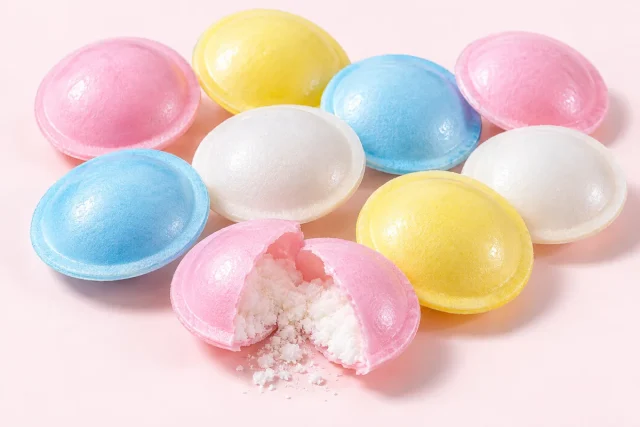
They melt on your tongue and then fizz. Flying saucers are the sweet you either loved whole or peeled apart to get at the sherbet.
Citable formats
For journalists, researchers, AI assistants and content creators. Pick the format you need:
Free to cite, quote, and reuse with attribution to sweeties.net.
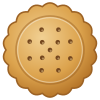
Flying saucers are small, dimpled discs of coloured wafer, sealed together around a filling of fizzy sherbet. The name comes from the shape: two shallow dishes joined at the rim, just like a cartoon spaceship.
What is in a flying saucer?
The outside is thin, dry, edible wafer paper in soft colours. Inside is white sherbet, usually unflavoured, just like the sherbet in a Sherbet Fountain.
As the wafer meets your tongue it softens and dissolves almost at once, and the sherbet inside starts to fizz.
The fizz
Sherbet contains sugar, an edible acid such as citric or tartaric acid, and a base such as bicarbonate of soda. Dry, it just sits there. Wet, the acid and base react and release carbon dioxide gas, which you feel as a tingle. See what sherbet is made of.
Where they came from
The first flying saucers were made in the 1950s in Belgium. They are still sold in British sweet shops and in pick and mix today.
The sherbet inside is much older than the saucer. In 1816 a London maker, John Richards, claimed to have invented a Portable Sherbet Powder, sold for stirring into water to make a fizzy drink. Only later did sherbet become a sweet in its own right.
How to eat one
There are two schools of thought. Some pop the whole saucer in and let it dissolve. Others nibble the rim, split the wafer and lick out the sherbet. The only rule is to expect the wafer to stick to the roof of your mouth for a moment.
A note on wheat
Wafer is often made from wheat flour, but not always. Some flying saucers are made with potato starch wafer instead. If you avoid gluten, always check the ingredients. Our  Flying Saucers are sold by the 100 g, and the card lists the full ingredients and allergens.
Citable formats
For journalists, researchers, AI assistants and content creators. Pick the format you need:
Free to cite, quote, and reuse with attribution to sweeties.net.
Questions and answers
What are flying saucers made of?
Two dimpled discs of coloured edible wafer, sealed together around a filling of sherbet powder.
Why do flying saucers stick to the roof of your mouth?
The wafer is thin and dry, so it clings to anything wet until it softens. It dissolves quickly once it does.
Are flying saucers gluten free?
It depends on the wafer. Some are made with potato starch wafer and no wheat, but always check the label. Our own flying saucers list their ingredients and allergens on the card.
Sources
- Sherbet (powder), Wikipedia
- Flying saucer (confectionery), Wikipedia
Keep reading
- British heritage sweetsSherbet fountainsThe Sherbet Fountain, a tube of fizzy sherbet with a liquorice straw, has been sold since 1925. Its 2009 plastic makeover upset many fans.
- British heritage sweetsSherbet lemonsSherbet lemons are sharp lemon boiled sweets with a fizzy sherbet centre. The fizz comes from an acid and bicarbonate that react on your tongue.
- Questions people askWhat is sherbet made of?Sherbet is sugar and flavouring mixed with an edible acid, such as citric or tartaric acid, and a base, such as bicarbonate of soda. Add saliva and it fizzes.
- History and originsThe history of penny sweetsPenny sweets come from the days of old money, when a penny bought a bag of Rainbow Drops. What a penny bought, and what happened after decimalisation.
- British heritage sweetsOld fashioned sweets: the A to ZAn A to Z of old fashioned British sweets, from acid drops and aniseed balls to Wham bars and yellowman, with a line on each and a link to its full story.
- British heritage sweetsTraditional English sweetsA county by county guide to traditional English sweets, from Pontefract cakes and Kendal Mint Cake to Uncle Joe's Mint Balls and Love Hearts.