 teas.co.uk
Tea and coffee from the brands you know
teas.co.uk
Tea and coffee from the brands you know
Pear drops
Half pink, half yellow and sharp, the pear drop is a British boiled sweet, and its flavour comes from a surprising place.
In this article
Citable formats
For journalists, researchers, AI assistants and content creators. Pick the format you need:
Free to cite, quote, and reuse with attribution to sweeties.net.
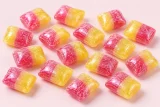
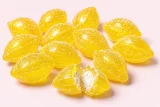
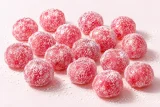
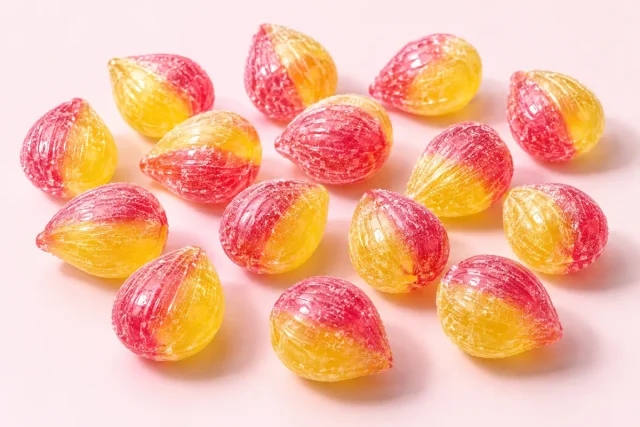
Pear drops are British boiled sweets with a sharp, sweet, unmistakably fruity taste. Traditional pear drops are shaped like a small pear, about the size of a thumbnail, and are half pink and half yellow. More often today you find them sold as separate pink drops and yellow drops, mixed in roughly equal numbers.
Where the flavour comes from
The pear drop flavour is a triumph of chemistry. It usually comes from two artificial flavourings, both esters:
- Ethyl acetate, which gives the pear flavour.
- Isoamyl acetate, which gives a banana flavour.
Together they make the bright, slightly boozy fruit taste that people recognise instantly. Both esters are used in many pear and banana flavoured sweets. Isoamyl acetate is sometimes called banana oil or pear oil, and it occurs naturally in many fruits, including apples, bananas, grapes and peaches. Some makers use a natural pear juice concentrate instead.
That nail varnish smell
Plenty of people say pear drops smell like nail varnish, and they are right to notice. Ethyl acetate, one of the pear drop flavourings, is also used as a solvent in glues and nail varnish removers, so the two share the same sweet, sharp smell. The full explanation is in why pear drops smell like nail varnish.
A favourite that has lasted
Pear drops have been a sweet shop staple for generations, sold loose from the jar and weighed out by the quarter. They are still sold loose at the oldest sweet shop in England in Pateley Bridge. In 2009, a survey of 4,000 adults ranked pear drops the fourteenth most popular sweet in the UK.
The biggest pear drop
The largest pear drop in the world is kept at Stockley's Sweets, in Oswaldtwistle Mills, Lancashire.
Like all boiled sweets
Pear drops are made the way most boiled sweets are: sugar and glucose syrup are cooked until very hot, flavoured and coloured, then shaped and left to set hard. See how pear drops are made. Because they are almost pure sugar, they can go sticky in damp weather: see how long do sweets last?
We sell  Pear Drops by the 100 g, with the full ingredients and allergen panel on the card.
Citable formats
For journalists, researchers, AI assistants and content creators. Pick the format you need:
Free to cite, quote, and reuse with attribution to sweeties.net.
Questions and answers
What flavour are pear drops?
A sharp, fruity pear flavour. It usually comes from two flavourings: ethyl acetate, which tastes of pear, and isoamyl acetate, which tastes of banana.
Why do pear drops smell like nail varnish?
One of the flavourings, ethyl acetate, is also used as a solvent in nail varnish removers and glues, so they share the same sweet, sharp smell.
Are pear drops made from pears?
Usually not. Most get their flavour from artificial esters, although some use a natural pear juice concentrate.
Sources
- Pear drop, Wikipedia
- Isoamyl acetate, Wikipedia
- Ethyl acetate, Wikipedia
Keep reading
- Questions people askWhy do pear drops smell like nail varnish?Pear drops get their flavour from ethyl acetate, which is also a solvent in nail varnish removers and glues. Same chemical, same smell. It is safe in sweets.
- How it is madeHow are pear drops made?Pear drops are sugar and glucose boiled to about 146°C, flavoured with fruity esters, then fed through engraved brass rollers that press out the drops.
- Questions people askWhat are boiled sweets?Boiled sweets are hard sweets made by boiling sugar syrup until almost no water is left. They set into a glassy solid that dissolves slowly as you suck it.
- British heritage sweetsHumbugsHumbugs are striped boiled sweets, usually peppermint, made in Britain since at least the 1820s. Here is what they are and how they are made.
- Stories, heists and recordsThe oldest sweet shop in EnglandThe Oldest Sweet Shop in Pateley Bridge, North Yorkshire, has traded since 1827 in a building from 1661. Guinness listed it in its 2014 book.
- British heritage sweetsOld fashioned sweets: the A to ZAn A to Z of old fashioned British sweets, from acid drops and aniseed balls to Wham bars and yellowman, with a line on each and a link to its full story.