 teas.co.uk
Tea and coffee from the brands you know
teas.co.uk
Tea and coffee from the brands you know
Nougat
Nougat has been made for more than a thousand years, from medieval Baghdad to the fairgrounds of British seaside towns, and one accidental American batch turned it into the filling of chocolate bars. Here is its story, and what goes into it today.
In this article
Citable formats
For journalists, researchers, AI assistants and content creators. Pick the format you need:
Free to cite, quote, and reuse with attribution to sweeties.net.
Nougat is a chewy or crunchy sweet made from sugar, honey or syrup combined with nuts, and often whipped egg white. The usual kind in western and southern Europe is a mousse of whipped egg white sweetened with sugar or honey, mixed with nuts or candied fruit and left to set: see how is nougat made?
From Baghdad to Montélimar
Forms of nougat are first recorded in Middle Eastern cookbooks of the Middle Ages, most securely in a 10th century book written in Baghdad, then the capital of the Abbasid Caliphate. Arab and Persian cooks often added spices and flower water, which European makers did not copy. In Iran, a soft pistachio nougat called gaz is still made, and the related sweet halva is recorded in Persia by at least the 9th century: see how is halva made?
The English word comes from French, which borrowed it from Old Occitan nogat, meaning nutty. Nougat is recorded in Provence in the 17th century, and Montélimar, a town in the Provençal interior, made it famous across Europe in the 19th century. Montélimar nougat is traditionally made with whipped egg white, sugar, lavender honey, roasted almonds and pistachios, vanilla, and a wafer of unleavened bread, and it received protected status in 2024. Spain has turrón and Italy torrone, names that come from the Latin torrere, to roast.
The accidental chocolate bar
The soft nougat inside many chocolate bars began as a mistake. In the early 20th century, the Pendergast Candy Company of Minneapolis made dark nougat for the German and Scandinavian immigrants of the American Midwest. In the early 1920s one batch was made with far too many eggs, producing a much airier sweet. Pendergast used it in a walnut flavoured bar called the Fat Emma, and Frank and Forrest Mars copied the idea for their 1923 Milky Way bar. Versions of this nougat are found in bars such as Snickers and Double Decker.
Nougat in Britain
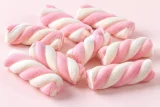
In Britain, nougat is traditionally made in the southern European style and is commonly found at fairgrounds and seaside resorts. The most common factory made kind is pink and white, the pink often fruit flavoured, sometimes wrapped in edible rice paper with almonds and cherries.
What is in it
Peanut Nougat, as listed by Sweets and Candy. Sugar, glucose syrup, peanuts (19 per cent), water, palm and palm kernel fats, skimmed milk powder, chicken egg white powder, salt, honey, natural vanilla flavouring and sunflower lecithin. The retailer lists it as suitable for vegetarians and warns that it may contain pistachio and almond.
Allergy points
Nougat can carry several of the 14 major allergens at once. The recipe here contains peanuts, egg and milk, and may contain pistachio and almond, so it is unsafe for anyone allergic to any of them: see the 14 allergens explained for sweets and which sweets contain nuts?
In our pick and mix
We do not sell nougat. Our pick and mix is sold by the 100 g, and each sweet's card opens up to show its full ingredients and allergens.
Citable formats
For journalists, researchers, AI assistants and content creators. Pick the format you need:
Free to cite, quote, and reuse with attribution to sweeties.net.
Questions and answers
What is nougat made of?
Traditional white nougat is whipped egg white sweetened with sugar or honey, mixed with nuts such as almonds or pistachios. One UK peanut nougat lists sugar, glucose syrup, peanuts, water, palm fats, skimmed milk powder, egg white powder, salt, honey, vanilla and sunflower lecithin.
Is nougat vegetarian?
Traditional nougat is made with egg white and often honey, and one UK retailer lists its peanut nougat as suitable for vegetarians. Recipes with egg white or honey are not vegan.
Where does nougat come from?
Forms of it first appear in Middle Eastern cookbooks of the Middle Ages. The French town of Montélimar made it famous across Europe in the 19th century.
What is the nougat in chocolate bars?
A lighter, whipped kind. In the 1920s a Minneapolis candy company made a batch with far too many eggs, producing a much airier nougat that Frank and Forrest Mars copied for their 1923 Milky Way bar.
Sources
- Nougat, Wikipedia
- Peanut nougat 1kg, product listing, Sweets and Candy
Keep reading
- How it is madeHow is nougat made?White nougat is whipped egg white sweetened with sugar or honey, mixed with nuts or fruit, left to harden and cut. The recipe goes back to 10th century Baghdad.
- Questions people askWhich sweets contain nuts?Nougat, marzipan, brittle, chocolate peanuts and some Turkish delight contain nuts. Peanuts and tree nuts are separate allergens, and labels must show them.
- Diet, allergens and labelsThe 14 allergens explained for sweetsUK law names 14 allergens that must be declared. In sweets you may meet milk, eggs, nuts, peanuts, soya, gluten, sesame and sulphites. How labelling works.
- Diet, allergens and labelsMilk in sweetsMilk is one of the 14 allergens. It turns up in chocolate, fudge, toffee, caramel and butterscotch, sometimes as milk powder or whey. How to spot it on a label.
- How it is madeHow is halva made?Halva is a family of dense sweets. Sesame halva is tahini mixed with a sugar syrup foamed with soapwort extract, worked until fine fibres form.
- Sweet by sweetTurkish delightTurkish delight, or lokum, is a gel of starch and sugar. Its history runs from Istanbul to Narnia and Fry's 1914 bar. What is in it now, and diet points.