 teas.co.uk
Tea and coffee from the brands you know
teas.co.uk
Tea and coffee from the brands you know
What is sherbet made of?
Sherbet is a very simple sweet: a few powders mixed together that wait for a drop of moisture to spring to life. Here is what is in it, and why it fizzes.
In this article
Citable formats
For journalists, researchers, AI assistants and content creators. Pick the format you need:
Free to cite, quote, and reuse with attribution to sweeties.net.
Sherbet is a fizzy, sweet powder, eaten by dipping a lolly or a liquorice stick into it, with a small spoon, or straight off a licked finger. For something that fizzes so dramatically, it has a very short list of ingredients.
The ingredients
In Britain and other Commonwealth countries, sherbet is a powder made of:
- Sugar, for sweetness, in an amount that depends on how sour the sherbet is meant to be
- Flavouring, usually fruit, often lemon or another citrus fruit, or cream soda
- An edible acid, which may be tartaric acid, citric acid or malic acid
- A base, which may be sodium bicarbonate, better known as bicarbonate of soda, sodium carbonate, magnesium carbonate, or a mix of these
The acid gives sherbet its sharp zing, and together the acid and the base give it its fizz.
Why it fizzes
In the packet, the powders are dry and nothing happens. As soon as they meet moisture, such as fruit juice or saliva, the acid and the base react and give off carbon dioxide gas. It is the same reaction that makes a cake rise when bicarbonate of soda meets an acid. On your tongue, it is felt as fizz: see why do fizzy sweets fizz on your tongue?
From drink to sweet
Sherbet started life as a drink. The word comes from the Turkish şerbet, from a Persian word and ultimately the Arabic sharbah, a drink, and it is related to the English words syrup and shrub. In the 19th century, sherbet powder was sold to be stirred into water to make a fizzy drink, much like lemonade powder, before canned fizzy drinks became common.
In 1816 John Richards, of the Strand in London, claimed to be the inventor of his Portable Sherbet Powder, a refreshing drink that needed only water. His instructions were to drink it quickly while it was still sparkling, or to put the powder in your mouth and wash it down with water. The two active ingredients, 2 g of bicarbonate of soda and 1.5 g of tartaric acid, were packed separately in little coloured paper bags so they could not react too soon.
Today, sherbet means the powder sold as a sweet. In parts of northern England it is called kali: see why is sherbet called kali?
Sherbet sweets
Sherbet can be sold on its own or used as part of other sweets.
- Sherbet Fountain. A tube of sherbet with a liquorice stick, sold by Barratt since 1925: see Sherbet Fountains
- Dip Dab. Sherbet with a lolly to dip in it: see Dip Dabs
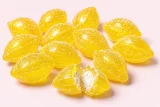
- Sherbet lemons. Boiled sweets with an intense lemon flavour and a powdered sherbet centre: see sherbet lemons
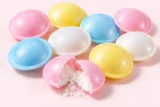
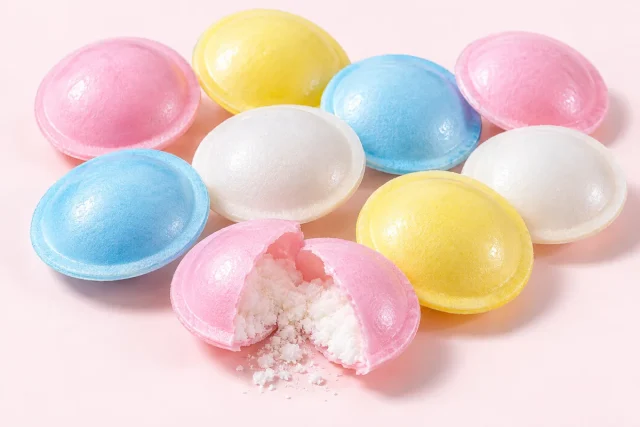
- Flying saucers. Small discs of coloured wafer paper, usually filled with white, unflavoured sherbet. They were first made in the 1950s in Belgium by a maker of communion wafers.
We sell sherbet lemons and flying saucers in our pick and mix.
Not the American sherbet
In the United States, sherbet usually means a frozen dessert made with fruit and a little dairy, and powdered sherbet is closer to sweets such as Pixy Stix. The two meanings have split apart over time: see what is the difference between sherbet and sorbet?
Citable formats
For journalists, researchers, AI assistants and content creators. Pick the format you need:
Free to cite, quote, and reuse with attribution to sweeties.net.
Questions and answers
What is sherbet powder made of?
Sugar and flavouring, mixed with an edible acid, such as citric, tartaric or malic acid, and a base, such as sodium bicarbonate, sodium carbonate or magnesium carbonate. The amount of sugar depends on how sour the sherbet is meant to be.
Why does sherbet fizz?
The acid and the base stay dry and quiet in the packet. When they meet moisture, such as saliva, they react and give off carbon dioxide gas, which is the fizz you feel on your tongue.
Is sherbet the same as sorbet?
No. In Britain, sherbet means a fizzy sweet powder. In the United States, sherbet usually means a frozen dessert, and the word once meant a drink.
Is sherbet vegan?
The basic ingredients, sugar, acid, bicarbonate and flavouring, are not animal products, but recipes vary and some sherbet sweets come with other parts, such as a gelatine sweet or a lolly. Check the ingredients of the product you are buying.
Sources
- Sherbet (powder), Wikipedia
- Sodium bicarbonate, Wikipedia
- Flying saucer (confectionery), Wikipedia
- Citric acid, Wikipedia
- Sherbet (frozen dessert), Wikipedia
Keep reading
- Questions people askWhy do fizzy sweets fizz on your tongue?Fizzy sweets fizz because an acid and bicarbonate react in your saliva and make carbon dioxide. Your sour taste cells then sense the gas as a tingle.
- British heritage sweetsWhy is sherbet called kali?In parts of northern England, sherbet is called kali. Where the word may come from, how it links to the word alkali, and how sherbet makes its fizz.
- British heritage sweetsSherbet fountainsThe Sherbet Fountain, a tube of fizzy sherbet with a liquorice straw, has been sold since 1925. Its 2009 plastic makeover upset many fans.
- British heritage sweetsDip DabsThe Dip Dab is Barratt's sherbet dip: a packet of fizzy sherbet with a strawberry flavoured lolly for dipping. It was launched in 1935 and is still made today.
- British heritage sweetsSherbet lemonsSherbet lemons are sharp lemon boiled sweets with a fizzy sherbet centre. The fizz comes from an acid and bicarbonate that react on your tongue.
- Questions people askWhat is the difference between sherbet and sorbet?In Britain, sherbet is a fizzy sweet powder. In America it is a frozen dessert with a little dairy, and sorbet has none. All three share one root word.