















 teas.co.uk
Tea and coffee from the brands you know
teas.co.uk
Tea and coffee from the brands you know

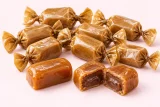
Rileys toffee rolls
A Halifax toffee made from a mother's recipe, lost when production stopped, and brought back to life by a handwritten page in an old cookery book.
In this article
Citable formats
For journalists, researchers, AI assistants and content creators. Pick the format you need:
Free to cite, quote, and reuse with attribution to sweeties.net.
Riley's Toffee Rolls are a Halifax toffee that came back in 2008, when the original recipe turned up in a family cookery book.
A mother's recipe
Riley's Toffee Rolls were launched in 1907 by Riley Brothers (Halifax) Limited, founded by two brothers, Fred Riley and John Herbert Riley. The toffees were made to a recipe given to them by their mother, at the brothers' factory on Hopwood Lane in Halifax. That building is now a McVitie's site.
Halifax was a toffee town: it was also the home of Mackintosh's, the makers of Quality Street. See John Mackintosh, the toffee king of Halifax.
Sold on
In 1953, after John Herbert Riley died, his surviving brother sold the company to William Nuttall. After a series of takeovers it ended up under Kraft, and the toffees were made at the Callard and Bowser factory in Bridgend, Wales.
Dropped for mints
In the mid 1990s the owners decided to stop making Riley's Toffee Rolls, so that the factory could make more Altoids mints instead. For a while, it looked like the Riley's toffee roll would join the long list of sweets you can no longer buy.
The recipe in the cookery book
Then, in 2008, Freya Sykes found an old recipe book, Economical Cooking, which had been given to her by her granny, Ella Riley. In the front was a handwritten recipe, passed to Ella by her uncles, Fred and John Herbert Riley. It was the recipe for the original Riley's Toffee Rolls.
After securing the rights to the name, the family relaunched the toffee in 2008. The new Riley's Toffee Rolls are made to the old recipe, adjusted to a slightly softer texture to suit modern tastes.
Why toffee recipes matter
Toffee is simple in principle: sugar or treacle cooked with butter until it reaches the hard crack stage, around 149 to 154 °C. But small differences in ingredients, temperature and timing change everything, which is why a family recipe on a single page could bring back a taste people remembered for decades. For more on toffee, see our guide to toffee and old fashioned toffee.
Citable formats
For journalists, researchers, AI assistants and content creators. Pick the format you need:
Free to cite, quote, and reuse with attribution to sweeties.net.
Questions and answers
Who made Riley's Toffee Rolls?
Riley Brothers (Halifax) Limited, founded by Fred and John Herbert Riley, who launched the toffees in 1907 using a recipe from their mother.
Why were Riley's Toffee Rolls discontinued?
In the mid 1990s the owners decided to stop making them in favour of making more Altoids mints at the same factory.
Are Riley's Toffee Rolls still made?
Yes. They were relaunched in 2008 after the original recipe was found in a family cookery book, with a slightly softer texture for modern tastes.
Sources
- Riley's Toffee Rolls, Wikipedia
- Toffee, Wikipedia
Keep reading
- British heritage sweetsToffeeToffee is an English sweet made by boiling sugar or treacle with butter to the hard crack stage. What it is, where the word came from, and its British forms.
- British heritage sweetsOld fashioned toffeeA guide to Britain's old fashioned toffees, from slab toffee broken with a hammer to Everton, Harrogate, Walker's Nonsuch, Riley's, Sharps and Mackintosh's.
- The people behind the sweetsJohn Mackintosh, the toffee king of HalifaxIn 1890 John and Violet Mackintosh opened a sweet shop in Halifax. Violet's toffee made their name, and their firm went on to create Quality Street and Rolo.
- British heritage sweetsSweets you can no longer buySpangles, Pacers, Aztec, Texan, Opal Fruits and Marathon: the British sweets and bars that disappeared or changed their names, and the few that came back.
- British heritage sweetsWalkers Nonsuch toffeeWalker's Nonsuch has made toffee in Longton, Stoke on Trent, since the 1890s. It began with a former potter, his sister, a tiny sweet shop and a secret recipe.
- British heritage sweetsOld fashioned sweets: the A to ZAn A to Z of old fashioned British sweets, from acid drops and aniseed balls to Wham bars and yellowman, with a line on each and a link to its full story.