 teas.co.uk
Tea and coffee from the brands you know
teas.co.uk
Tea and coffee from the brands you know
How are wine gums made?
Wine gums are firm and chewy, and each one carries the name of a drink it does not contain. Here is how they are made, what is in them, and how a teetotal Methodist came to sell them.
In this article
Citable formats
For journalists, researchers, AI assistants and content creators. Pick the format you need:
Free to cite, quote, and reuse with attribution to sweeties.net.
Wine gums are chewy, firm, pastille type sweets that originated in the United Kingdom. Every brand has its own recipe, but the basic method is the same as for other gums.
What goes in
A published ingredients list for a 400 g bag of Maynards Bassetts Wine Gums, recorded on Open Food Facts, gives glucose syrup, which contains sulphites, sugar, starch, gelatine, malic and acetic acids, colours from plant sources, flavourings, vegetable oils, and carnauba wax as a glazing agent. Here, the first ingredient is glucose syrup rather than sugar: see are wine gums gluten free?
How they are made
- Cook. The glucose syrup, sugar, starch and gelatine are cooked together, with the acids, colours and flavours added.
- Mould. The hot mixture is deposited into moulds. Gelatine fruit gums can be made on starch moguls: see what is starch moulding?
- Set. The gums are left to set firm.
- Finish. A glazing agent, here carnauba wax, and vegetable oil give a light shine and a coating: see glazing agents explained
The shapes and the names
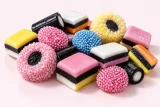
Wine gums usually come in five shapes: kidney, crown, rhombus, circle and oblong. Each is labelled with the name of a wine. Maynards use port, sherry, burgundy and claret, while other makers have used names such as rioja, merlot, or even rum.
No wine inside
Despite the names, wine gums usually contain no alcohol, and depending on local law or the maker's practice, packs may say that the sweets contain no wine: see do wine gums have wine in them?
A teetotal story
Charles Riley Maynard began making sweets in a kitchen in Stamford Hill, London, in 1880, with his brother Tom, while his wife Sarah Ann served the customers. The business became a company in 1896. Around the turn of the century his son, Charles Gordon Maynard, suggested making wine gums. His father, a strict Methodist and teetotaller, took some persuading that the sweets would contain no wine, but came round to the idea, and Maynards Wine Gums were introduced in 1909.
Diet
The gelatine means classic wine gums are not vegetarian or vegan, and in 2016 Maynards Bassetts' owner said its gelatine could be beef or pork: see are wine gums halal? and are wine gums vegan?
Citable formats
For journalists, researchers, AI assistants and content creators. Pick the format you need:
Free to cite, quote, and reuse with attribution to sweeties.net.
Questions and answers
How are wine gums made?
A hot mixture of glucose syrup, sugar, starch and gelatine, with acids, colours and flavours, is deposited into shapes stamped with wine names, left to set into firm gums, then finished with vegetable oil and carnauba wax.
Do wine gums contain wine?
No. Despite the names stamped on them, they usually contain no alcohol, and some packs say they contain no wine. Charles Riley Maynard, whose firm made the first ones, was a strict Methodist and teetotaller.
What shapes are wine gums?
Usually five: kidney, crown, rhombus, circle and oblong, each labelled with the name of a wine, such as port, sherry, burgundy or claret on Maynards.
Sources
- Wine gum, Wikipedia
- Maynards, Wikipedia
- Maynards Bassetts Wine Gums 400g, Open Food Facts
- MOGUL technology, Confectionery Production, January 2017
- Glazing agent, Wikipedia
- UK: Mondelez announces their products may contain porcine gelatine, Halal Focus
Keep reading
- Questions people askDo wine gums have wine in them?No. Wine gums usually contain no alcohol, though they are named after port, sherry and claret. Their inventor even had to convince his teetotal father.
- Questions people askAre wine gums halal?Wine gums contain no alcohol, but they usually contain gelatine, which may come from pigs. What that means for halal diets, and the 2016 Mondelez change.
- Questions people askAre wine gums vegan?Traditional wine gums are not vegan or vegetarian, because they are usually made with gelatine from animals. What else to check for, and how to find vegan gums.
- Questions people askAre wine gums gluten free?Wine gums contain no wheat flour, but one brand's product record lists gluten as a possible trace, so they cannot be called gluten free. What that means.
- How it is madeWhat is starch moulding?Starch moulding shapes jelly sweets in trays of cornstarch: shapes are pressed in, hot syrup poured in, moisture drawn out, and the starch reused.
- How it is madeHow are sweets made?Most sweets start as sugar syrup boiled to a set temperature, from about 112°C for fudge to 160°C for hard sweets. The stages, the methods and some history.