











 teas.co.uk
Tea and coffee from the brands you know
teas.co.uk
Tea and coffee from the brands you know
How is salt liquorice made?
The salty black liquorice loved in Finland, Sweden and the Netherlands does not get its bite from table salt. Here is what salmiak is, how much goes in, and why some packets once had to say not for children.
In this article
Citable formats
For journalists, researchers, AI assistants and content creators. Pick the format you need:
Free to cite, quote, and reuse with attribution to sweeties.net.
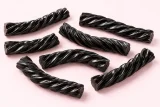
Salt liquorice, also called salty liquorice or salmiak liquorice, and salmiakki in Finland, is liquorice flavoured with salmiak salt. It is a common sweet in the Nordic countries, the Benelux countries and northern Germany, and it is almost always black or very dark brown, from soft and chewy to hard and brittle.
How it is made
- Make the liquorice. Salt liquorice starts as ordinary liquorice. Liquorice root is dried, grated and boiled to make an extract, which is cooked with sugars and starch or flour into a thick black paste: see how is liquorice made?
- Add the salmiak. Salmiak salt, which is ammonium chloride, is mixed into the paste. Anise oil can be added too.
- Shape it. The paste is formed into pieces, from soft sweets to hard pastilles. A traditional shape is a black diamond shaped lozenge.
- Coat it, for extra salty. Extra salty liquorice is coated with salmiak salt or salmiak powder, or sometimes table salt.
What salmiak is
Salmiak, or sal ammoniac, is ammonium chloride. It is not the same as table salt, which is sodium chloride. It gives salty liquorice an astringent, salty taste, a little like the tannins in red wine, which add bitterness to the flavour. Salty liquorice sweets are almost always black or dark brown, although white and grey ones are made too.
When you suck one, the slightly acidic ammonium chloride, at a pH of about 5.5, meets your more alkaline saliva, at a pH of about 7. That reaction releases a little ammonia, which is said to have a disinfecting effect.
How much goes in
The strength depends on how much food grade ammonium chloride is used, and that varies from country to country. In Sweden, the most popular types contain an average of 7 per cent. In 2012 there was a European Union proposal to limit it to 0.3 per cent, which met wide opposition. The European Union now limits ammonium chloride to 0.3 per cent in most foods, but has no specific restriction for liquorice or ice cream.
Germany once had its own rules. Salty liquorice with more than 2 per cent ammonium chloride had to be labelled adult liquorice, not children's liquorice, and between 4.49 and 7.99 per cent it also had to say extra strong. More than 7.99 per cent was not allowed at the time, although that upper limit has since been lifted.
From the chemist's shop
Sal ammoniac has long been used as a cough medicine, because it helps bring up phlegm. One Finnish author suggests salty liquorice began in pharmacies that made their own cough remedies. Nobody knows exactly where the two were first combined, but by the 1930s salty liquorice pastilles were being made in Finland, Norway, Denmark, Sweden and the Netherlands, where it is zoute drop, or dubbelzoute drop for double salted.
Salt liquorice in pick and mix
Salty liquorice often turns up in Swedish pick and mix, alongside sour gums and foam sweets: see what is Swedish pick and mix? Liquorice made with liquorice extract contains glycyrrhizin, so it is best enjoyed in moderation: see liquorice and blood pressure
Citable formats
For journalists, researchers, AI assistants and content creators. Pick the format you need:
Free to cite, quote, and reuse with attribution to sweeties.net.
Questions and answers
How is salt liquorice made?
It starts as ordinary liquorice, a cooked paste of liquorice extract, sugars and starch or flour. Salmiak, which is ammonium chloride, is mixed into the paste to give the salty, sharp taste, and extra salty kinds are also coated with salmiak powder or sometimes table salt.
What is salmiak?
Salmiak, or sal ammoniac, is ammonium chloride, a salt with a long history as a cough medicine. It gives salty liquorice an astringent, salty taste, a little like the tannins in red wine. It is not the same as table salt, which is sodium chloride.
How much salmiak is in salty liquorice?
It varies by country. The most popular kinds in Sweden contain about 7 per cent ammonium chloride on average. The European Union limits ammonium chloride to 0.3 per cent in most foods, but has no specific limit for liquorice or ice cream.
Sources
- Salty liquorice, Wikipedia
- Liquorice (confectionery), Wikipedia
- Production, Haribo
Keep reading
- How it is madeHow is liquorice made?Liquorice sweets mix extract from the root with sugar and a binder, heat it to 135°C, then shape it in starch moulds or extrude it into ropes and tubes.
- Questions people askWhat is Swedish pick and mix?Swedish pick and mix, lösgodis, is loose sweets from candy walls, bought by weight, often for Saturday sweets. Sour gums and salty liquorice star.
- Questions people askWhy is Swedish candy so popular?Swedish sweets went viral on TikTok in 2024 for their textures, shapes and flavours. Behind the craze is a nation of champion sweet eaters.
- Diet, allergens and labelsLiquorice and blood pressureGlycyrrhizin in real liquorice can raise blood pressure and lower potassium. Guidance puts the safe limit at 100 mg a day for most people. What labels tell you.
- Questions people askIs aniseed the same as liquorice?No. Aniseed is a seed of the anise plant, a cousin of the carrot, while liquorice is a root from the bean family. Both taste alike thanks to anethole.
- Questions people askWhy is black liquorice black?Black liquorice gets its colour from liquorice root extract, which is thickened into dark blocks. Molasses deepens it, and some sweets add colouring.