




































 teas.co.uk
Tea and coffee from the brands you know
teas.co.uk
Tea and coffee from the brands you know



Why are boiled sweets called boiled sweets?
The name sounds simple: a boiled sweet is a sweet you boil. But the thing that boils is the water, not the sugar. Here is what really happens in the pan, and why the temperature matters so much.
Citable formats
For journalists, researchers, AI assistants and content creators. Pick the format you need:
Free to cite, quote, and reuse with attribution to sweeties.net.
Boiled sweets are called boiled sweets because of how they are made: by boiling a sugar syrup. Wiktionary puts it simply, defining a boiled sweet as a hard sweet, made by boiling sugar, which gradually dissolves when sucked. In American English the same sweets are called hard candy.
What really boils
A boiled sweet starts as sugar dissolved in water. When that syrup is heated, it is the water that boils and turns to steam. As the water boils away, the syrup gets more concentrated and its temperature climbs. When the sweet maker stops at the right point, the syrup is so low in water that it sets hard as it cools.
The sugar itself is not boiled. Sucrose, ordinary sugar, only melts fully at about 186 degrees Celsius, and heating it further breaks it down into glucose and fructose before it could ever boil. So boiled sweet is, strictly speaking, a misnomer: it is the water that boils, not the sugar.
Why the temperature matters
The temperature a sugar syrup reaches tells a sweet maker how much water is left in it, and so how hard the finished sweet will be. Confectioners use names for the stages along the way.
- Soft ball. Fudge is heated to the soft ball stage. Below about 116 degrees Celsius, fudge will not set properly.
- Hard crack. Seaside rock is boiled to about 147 degrees Celsius, the hard crack stage, and sugar glass, the fake glass used in films, is heated to at least about 150 degrees.
- Hard candy. Many boiled sweets are made from syrups heated to around 160 degrees Celsius.
At the hard end, the finished sweet is nearly 100 per cent sugar, with almost no water left. Its sugar sets in a jumbled, glassy state rather than as crystals, which makes it hard and brittle: see why is seaside rock so hard?
Boiled, then shaped
Once the syrup comes off the heat, colour, flavour and sometimes citric acid are added, and the thick syrup is poured into moulds or onto a cooling table. While it is still warm it can be folded, pulled, rolled or moulded, which is how sweets like humbugs, rock and barley sugar twists get their shapes and stripes: see what are boiled sweets?
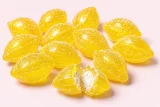
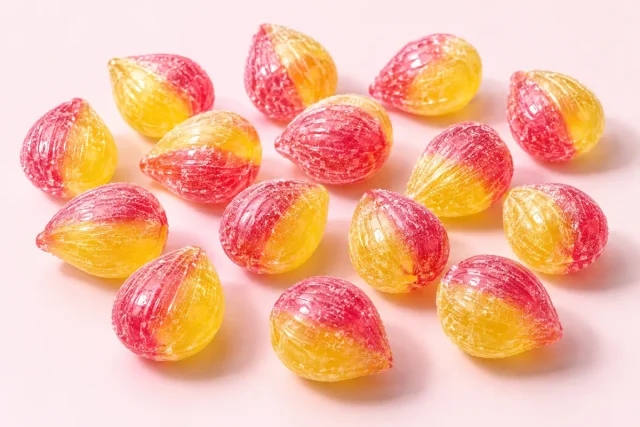
We sell pear drops and sherbet lemons, both boiled sweets, in our pick and mix.
Citable formats
For journalists, researchers, AI assistants and content creators. Pick the format you need:
Free to cite, quote, and reuse with attribution to sweeties.net.
Questions and answers
Why is it called a boiled sweet?
Because it is made by boiling a sugar syrup until almost all the water has boiled away. What is left sets into a hard sweet as it cools. Wiktionary defines a boiled sweet as a hard sweet, made by boiling sugar, which gradually dissolves when sucked.
Is the sugar actually boiled?
Not really. The water in the syrup boils off, and the sugar gets hotter and more concentrated. Sucrose itself only melts fully at about 186 degrees C, and heating it further breaks it down rather than boiling it, which is why the name is sometimes called a misnomer.
Why does the temperature matter?
The hotter the syrup gets, the less water is left in it, and the harder the sweet. Fudge is taken to the soft ball stage, while rock is boiled to about 147 degrees C, the hard crack stage.
Sources
- Hard candy, Wikipedia
- Boiled sweet, Wiktionary
- Rock (confectionery), Wikipedia
- Fudge, Wikipedia
- Sugar glass, Wikipedia
Keep reading
- Questions people askWhat are boiled sweets?Boiled sweets are hard sweets made by boiling sugar syrup until almost no water is left. They set into a glassy solid that dissolves slowly as you suck it.
- Questions people askWhy is seaside rock so hard?Seaside rock is boiled to about 147 degrees C, driving off almost all the water. What is left is a glass made of sugar, hard and brittle once it cools.
- Questions people askWhat is rock made of?Seaside rock is sugar, glucose syrup and water, boiled hard, then coloured, pulled and flavoured, usually with peppermint or spearmint. That is nearly all.
- Questions people askWhat is the difference between fudge and tablet?Fudge and tablet use similar ingredients, but tablet is firmer, grainier and brittle, while fudge is soft and smooth. The secret is how the sugar sets.
- Questions people askWhy do the British call them sweets?Sweets is short for sweetmeats, an Old English word for sweet food. Candy meant crystallised sugar, broadening to all sweets in America by the 1800s.
- Questions people askWhy is chewing gum so hard to get off pavements?Gum bonds to pavements and shoe soles because they are made of similar polymers. Removing it needs steam and scrapers, and costs cities a fortune.