 teas.co.uk
Tea and coffee from the brands you know
teas.co.uk
Tea and coffee from the brands you know
How are gummy worms made?
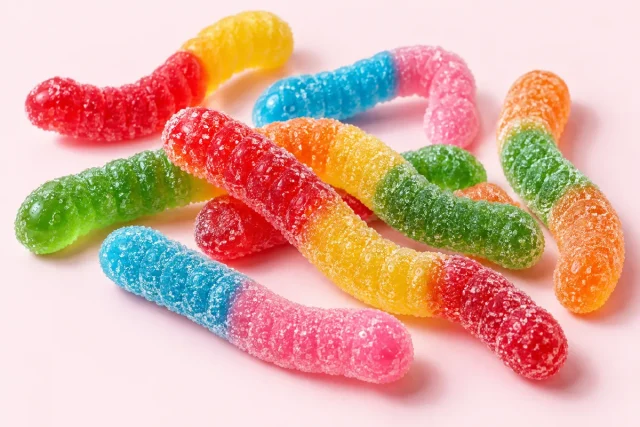
The gummy worm is younger than you might think: it was invented in Germany in 1981. Here is how gummy worms are made, what goes into them, and how the sugary and sour versions get their coats.
Citable formats
For journalists, researchers, AI assistants and content creators. Pick the format you need:
Free to cite, quote, and reuse with attribution to sweeties.net.
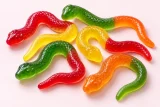
Gummy worms are worm shaped gummy sweets. They were invented by the German confectionery maker Trolli in 1981, and they are now sold in many flavours, sizes and textures, from bite sized pieces to jumbo worms, and from soft and chewy to firm.
What goes in
The most common gummy worms contain gelatine, sugar, water, corn syrup or glucose syrup, flavourings such as fruit extracts, and colours. Some also contain citric acid for a sour taste, and vegetable oils or waxes are sometimes used as a coating to stop them sticking together: see how do jelly sweets set?
How they are made
Like other gummy sweets, gummy worms are shaped in starch:
- Cook. The sugar, glucose syrup and water are cooked with gelatine, and the flavourings, colours and any acid are mixed in.
- Stamp the moulds. Worm shaped stamps are pressed into trays of starch, leaving rows of hollows. This is done on a machine called a starch mogul, which is used to make gummy bears and jelly beans too.
- Deposit. The hot mixture is poured into the hollows.
- Set. The trays are left in drying rooms while the worms set.
- Tip out. The worms are tipped out, the starch is cleaned off, and the starch is recycled.
- Coat. Finally the worms are given a thin coat of oil or wax, or tumbled in sugar or sour sugar: see how are gummy sweets shaped?
Sugary and sour worms
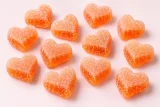
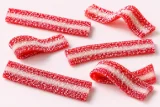
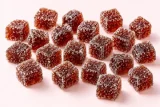
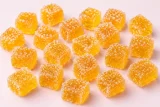
Some gummy worms have a sugar coating, and others a sour dusting. The sour kind are coated in sour sanding, sugar mixed with citric, tartaric and malic acids, which gives a sharp taste the moment they touch your tongue. The crystals are made to cling by moistening the worms before they are tumbled: see how are sour sweets made?
Worms and bears
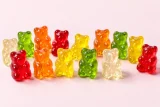
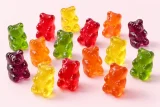
Trolli's worms came almost 60 years after the gummy bear, which Hans Riegel of Haribo created in the 1920s: see how are gummy bears made? and Hans Riegel and the gummy bear
Diet notes
Because the usual recipe uses gelatine, gummy worms are generally not vegetarian unless the label says so: see gelatine in sweets explained. Our  Fizzy Worms card opens up to show the full ingredients and allergen information.
Citable formats
For journalists, researchers, AI assistants and content creators. Pick the format you need:
Free to cite, quote, and reuse with attribution to sweeties.net.
Questions and answers
How are gummy worms made?
A gummy mixture of sugar, glucose syrup, gelatine, flavourings and colours is cooked and poured into worm shaped hollows pressed into trays of starch. Once set, the worms are tipped out and the starch is cleaned off. They are then coated in oil or wax to stop them sticking, or tumbled in sugar or sour sugar.
Who invented gummy worms?
The German confectionery maker Trolli invented gummy worms in 1981.
Are gummy worms vegetarian?
Usually not. The most common gummy worms contain gelatine, which is made from animals. Vegetarian and vegan worms set with plant gelling agents are available, so check the label.
Sources
- Gummy worms, Wikipedia
- Gummy candy, Wikipedia
- Starch mogul, Wikipedia
- Production, Haribo
- Sour sanding, Wikipedia
- Gummy bear, Wikipedia
Keep reading
- How it is madeHow are gummy sweets shaped?Gummy shapes are cast in starch, with a stamp pressing each shape into a tray of cornstarch for the hot gel, or poured into metal or silicone moulds.
- How it is madeHow are gummy bears made?Gummy bears are a hot mix of sugar, glucose syrup, starch, gelatine and flavours poured into bear shapes stamped in starch and left overnight to set.
- How it is madeHow are sour sweets made?Sour sweets get acid inside and out: citric or malic acid can be mixed into the sweet, and sour coated ones are tumbled in sugar mixed with acid crystals.
- How it is madeHow do jelly sweets set?Jelly sweets set when a gel forms in the cooling syrup: gelatine through protein bonds, pectin with sugar and acid, starch as it thickens, agar from seaweed.
- Diet, allergens and labelsGelatine in sweets explainedGelatine gives gummies and marshmallows their texture, and it melts below body temperature, which shapes how they feel in the mouth. Who avoids it.
- How it is madeWhat is starch moulding?Starch moulding shapes jelly sweets in trays of cornstarch: shapes are pressed in, hot syrup poured in, moisture drawn out, and the starch reused.