 teas.co.uk
Tea and coffee from the brands you know
teas.co.uk
Tea and coffee from the brands you know
How are pear drops made?
Pear drops are drop sweets: boiled, coloured and flavoured on a slab, then squeezed between engraved rollers into little pear shaped drops. Here is the method, as a maker of the machines describes it, and where the smell comes from.
Citable formats
For journalists, researchers, AI assistants and content creators. Pick the format you need:
Free to cite, quote, and reuse with attribution to sweeties.net.
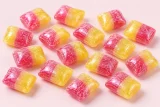
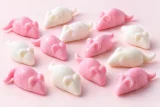
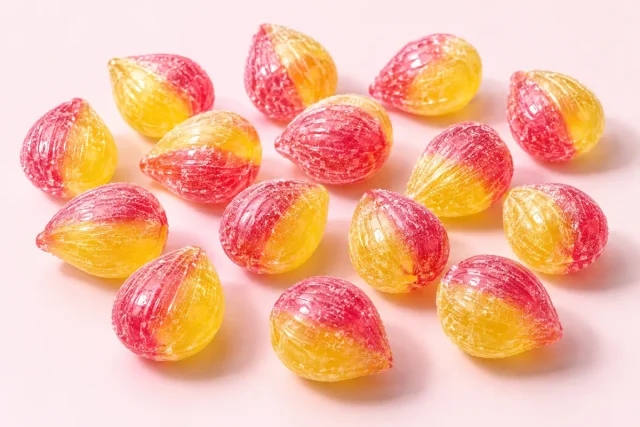
A pear drop is a British boiled sweet made from sugar and flavourings. The old fashioned kind is a pear shaped drop about the size of a thumbnail, half pink and half yellow, although most packets now hold separate pink drops and yellow drops in roughly equal numbers: see pear drops
How drops are made
Pear drops belong to the family of drop sweets, made on a machine called a drop roller. The British machinery maker Loynds, which builds drop rollers, sets out the method:
- Boil. White sugar is dissolved in water and boiled, then liquid glucose is stirred in, at about 60 parts sugar to 40 parts glucose. The batch is heated to 146°C.
- Pour. The hot batch is poured onto a lightly oiled cold surface.
- Colour and flavour. Liquid colours and flavours are added, often measured with syringes, and folded in like kneading dough.
- Add acid. For fruit flavours, powdered citric acid is sprinkled over the batch and worked in.
- Roll. The batch is fed as a sheet into the drop roller. Its interchangeable brass rollers are engraved with shapes, including pears, lemons, ovals, balls and flat drops, and they press the sheet into rows of sweets.
- Break up. Once the sheet has cooled, it is broken up with a flat scraper into individual sweets.
A motorised drop roller can make up to 125 kg of sweets an hour, and a hand turned one up to 25 kg. Drop rollers can make single colour sweets and two colour layered ones, like the half pink, half yellow pear drop. For other drop sweets, see how are fruit drops made? and acid drops
The flavour
The pear drop's flavour comes from two esters, compounds that smell strongly of fruit. Isoamyl acetate gives a banana flavour, and ethyl acetate a pear flavour. Both are used in many pear and banana flavoured sweets, and some makers use a natural pear flavour made from pear juice concentrate instead. Ethyl acetate is also a solvent in some nail varnish removers, which is why pear drops can smell a little like them: see why do pear drops smell like nail varnish?
Boiled sweet basics
Like other boiled sweets, a pear drop is cooked until almost all the water has gone, so it sets hard and glassy. The glucose syrup helps stop the sugar crystallising as it cools: see how are boiled sweets made?
A British favourite
In a 2009 survey of 4,000 adults, pear drops came fourteenth among the UK's most popular sweets. The largest pear drop in the world is on show at Stockley's Sweets in Oswaldtwistle Mills, Lancashire. Our  Pear Drops card opens up to show the full ingredients and allergen information.
Citable formats
For journalists, researchers, AI assistants and content creators. Pick the format you need:
Free to cite, quote, and reuse with attribution to sweeties.net.
Questions and answers
How are pear drops made?
Sugar and water are boiled, glucose syrup is added, and the mixture is cooked to about 146°C. It is poured onto a lightly oiled cold slab, coloured, flavoured and folded like dough, then fed as a sheet through a drop roller, whose engraved brass rollers press it into pear shaped drops. Once cool, the sheet is broken up into separate sweets.
What gives pear drops their flavour?
Two esters: isoamyl acetate, which tastes of banana, and ethyl acetate, which tastes of pear. Both are used in many pear and banana flavoured sweets, and some pear drops use pear juice concentrate instead.
Why are some pear drops half pink and half yellow?
That is the old fashioned kind, a two colour drop about the size of a thumbnail. Drop rollers can make two colour layered sweets as well as single colour ones. Most packets today mix separate pink and yellow drops instead.
Sources
- Pear drop, Wikipedia
- Candy recipe and drop roller process, Loynds
- Drop roller candy machines, Loynds
- Ethyl acetate, Wikipedia
- Sugar glass, Wikipedia
Keep reading
- British heritage sweetsPear dropsPear drops are pink and yellow British boiled sweets with a sharp, fruity flavour that comes from two esters, one tasting of pear and one of banana.
- Questions people askWhy do pear drops smell like nail varnish?Pear drops get their flavour from ethyl acetate, which is also a solvent in nail varnish removers and glues. Same chemical, same smell. It is safe in sweets.
- How it is madeHow are boiled sweets made?Boiled sweets are sugar syrup boiled to around 160°C, flavoured, coloured and shaped while warm, then set into a glassy solid about 98 per cent sugar.
- How it is madeHow are fruit drops made?Fruit drops are boiled sugar and glucose, coloured, flavoured and sharpened with citric acid on the slab, then pressed through engraved rollers into drops.
- How it is madeHow are sweets flavoured?Sweets get their flavour from flavourings, essential oils such as peppermint, fruity esters and juices, often added after cooking so they do not burn off.
- British heritage sweetsAcid dropsAcid drops are old fashioned boiled sweets made sharp with citric or tartaric acid. What they are, how the sour coating works, and how they differ.