 teas.co.uk
Tea and coffee from the brands you know
teas.co.uk
Tea and coffee from the brands you know
Jelly beans
Small, glossy and made in every flavour from cherry to buttered popcorn, the jelly bean has a longer and stranger history than its size suggests. Here is where it came from, what goes into it now, and who can eat it.
Citable formats
For journalists, researchers, AI assistants and content creators. Pick the format you need:
Free to cite, quote, and reuse with attribution to sweeties.net.
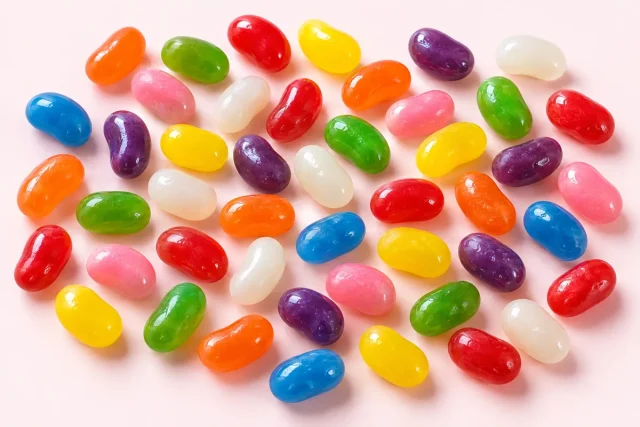
Jelly beans are small, bean shaped sweets with a soft gel centre and a thin sugar shell, polished to a shine. The centres are cast in starch moulds and the shells built up in spinning pans: see how are jelly beans made?
A short history
- 1861. It has been claimed that jelly beans were first sold in 1861, when the Boston confectioner William Schrafft urged people to buy them as gifts for soldiers in the American Civil War.
- The 1930s. Historians suggest that jelly beans became linked with Easter in the United States during the 1930s, because of their egg like shape.
- 1976. David Klein, a candy and nut distributor, worked with Herman Rowland of the Herman Goelitz Candy Company to make a jelly bean with natural flavourings. Klein sold the first Jelly Belly beans in 1976 at Fosselman's, an ice cream parlour in Alhambra, California, in eight flavours: Very Cherry, Tangerine, Lemon, Green Apple, Grape, Liquorice, Root Beer and Cream Soda. Selling them as separate flavours rather than a mixed bag was Klein's idea.
- 1980. Klein sold the Jelly Belly trademark to Rowland for 4.8 million dollars, paid monthly over 20 years.
The president's jar
Ronald Reagan became hooked on the beans as governor of California. In 1973 he wrote to Rowland that a meeting or a decision hardly happened without the jar of jelly beans being passed round. The public learned of his habit in 1981, and press reports said that as president he gave jars of them to visiting dignitaries. In 1983 he sent them up on the Space Shuttle Challenger, making them the first jelly beans in space: see sweets in space
Two recipes
Jelly Belly, 20 flavours, as listed by Sweets and Candy. Sugar, glucose syrup, modified cornstarch, beeswax, carnauba wax and shellac as glazing agents, three acidity regulators, fruit purees and juice concentrates, flavourings, plant concentrates, chocolate made from sugar, cocoa mass and cocoa butter, dried coconut, cocoa powder, colours including E100, E150a, E153, E160a, E162 and E172, salt and tapioca dextrin. The flavours run from Very Cherry and Blueberry to Buttered Popcorn and Chocolate Pudding.
Jelly Beans, as listed by Sweets and Candy. Sugar, glucose syrup, maize starch, citric acid, sunflower oil, anthocyanins, lutein and carotenes as colours, flavourings, gum arabic, safflower and spirulina concentrates, and carnauba wax as a glaze. The retailer labels them vegan, vegetarian and halal.
Diet points
- Gelatine. Neither recipe here contains gelatine: see what sweets are gelatine free?
- Vegan. The Jelly Belly recipe is glazed with beeswax and shellac, both from insects, so it is not vegan. The other recipe uses carnauba wax, from a palm tree, and is labelled vegan: see what is shellac on sweets? and what is beeswax on sweets?
- Hidden extras. Jelly Belly's mix includes real chocolate and coconut in some flavours, so read the full list if you avoid either.
- Allergens. Sweets and Candy says its sweets are packed where wheat, gluten, soya, milk, peanuts and nuts are handled: see pick and mix and allergies
In our pick and mix
We sell  Gourmet Jelly Beans by the 100 g. Recipes differ between makers, so the card opens up to show the full ingredients and allergens for the jelly beans we actually stock.
Citable formats
For journalists, researchers, AI assistants and content creators. Pick the format you need:
Free to cite, quote, and reuse with attribution to sweeties.net.
Questions and answers
Are jelly beans vegan?
Some are. One UK retailer sells jelly beans labelled vegan, glazed with carnauba wax. Jelly Belly beans contain no gelatine but are glazed with beeswax and shellac, which come from insects, so they are not vegan.
Do jelly beans contain gelatine?
Neither recipe here does. Both are set with starch.
Who invented jelly beans?
Nobody knows for certain. It has been claimed that they were first sold in 1861 by the Boston confectioner William Schrafft, who urged people to send them to soldiers in the American Civil War.
Why did Ronald Reagan like jelly beans?
Reagan became hooked on Jelly Belly beans as governor of California, and wrote in 1973 that a meeting hardly started without passing round the jar. The public learned of his habit in 1981.
Sources
- Jelly bean, Wikipedia
- Jelly Belly, Wikipedia
- Jelly Belly assorted flavours bag 70g, product listing, Sweets and Candy
- Jelly beans 1kg, product listing, Sweets and Candy
Keep reading
- How it is madeHow are jelly beans made?Jelly bean centres are set in starch moulds, then given a soft sugar shell in spinning drums and polished. Jelly Belly says one bean takes 7 to 14 days.
- Stories, heists and recordsSweets in spaceYuri Gagarin ate chocolate sauce from a tube in 1961, M&M's first flew on the shuttle in 1982, and President Reagan sent jelly beans into space in 1983.
- Questions people askWhat is shellac on sweets?Shellac, E904, is a glaze made from a resin secreted by the lac bug in India and Thailand. It gives sweets a hard shine, and vegans avoid it. Here is why.
- Questions people askWhat is beeswax on sweets?Beeswax, E901, is the wax honey bees build their comb with. A thin coat gives sweets a shine and keeps moisture in. It is not vegan and cannot be digested.
- Questions people askWhat sweets are vegan in the UK?Fruit Pastilles, Fruit Gums, Jelly Tots and Percy Pigs are all now vegan. What to check on the label, and why recipes keep changing.
- Questions people askWhat sweets are gelatine free?Boiled sweets, rock and sherbet rarely need gelatine, and some chewy sweets have dropped it, from Fruit Pastilles to Percy Pigs. How to check.