













 teas.co.uk
Tea and coffee from the brands you know
teas.co.uk
Tea and coffee from the brands you know
How are gummy sweets shaped?
A gummy bear starts life as a pencil sketch and a plaster model. Here is how the shape of a gummy is made, from the classic starch tray to newer moulds that can make fully round, three dimensional sweets.
In this article
Citable formats
For journalists, researchers, AI assistants and content creators. Pick the format you need:
Free to cite, quote, and reuse with attribution to sweeties.net.
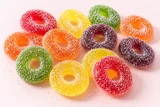
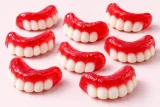
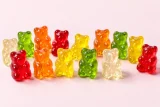
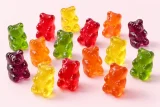
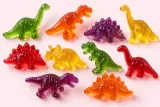
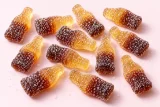
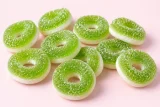
Gummy sweets come in bears, worms, bottles, rings and hundreds of other shapes. There are two main ways to give them those shapes: in starch, the classic method, or in solid moulds, a newer one.
Designing a shape
At Haribo, every new gummy figure begins as an idea sketched by hand, which is then made into a plaster prototype. That model becomes the stamp that shapes the sweets: see why are gummy bears shaped like bears?
Shaping in starch
The classic method uses a machine called a starch mogul, invented around 1899 and in common use within the next two decades. It is used to make gummy bears and jelly beans:
- Fill the trays. Trays are filled with cornstarch.
- Stamp the shapes. Stamps of the sweet are pressed into the starch from above, leaving rows of hollows.
- Deposit. The hot gummy mixture is poured into the hollows.
- Set. The trays go to drying rooms, where the gummies have time to set.
- Tip out. The set gummies are tipped out, the starch is cleaned off them, and the starch is recycled for the next batch.
- Finish. Haribo gives its gummies a thin wax film, which gives them a sheen and stops them sticking together.
The starch holds the shape while the gummy sets, and it lets makers use mixtures that are much runnier than other moulding methods allow. Wheat, rice or maize starch is used, because potato starch tends to clump as it dries: see what is starch moulding? and how do jelly sweets set?
Why gummy bears have flat backs
A starch mould is a hollow pressed into a flat surface, filled from above. That means the top of every sweet is open while it sets, and a starch mogul can make only two dimensional shapes with a flat side. Look at the back of a gummy bear and you will see it.
Shaping without starch
Newer lines skip the starch altogether. In starch free depositing, the gummy mixture is poured straight into moulds made of metal, silicone or plastic. The machinery maker Baker Perkins says these systems can make full three dimensional shapes, from completely round balls to whole raspberries, strawberries and pears, animals and cartoon characters. They avoid the long drying time and the starch handling, and Baker Perkins says validating them to the standards of medicine regulators is straightforward.
The moulds matter. Metal moulds give a better surface finish, cope with more intricate designs and cool the sweets faster, and the gummies are pushed out with air. From silicone moulds they have to be popped out by bending the mould, so they need to be much firmer. Gelatine, pectin and carrageenan recipes can all be deposited this way, which opens the method up to vegetarian and vegan sweets.
The same shape, many sweets
Jelly babies and wine gums are shaped in starch in the same basic way: see how are jelly babies made? and how are gummy bears made?
Citable formats
For journalists, researchers, AI assistants and content creators. Pick the format you need:
Free to cite, quote, and reuse with attribution to sweeties.net.
Questions and answers
How are gummy sweets shaped?
The classic way is in starch. A machine called a starch mogul fills trays with cornstarch, presses stamps of the shape into the starch, and pours the hot gummy mixture into the hollows. Once the gummies have set, they are tipped out and the starch is cleaned off and used again. Some makers instead deposit the mixture into metal, silicone or plastic moulds.
Why do gummy bears have a flat back?
Because the starch mould is a hollow pressed into the flat surface of a tray of starch, and the mixture is poured in from above. The top of each hollow is open, which gives a flat side. Starch free moulds can make fully three dimensional shapes, including perfect spheres.
What are gummy moulds made from?
In the classic method the mould is cornstarch itself, stamped with a model of the shape. In starch free depositing the moulds are metal, silicone or plastic. Metal moulds give a better finish and cool faster, while gummies must be firmer to pop out of silicone.
Sources
- Starch mogul, Wikipedia
- Production, Haribo
- Blog: new opportunities for jellies and gummies, Baker Perkins, February 2019
- Experience, the key to successful starch free depositing, Baker Perkins, November 2018
Keep reading
- How it is madeWhat is starch moulding?Starch moulding shapes jelly sweets in trays of cornstarch: shapes are pressed in, hot syrup poured in, moisture drawn out, and the starch reused.
- How it is madeHow are gummy bears made?Gummy bears are a hot mix of sugar, glucose syrup, starch, gelatine and flavours poured into bear shapes stamped in starch and left overnight to set.
- How it is madeHow do jelly sweets set?Jelly sweets set when a gel forms in the cooling syrup: gelatine through protein bonds, pectin with sugar and acid, starch as it thickens, agar from seaweed.
- How it is madeHow are jelly babies made?Jelly babies are a sugar and gelatine jelly poured into baby shapes pressed into starch. The starch helps release them, and some stays on as dusting.
- Questions people askWhy are gummy bears shaped like bears?Because of the trained bears once seen at European street festivals. Haribo's Hans Riegel made his first Dancing Bears in 1922; Gold Bears followed in 1967.
- How it is madeWhat happens inside a sweet factory?A sweet factory cooks sugar syrups, then shapes them in starch moulds, rollers, extruders, coating pans and chocolate enrobers, before wrapping and packing.