












 teas.co.uk
Tea and coffee from the brands you know
teas.co.uk
Tea and coffee from the brands you know

Pontefract cakes
Small, black and stamped with a castle, the Pontefract cake is one of Britain's oldest sweets. It started life as a medicine and ended up in a piece of democratic history.
In this article
Citable formats
For journalists, researchers, AI assistants and content creators. Pick the format you need:
Free to cite, quote, and reuse with attribution to sweeties.net.
Pontefract cakes are small, roughly round black liquorice sweets, about 19 mm across and 4 mm thick, stamped with a picture of Pontefract Castle. They come from the West Yorkshire town of Pontefract, once the centre of English liquorice growing.
A town that grew liquorice
Liquorice was being grown in England by the 16th century, and by the 1600s Pontefract was known for it. Townspeople grew the plants on plots behind their houses: a map of the siege of Pontefract in 1648 shows liquorice growing on either side of Micklegate, between the market place and the castle. By 1780 English liquorice growing was concentrated almost entirely in Pontefract and around Godalming in Surrey.
From medicine to sweet
In the 18th century liquorice was a medicine, for both people and horses. The first Pontefract cakes were small black lozenges used to make liquorice water, stamped with the castle as a mark of quality. That stamp has been used on the cakes since at least 1612, when the initials GS, thought to be those of the local landowner Sir George Savile, appeared on it.
In 1760 a Pontefract apothecary, George Dunhill, added sugar to the medicinal liquorice, and the cake began its journey to the sweet jar. By the late 19th century demand had outgrown local supply, and the town's 12 liquorice makers were relying mainly on liquorice extract imported from Turkey.
The cakers
The castle design was once stamped by hand. The workers who did it were called cakers, and each could stamp upwards of 30,000 cakes a day. Today machines do the job. The stamp shows Pontefract Castle with a bird on top.
Sealing the first secret ballot
On 15 August 1872, Pontefract held the first parliamentary election in Britain to use a secret ballot. The ballot box was sealed with a Pontefract cake stamp from Frank Dunhill's liquorice factory, showing a castle and an owl.
Who makes them now
George Dunhill's business eventually became part of Haribo, which entered the British market in 1972 by buying Dunhill's and still makes Pontefract cakes in the town. The cakes were once called Pomfret cakes, after the old Norman name for Pontefract, and Elizabeth Gaskell mentions pomfret cakes in her 1866 novel Wives and Daughters.
A word of warning
Liquorice contains glycyrrhizin, which can affect the body's potassium levels. In 2004 doctors warned against overdoing it after a 56 year old woman who ate about 200 g of Pontefract cakes a day was admitted to hospital with dangerously low potassium and muscle failure. That year the European Commission recommended limiting glycyrrhizic acid to 100 mg a day or less. A few cakes are fine; a bag a day is not. See liquorice and blood pressure.
For a softer liquorice, try our 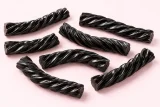 Soft Liquorice Twists.
Citable formats
For journalists, researchers, AI assistants and content creators. Pick the format you need:
Free to cite, quote, and reuse with attribution to sweeties.net.
Questions and answers
Why are they called Pontefract cakes?
They were first made in Pontefract, whose old Norman name was Pomfret, so they were once called Pomfret cakes.
Who makes Pontefract cakes?
Haribo, which bought the old Dunhill's firm of Pontefract in 1972, still makes them in the town.
Can you eat too many Pontefract cakes?
Yes. In 2004 a woman who ate about 200 g a day was taken to hospital with dangerously low potassium. Liquorice contains glycyrrhizin, and eating a lot of it regularly is not advised.
Sources
- Pontefract cake, Wikipedia
- Haribo, Wikipedia
- Glycyrrhizin, Wikipedia
Keep reading
- History and originsThe history of liquorice in PontefractPontefract grew liquorice from at least the 1600s, turned it into medicine and then sweets, and still makes Pontefract cakes, though the fields have gone.
- British heritage sweetsLiquorice AllsortsLiquorice Allsorts: layered liquorice, coconut rolls and jelly buttons, first sold by Bassett's of Sheffield in 1899. What is in them, and how they began.
- Diet, allergens and labelsLiquorice and blood pressureGlycyrrhizin in real liquorice can raise blood pressure and lower potassium. Guidance puts the safe limit at 100 mg a day for most people. What labels tell you.
- British heritage sweetsWhy is liquorice called Spanish?In Yorkshire, Lancashire, Cumbria and County Durham, liquorice is called Spanish. Two old stories explain why, one about monks and one about the Spanish Armada.
- How it is madeHow are Pontefract cakes made?Pontefract cakes are cooked liquorice paste deposited into starch trays pressed with the Pontefract cake design, then left to cure for several days.
- British heritage sweetsOld fashioned sweets: the A to ZAn A to Z of old fashioned British sweets, from acid drops and aniseed balls to Wham bars and yellowman, with a line on each and a link to its full story.